Day 86: one command reads a booking’s worth of sweeps
Date: 2026-10-16 · Week 14 · Phase 5 Benchmark and optimize
What I added today
Day 85 gave --table an exit code: print the sweep’s table, then fail if any row is a rerun or ?. It read one file. A card booking leaves one CSV per day or per card, so guarding a notebook over five of them meant five commands and five exit codes, and the first failure hid the other four tables.
--table is nargs="+":
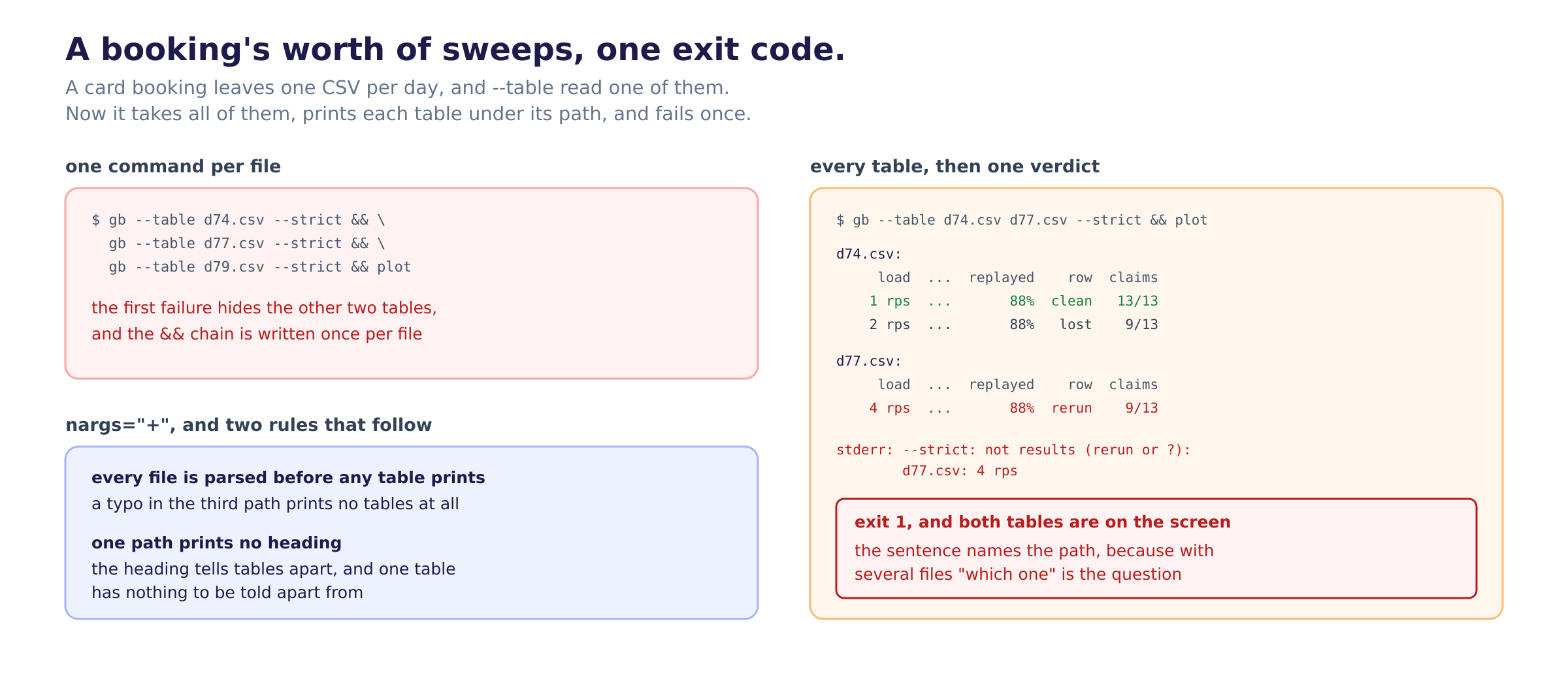
- Each sweep’s table prints under its path, in the order the paths were given, with a blank line between them.
- One path prints no heading at all. Day 83’s output for a single file is unchanged, down to the line. The heading is there to tell the tables apart, and one table has nothing to be told apart from.
- Every file is parsed before any table prints. A typo in the third of five paths prints no tables, just the sentence. Otherwise the real message lands under two tables that look like a partial answer.
--strictis one verdict over all of them. Every table prints first, then the exit is 1 if any row anywhere is arerunor?, and the sentence names each offending path with its own loads.lostis still a result, in one file or in five.-
The same path twice is refused. It would print twice under one heading and
--strictwould name it twice.graphbench.py --table day-74.csv day-77.csv day-79.csv --strict && plot
reprint_sweeps returns the marks keyed by path, in the order given; reprint stays as the one-file call that returns the single list, because marks[path] is a layer a reader with one file should not have to unwrap.
tests/test_table_sweeps.py has 10 pure tests: one path prints no heading, two print under their paths in the order given, --strict passes a booking of results, fails on the second sweep after both tables, names each bad path with its own loads, a bad path is refused before anything prints, the same path twice is refused, and both functions return their marks.
Suite 2512 green (34 GPU-gated skips), ruff clean.
Why it matters
A booking is the unit, not a file. The sweeps from one card session are read together or not at all: the rows they have in common are the comparison. A flag that takes one path makes the shell do the joining, and the shell does it badly.
Fail once, after showing everything. Day 85’s rule was print then fail for one table. Over several it matters more: the reason to look at all five is that the rerun in the third one might also be in the fourth.
The heading appears exactly where it is needed. One file, no heading, byte for byte what Day 83 printed. The Day 83 and Day 84 tests that compare stdout line by line did not change, which is how I know the single-file path did not move.
What I learned
- Two of my ten tests passed before I wrote a line of code, for the wrong reason.
--table a.csv b.csvwith the old single-value flag made argparse exit non-zero on “unrecognized arguments”, and my refusal tests only asserted non-zero with empty stdout. They were green at the red step. I kept them (they assert the right thing now) but the lesson is that a test asserting a failure has to assert which failure, and mine only got specific enough when I checked the path was in stderr. - Read-all-then-print is a different rule from print-then-fail, and both are right. A parse refusal is a usage error, so nothing should have printed. A
--strictfailure is a verdict on output the reader wants, so all of it prints. Same command, two orders, decided by whether the output is an answer. - A default that is “one” should stay the same shape as before. Making
reprinta one-line call intoreprint_sweepskept Day 85’s API intact and meant the single-file tests were the regression suite for the new code path.
Diagram
table-sweeps.png. Left: the && chain this replaces, and the two rules that follow from nargs="+". Right: two tables under their paths, the stderr sentence naming the path, and the exit code.
Tomorrow
The tables are side by side but nothing compares them. A booking’s five sweeps share loads, and the question a reader actually has is whether 4 rps moved between day 74 and day 79. Next: with more than one sweep, print a last block that joins the rows by load and shows each sweep’s itl_p50_speedup in its own column, with a gap where a sweep did not run that load.
The card run still comes first when hardware is booked.
Post angle
Day 86 of building an LLM inference engine from scratch. A card booking leaves one benchmark CSV per day, and my --table flag read exactly one of them, so guarding a notebook over five sweeps was five commands whose first failure hid the other four tables. Now --table takes all of them, prints each table under its path, and --strict is one exit code over the lot. 2512 green.