Day 67: the partials got one owner, and the owner had the right rows
Date: 2026-09-23 · Week 14 · Phase 5 Benchmark and optimize
What I added today
Yesterday’s “Tomorrow” had two items. I did the small one: deciding which boot line owns the split read’s partials. It turned out not to be a matter of taste. Answering it turned up a second, worse bug in the budget probe.
captured.py. split_workspace_bytes is now the sum of two new functions, and its value hasn’t changed. split_tile_bytes is the score tiles, one per chunk, which is what a CUDA graph’s pool holds. split_partial_bytes is the max, denominator and accumulator per (row, head, chunk), which is what SplitWorkspace.bytes reports. Each half keeps the refusal the total had for its own itemsize.
launch.py. CapturePlan gets one field and two properties:
arena_rowsis the row count the partials arena is allocated for: the scheduler’s slot count under a split, 0 otherwise.pool_bytesunder a split is now the tiles only.partial_bytesis the arena priced atarena_rows.reserved_bytesis the sum, and it’s the number the budget probe is asked about.
plan_capture sets arena_rows = plan.max_batch_size and checks tiles at the recorded rows plus partials at the arena rows. Its refusal now says that lowering max_rows doesn’t shrink the partials. describe ends a split’s capture line with “partials on the split workspace line”. check_arena_matches_capture gains an equality: capture.partial_bytes == workspace.bytes, or BootUnsound.
tests/test_partial_owner.py has 15 new tests. One Day 64 test in tests/test_width_axis.py now asserts its total against reserved_bytes instead of pool_bytes (explained below). Suite 2195 green (21 GPU-gated skips), ruff clean.
ownerbench.py, host only, arithmetic only (day-67-ownerbench.csv):
a 16-way split server, 256 slots, 8192 tokens, 32 heads x 128, 32-key tiles:
warm-rows          capture line   arena line  lines summed   probe asked        held
      256   day66      84.93 MB     68.16 MB     153.09 MB      84.93 MB    84.93 MB
      256   day67      16.78 MB     68.16 MB      84.93 MB      84.93 MB    84.93 MB
       64   day66      21.23 MB     68.16 MB      89.39 MB      21.23 MB    72.35 MB
       64   day67       4.19 MB     68.16 MB      72.35 MB      72.35 MB    72.35 MB
        8   day66       2.65 MB     68.16 MB      70.81 MB       2.65 MB    68.68 MB
        8   day67       0.52 MB     68.16 MB      68.68 MB      68.68 MB    68.68 MB
        1   day66       0.33 MB     68.16 MB      68.49 MB       0.33 MB    68.22 MB
        1   day67       0.07 MB     68.16 MB      68.22 MB      68.22 MB    68.22 MB
Why it matters
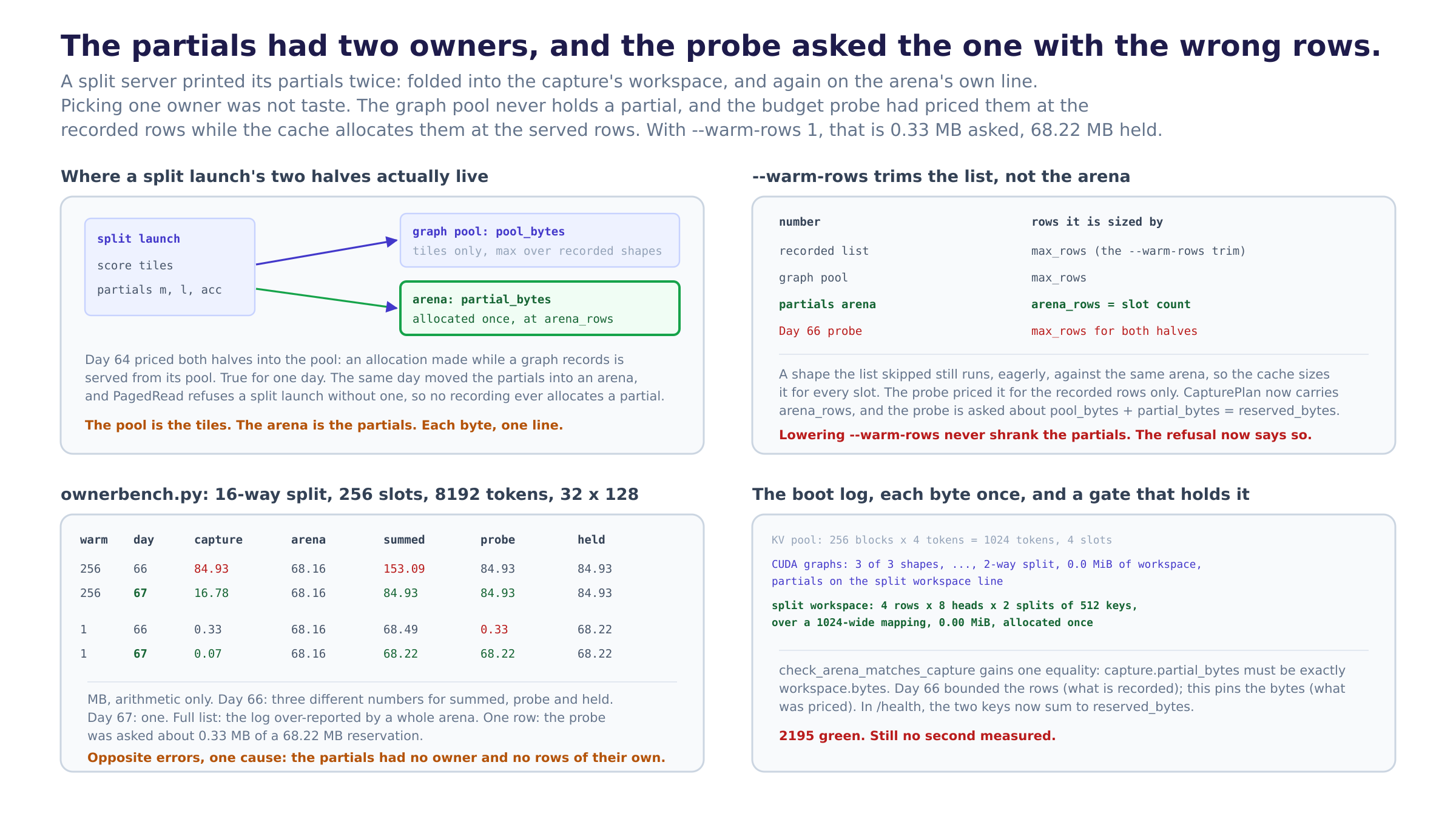
The graph pool never holds a partial, so the capture line had no claim to them. Day 64 priced the partials into pool_bytes because an allocation made while a graph records is served from the graph’s pool. That argument was true for about a day. The same day moved the partials into an arena allocated once. Day 65 made PagedRead refuse a split launch that wasn’t handed that arena, so no recording can allocate a partial. Day 66 printed the arena on its own line, which meant the same bytes appeared twice: at serving size, 153.09 MB across two boot lines for 84.93 MB actually held. The choice of owner follows from where the bytes live. The pool is the tiles, the arena is the partials, and the capture line says where the partials went, so a reader who knows a split holds them doesn’t go looking in the wrong number.
The more serious bug went the other way, and only showed up once the two numbers were separated. The capture list is sized by the recorded rows, which --warm-rows can trim. The arena is sized by the served rows, the slot count, because a shape the list skipped still runs eagerly against the same buffers (Day 66 learned this, and the arena’s rows became an inequality). But Day 64’s budget check priced tiles and partials together at the widest recorded shape. So a --warm-rows 1 server asked the probe about 0.33 MB and then reserved 68.22 MB, about 200x more than it checked. The boot log over-reported with the full list and the probe under-asked with a trimmed one. Two opposite errors, one cause: the partials had no owner and no row count of their own.
The fix is a field, not a formula. arena_rows is the one number the plan was missing, and every other change follows from it. partial_bytes is priced at it. reserved_bytes is what the probe checks. check_arena_matches_capture holds the priced bytes equal to the allocated bytes. Day 66’s rows clause was a bound, about what’s recorded. This one is an equality, about what was priced. They’re different questions, and a --warm-rows server needs the answer to both.
What I learned
- Day 66 guessed the double count at 76.55 MB. It’s 68.16 MB. Since the count is in
ownerbench.pynow, it’s a number rather than a guess:256 x 32 x 16 x (128 + 2) x 4bytes. The guess was in the right range, and this whole week has been about ranges not being numbers. - The Day 64 test changed what it asserts, and I left it in place instead of deleting it.
test_the_arena_of_a_split_plan_is_the_tiles_plus_the_partialsstill asserts the Day 64 total, because that total is still the right answer to “what does this plan commit the card to”. What changed is which property holds it:reserved_bytesnow, notpool_bytes. The test’s docstring says so and points here. - Without the partials, a split’s pool is exactly
splits xthe streamed pool. That’s a check you can do in your head, and it’s now a test. Before today the ratio was 81x at serving size and meant nothing. Now it’s 16x, the split count, which says the pool holds one tile per chunk and nothing else. - Lowering
--warm-rowshad never been a way to fit a split on a smaller card. The old refusal told the operator to lowermax_rows, which shrank the number being checked and not the memory being reserved. The new message says the partials are sized by the slot count and names the two knobs that actually move them: batch size, or no split. - I put
partial_bytesin neitheras_dictnordescribe, and that was deliberate. The arena reports the same number undersplit_workspaceonce it exists. A second key undercuda_graphswould recreate the double count in/health, one day after removing it from the log. The plan keeps its own copy for the one caller that needs it before the arena exists, which is the probe.
Diagram
partials-one-owner.png. Top left: a split launch’s two halves and where each one lives. Top right: the row count each number is sized by, with Day 66’s probe in red. Bottom left: ownerbench.py at 256 and 1 warm rows, before and after. Bottom right: the boot lines with each byte printed once, and the new equality.
Tomorrow
The other half of yesterday’s “Tomorrow” is still open: the acceptance run’s third arm. test_the_same_engine_answers_the_same_bytes_on_either_read compares two live servers over a socket, and a --split-read server can now boot into it. On this box every arm is a Python tlsim loop, so Day 68 is either that run with PLANS cut down to stay under a minute, or a written decision that it waits for the card.
The hardware caveat hasn’t changed: graphbench.py --weights ./weights --device cuda --rates 1,2,4,8 on all three arms is the first run to book, and the flag it was waiting on has existed since yesterday.
Post angle
Day 67 of building an LLM inference engine from scratch. Yesterday’s note said my flash-decoding server printed its partials twice on the boot log: once inside the CUDA graph workspace, once on the arena’s own line. Deciding which line owns them looked like a style choice. It wasn’t. A split launch never allocates a partial under capture, because the read refuses to run without the arena, so the graph pool only ever holds the score tiles. Separating the two numbers exposed the real bug. The capture list is sized by the rows you record, and --warm-rows can trim that. The arena is sized by the rows you serve, because a skipped shape still runs eagerly against it. The budget probe priced the partials at the recorded rows. At --warm-rows 1 on a 256-slot server, the probe checked 0.33 MB and the process reserved 68.22 MB. The fix is one field, arena_rows, plus a boot gate that holds the priced bytes exactly equal to the allocated bytes. vLLM and SGLang both size these workspaces up front at startup. Building it myself showed me that “up front” only helps when every number is priced at the rows it’s actually allocated for. 2195 green, and still not one measured second.