Day 84: the table says which rows are results
Date: 2026-10-14 · Week 14 · Phase 5 Benchmark and optimize
What I added today
Day 83 made the table print from the row read_sweep gives back, so --table reprints a sweep from its CSV. That table still had one number for both kinds of FAIL: claims_ok over the total. A row that measured four claims and lost them printed 9/13. A row whose arms served different work also printed 9/13. Day 80 said the second one is not a result, and the CSV knew which was which, but the table did not show it.
A mark on every row, and the reruns listed under the table:
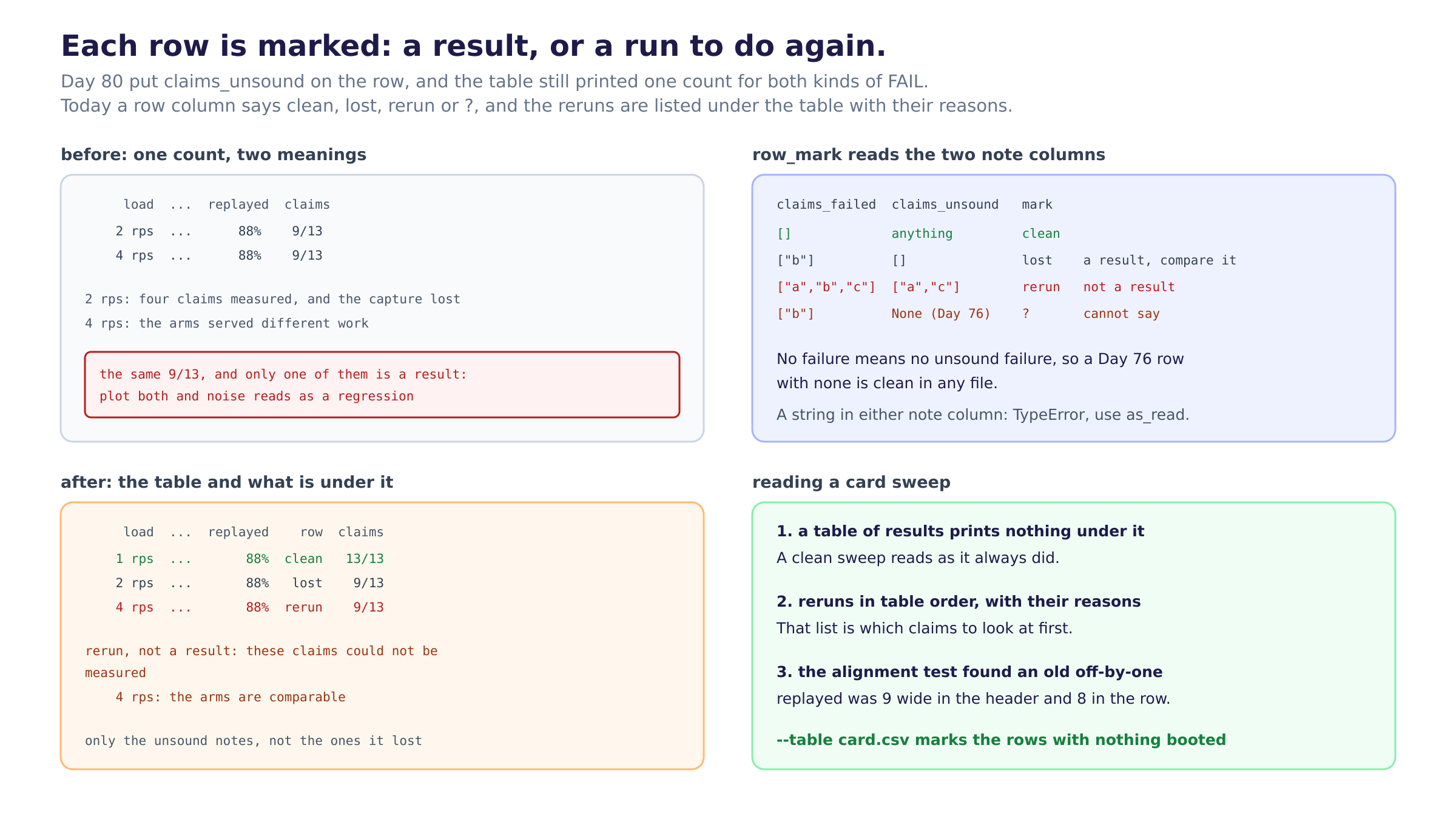
row_mark(row)reads the two note columns and returns one ofMARKS:clean(every claim held),lost(some failed, every failure measured: a result),rerun(at least one failure could not be measured: not a result), or?(a Day 76 file, which did not record which failures were unmeasurable, on a row that has failures). A Day 76 row with no failures isclean, because no failure means no unsound one.print_tablehas arowcolumn just beforeclaims. The count stays the last cell, so it still reads where it always did.- Under the table, each
rerunrow is listed again with the notes that made it a rerun, in table order. Only its unsound notes are listed, not the ones it lost. If any row is?, there is one more line saying why. A table of results prints nothing under it, so a clean sweep looks the same as before. row_markrefuses a string in either note column, with the sameTypeErroras Day 83."a; c"is truthy, so it would read as a rerun and its notes would be listed letter by letter.
While I wrote the column alignment test, it found an older bug: the replayed header was 9 characters wide and its cell 8, so every column after it was off by one. The cell is 9 wide now.
tests/test_sweep_marks.py has 16 pure tests: the three marks from the note columns, ? and clean on Day 76 rows, the string refusal, the column’s place, each line’s mark next to its count for two-arm and three-arm rows, the columns lining up, nothing printed under a table of results, the reruns listed with their unsound notes only, the ? line, reruns printed before the ? line, and --table as a process printing the same marks and reruns from the file. Two older tests read the count from the row’s own line now, because the last line printed is the list under the table.
Suite 2496 green (34 GPU-gated skips), ruff clean.
Why it matters
A count cannot tell you what to do with a row. 9/13 from a run that lost is a finding to plot and explain. 9/13 from a run that could not measure is a run to do again. Day 80 put that difference in the CSV. A person reading the table did not see it, and the table is what they read first.
The list under the table is the work queue. A card sweep with a rerun row needs the hardware again before anything in it is compared. Listing the unsound notes in table order says what to fix before the next booking: too few gaps means more requests, and arms that served different work means checking the load.
A result-only sweep should look unchanged. All the new output goes under the table and only shows when something needs attention, so a clean card run reads the same as it did yesterday.
What I learned
- Name the action, not the cause.
reruntells the reader what to do with the row.unsoundwould only repeat the column name and leave them to work out what it means. - “Not recorded” has to stay a third answer even in a one-word cell. A Day 76 row with failures could be
lostorrerun, and the table should not guess. One with no failures can be answered, so it is. - An alignment test checks more than the new column. I wrote it for the
rowcolumn and it found thereplayedheader one character wider than its cell, which had been there since the column was added.
Diagram
sweep-marks.png. Top left: two rows with the same count and different meanings. Top right: how row_mark reads the two note columns. Bottom left: the marked table and the rerun list under it. Bottom right: reading a card sweep with it.
Tomorrow
The table now says which rows are reruns, and the exit code of --table does not. A script that checks a card sweep before a notebook plots it has to parse stdout to find out. Next: a --strict flag on --table that exits non-zero when any row is rerun or ?, so a CI step or a shell && can refuse to plot a sweep that is not all results.
The card run still comes first when hardware is booked.
Post angle
Day 84 of building an LLM inference engine from scratch. My benchmark table printed 9/13 for a run that measured four claims and lost them, and 9/13 for a run whose two arms served different work. Only the first is a result. Now every row is marked clean, lost, rerun, or ?, and the reruns are listed under the table with the claims they could not measure. 2496 green.