Day 19: the fused paged read wired into attention
Date: 2026-07-03 · Week 6 · Phase 2 Paged memory
What I added today
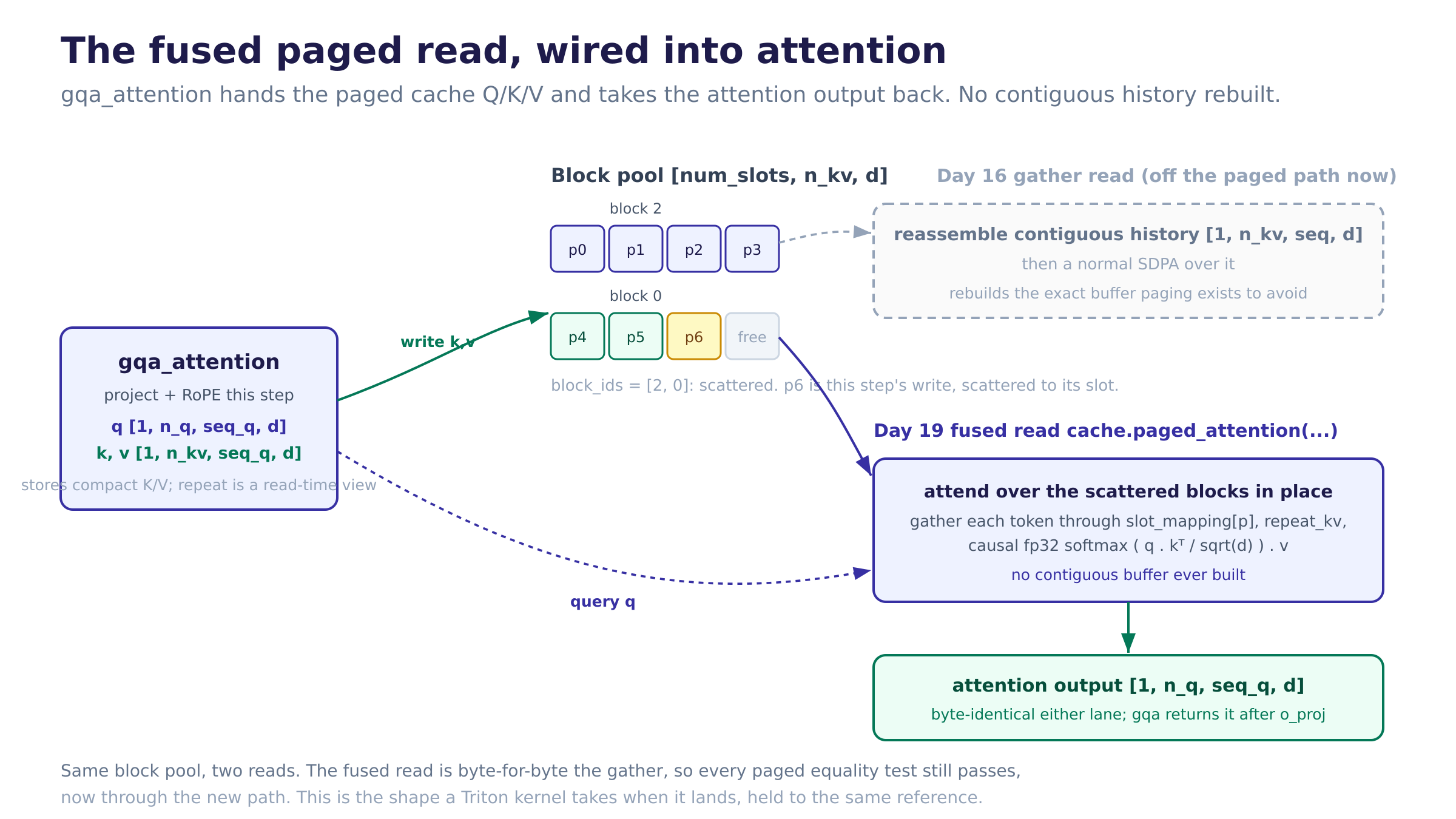
PagedKVCache.paged_attention(layer, k, v, q, n_rep, scale=None) in src/nanoserve/cache.py, and the wiring that puts gqa_attention on it. The new method is the fused read: hand it this step’s rotated Q/K/V and it writes the K/V into its block pool (the same write append does, now factored into a shared _write) and then attends over the whole history through the block table via the Day-18 paged_attention_reference, returning the attention output before o_proj. No contiguous history is rebuilt. gqa_attention gained one duck-typed branch: if the cache exposes paged_attention, it calls it and takes the output straight back, skipping the local repeat/mask/softmax; a naive cache has none, so it still takes the append gather path unchanged. Five new tests (four in tests/test_paged_attention.py for the method, one spy test in tests/test_cache.py for the plumbing), pure suite 124 green, ruff clean.
Why it matters
Day 16 built the paged cache but read it the slow way: every step it gathered the scattered blocks back into one contiguous [1, n_kv, seq, d] tensor and ran a normal SDPA over it, which re-materializes the very buffer paging exists to avoid. Day 18 wrote the torch reference that reads through the block table directly and froze it. Today those two meet: the model no longer rebuilds the history to attend. The paged path writes each token’s K/V to its slot and scores the query against the scattered blocks in place, exactly the shape a Triton kernel will take when it lands. This is the wiring that makes the reference load-bearing instead of a test-only oracle, and it is the last CPU-provable step before the kernel: the fused read is byte-identical to the gather (every paged equality test still passes, now running through the new path), so the interface and the math are nailed down and only the implementation underneath is left to swap.
What I learned
- A behaviour-preserving change still needs a failing test, just aimed one level down. The fused read produces the exact same tokens as the gather, so no output test could fail before I wired it: the change is invisible at the model’s surface. The honest TDD target was the new method (it did not exist, so its tests failed with
AttributeError) plus a spy on the plumbing: forward over a paged cache must callpaged_attentiononce per layer andappendzero times. That spy is what actually pins the wiring; the equality tests only confirm it did not change what comes out. - Factor the write before you fork the read.
appendandpaged_attentionare the same write followed by two different reads. Pulling the write into_write(grow the shared table on layer 0, lazily allocate the pools, scatter the K/V to this step’s slots) means both reads leave the cache in provably identical state, and one test asserts exactly that: run two caches side by side, one through each read, and their tables and pools end byte-for-byte equal. Only the return value differs. Duplicating the write instead would have been two places for a slot bug to hide. - Duck-typing keeps the layer decoupled from the cache.
gqa_attentionnever imports the cache classes; it already calledcache.appendblind. The fused path is the same trick:getattr(cache, "paged_attention", None). Present means paged, so read through the blocks and return; absent means naive, so gather and score. Noisinstance, no import cycle (cacheimports the kernel reference,layersimports neither), and the split between the two backends is one line. - The compact-then-repeat discipline survives the fusion. The cache still stores the 8-head K/V, and the GQA repeat to 32 heads still happens at read time inside the reference, as a view. Fusing the read did not tempt the cache into storing the blown-up K/V; the whole reason GQA shrinks the cache 4x is preserved because the repeat lives on the read side, wherever that read now happens.
Diagram
paged-fused-read.png. Two reads off the same block pool. The top path is Day 16’s gather: scattered blocks reassembled into a contiguous history, then a normal SDPA, the buffer paging meant to avoid. The bottom path is today’s fused read: gqa_attention hands the cache Q/K/V, the K/V is scattered to its slots, and attention scores the query over the blocks in place through slot_mapping, returning the output with no contiguous buffer ever built. The dashed box marks the history the top path materializes and the bottom path never does.
Tomorrow
Week 6’s kernel. With the fused read wired and pinned to the reference, the next step is the first cut of the triton.jit paged-attention kernel behind the same paged_attention signature, held byte-close to paged_attention_reference. It needs a GPU, so it may run gated like the weights tests; the reference and the fused shape proven on CPU today are the fixed target it gets checked against. Alternatively, microbenchmark the fused read against the gather to put a number on what the kernel has to beat.
Post angle
Day 19 of building an LLM inference engine from scratch. Day 16 stored the KV cache in scattered blocks but read it the slow way: gather every block back into one contiguous tensor each step, then run normal attention over it, rebuilding the exact buffer paging exists to avoid. Day 18 wrote the torch reference that reads through the block table directly and froze it. Today they meet: attention no longer rebuilds the history. The cache gained a fused read, write this step’s K/V to its slot, then score the query over the scattered blocks in place, and gqa_attention takes the output straight back. The interesting part was testing a change that changes nothing you can see: the fused read is byte-identical to the gather, so no output test could fail first. So the real target was the new method (it did not exist) plus a spy on the plumbing, forward over a paged cache must call the fused read once per layer and the gather zero times. That spy is what pins the wiring. This is the shape a Triton kernel will take when it lands; today nails the interface and the math on CPU so only the implementation underneath is left to swap, the same reference-behind-every-kernel discipline vLLM and SGLang lean on. 124 tests green. #AI #LLM #vLLM #BuildInPublic #Claude #OpenAI