Day 54: the step got recorded, and the output turned out to be a buffer too
Date: 2026-09-08 · Week 13 · Phase 5 Benchmark and optimize
What I added today
nanoserve.captured, the decode step recorded once per shape and replayed after that. A CapturedGraph is one recorded shape: the replay() that takes no arguments, the output tensor those kernels write into, the input buffer addresses they were recorded against, and the row tuple the recorded plan covers. CapturedDecode is the wrapper: first sighting of a shape records, every sighting after it replays, and a view with no plan falls through to eager and is counted.
The recorder is the seam, the way torch_compiler was on Day 49. cuda_graph_recorder is the real one and it is four lines: warm up on a side stream, torch.cuda.CUDAGraph(), record inside torch.cuda.graph(graph, pool=pool), hand back graph.replay and graph.pool(). eager_recorder records nothing and reproduces a capture’s semantics on a box with no device: it keeps the exact argument objects, takes no arguments, and copies its result into one buffer allocated at record time. default_recorder picks between them off the tensors.
The arithmetic is score_cells, workspace_bytes, shared_pool_bytes, private_pool_bytes, pool_sharing_ratio, capture_cost_s, launch_saving_s and capture_breakeven_steps. The gates are check_capture_ready, check_capture_preconditions, check_replay_rows, check_all_shapes_captured, check_replays_dominate, check_pool_shared, check_pool_budget and check_output_not_held.
The wiring is small because the five days did it already. Engine gains capture_decode and a decode_graphs that is always an object, “off” or not, and sits in front of Day 49’s CompiledDecode rather than instead of it; Engine.build refuses capture_decode without bucket_decode and persist_inputs by name, and _decode’s forward line goes through it.
tests/test_captured.py is 55 tests. Suite 1558 green (5 GPU-gated skips), ruff clean.
capturebench.py, host only, no weights, 2 rows of a real batched cache from a 16-token prompt (day-54-capturebench.csv):
steps   captures: open set -> closed   replays   reuse    run ms eager -> replayed
    8              8 -> 1                    8     88%      9.619 ->   10.889
   32             32 -> 1                   32     97%     36.402 ->   45.251
   64             64 -> 1                   64     98%     74.882 ->   77.126
  128            128 -> 2                  128     98%    152.503 ->  158.508
and the pool table, at 256 rows and 8192 tokens with 32 heads and fp32 scores:
width multiple    shapes      shared pool      private pools     ratio
          128       576          268.4 MB         17,414.2 MB     64.9x
          512       144          268.4 MB          4,554.5 MB     17.0x
         2048        36          268.4 MB          1,339.6 MB      5.0x
         8192         9          268.4 MB            535.8 MB      2.0x

what a decode step holds at the top of that list, side by side:
  the [rows, heads, 1, ctx] score rectangle     268,435,456 bytes
  the Day-51 slot table                          16,777,216 bytes
  the Day-53 input buffers                            8,192 bytes
Why it matters
Five days of gates got spent, and spending them is what they were for. Day 49 ended in check_single_graph, Day 51 in check_mapping_is_window and check_window_intact, Day 52 in check_shape_in_set and check_pad_inert, Day 53 in check_step_inputs_persistent and check_snapshots_present. Today they are the body of check_capture_preconditions, in that order, run before a graph exists. The thing that made this a twenty-line function instead of a day of re-deriving is that none of them were comments. A comment saying “the rectangle must be a window” would have needed rewriting as code today; a function saying it needed importing.
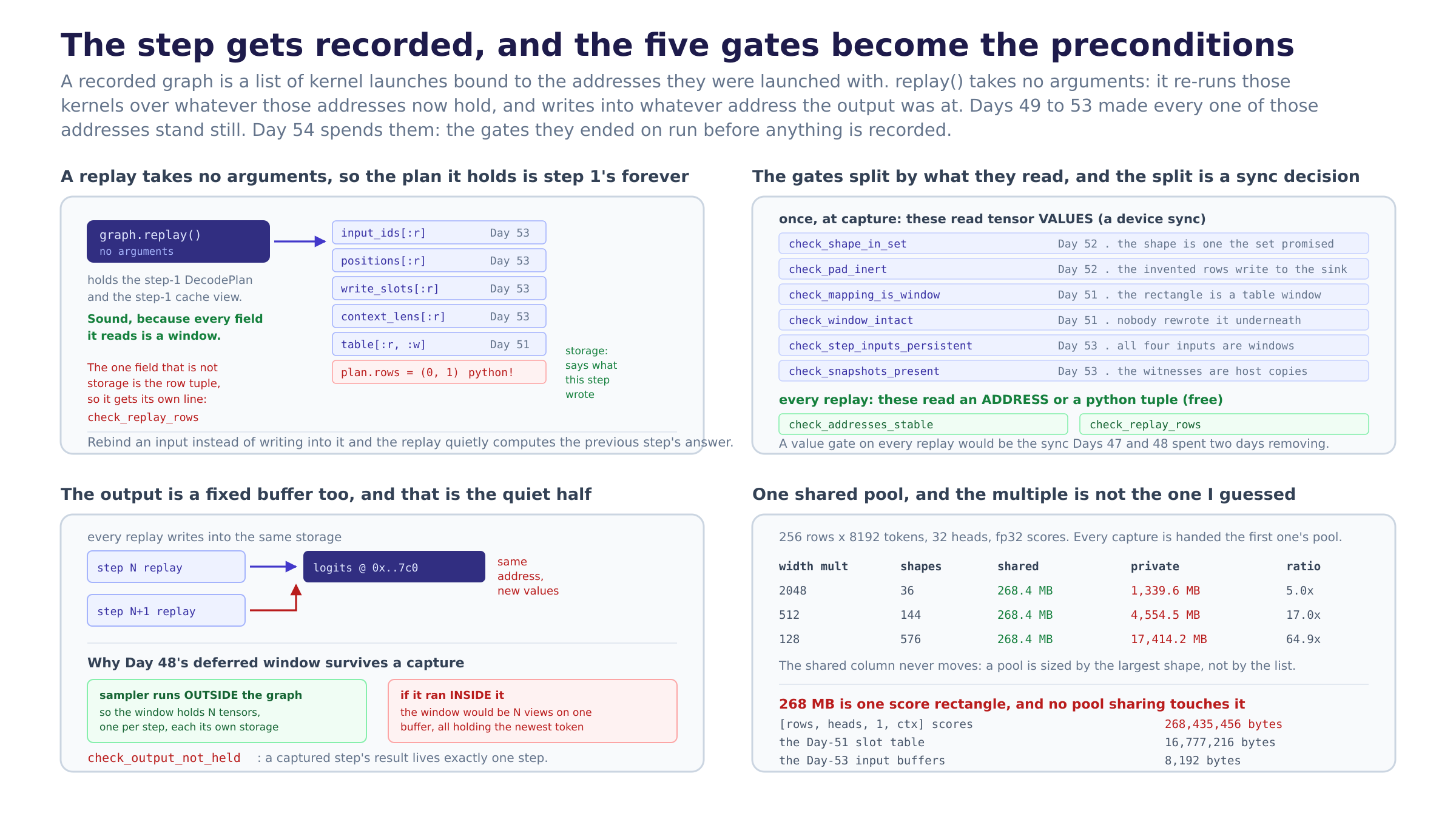
A replay does not hold tensors, it holds a Python object full of windows, and that distinction is the whole design. The recorded call keeps the DecodePlan and the cache view from the step it was recorded on, and it keeps them for the life of the process: step 500 replays with step 1’s plan. That is sound for exactly one reason. Everything the forward reads off a plan is storage that persists and gets written in place, so the object is frozen and the numbers in it are not. write_slots, context_lens and positions are Day 53’s buffers; slot_mapping is Day 51’s table. Which makes plan.rows conspicuous: it is a Python tuple, so it says what step 1 said, forever. check_replay_rows is one line and it is the only thing on this page guarding a field rather than a pointer.
The gates split into two kinds and the split is a performance decision I did not expect to have to make. check_pad_inert reads int(plan.context_lens[i]). check_window_intact reads plan.slot_mapping[i, n - 1]. On a device those are synchronisations, which is exactly what Day 47 and Day 48 spent two days removing from this loop. So the value gates run once, at capture, where a sync is unavoidable anyway, and the ones that run every replay are the two that read an address or a Python tuple: check_addresses_stable and check_replay_rows. Writing “check the preconditions” and then finding out that checking them every step would undo a week of work is the sort of thing that only shows up when you try it.
The output is a fixed buffer too, and I spent five days on the input side without noticing. A replay writes into the storage it was recorded against, so a captured step’s logits have a lifetime of exactly one step: the next replay writes through them. Every gate before today points at the inputs, because that is where the loud failure is. This is the quiet one, and it is the reason Day 48 still works. The deferred window keeps token tensors across step boundaries on purpose, and it survives a capture only because the sampler runs outside the recorded region, so what crosses the boundary is the sampler’s own allocation. Move the sampling inside the graph and a window of N steps becomes N views on one buffer, all holding the newest token, and every test that checks a finished request’s text would still pass until the window was longer than one.
And the memory number Day 53 flagged came out wrong in a direction worth the day. Yesterday’s log said “36 recorded graphs each holding a private workspace is a number nobody has measured”. Sharing the pool is right and the multiple is not 36. A bucket set is geometric on the row axis, so the sum is dominated by its largest term, and sharing over 36 shapes saves 5.0x. Over 576 shapes it saves 64.9x, and the shared column does not move at all between the two, because a pool is sized by the biggest shape and not by the list. The number that hurts is the absolute one: 268 MB, and it is one [rows, heads, 1, ctx] score rectangle from paged_attention_batched_reference, sixteen times the whole slot table and thirty thousand times the input buffers. No pool sharing touches it. vLLM’s capture pool is small because its kernel never builds that tensor, and that is the same sentence Day 52 wrote about why its capture list has no width axis.
What I learned
- Writing a gate as a function rather than a comment is worth a day, and today is the day it paid. Six functions imported from four modules, in the order the days wrote them, and the whole precondition check was twenty lines. The part I nearly got wrong was wrapping their exceptions in
CaptureUnsoundfor tidiness. LettingSlotsUnsoundpropagate is better: “the rectangle is a gather” should namenanoserve.slots, because that is the module whose promise broke and the module where the fix is. The exception type is the pointer to the day. - The held plan is frozen Python around live storage, and only one field is on the wrong side of that. I expected to have to rebuild something per replay and there is nothing to rebuild, because Day 50 through Day 53 already moved every number the forward reads into a buffer.
plan.rowsis the exception, it is a tuple, and a replay over the same shape but a different set of sequences would write this step’s tokens into the other batch’s slots. Day 51’s prefix requirement makes it rare rather than impossible, and rare is the reason to spend a line on it rather than a paragraph. - Running all the preconditions on every replay would have undone Day 47 and Day 48. Two of them index into tensors, which is a device synchronisation, which is the exact cost those two days removed. So the checks got sorted by what they read: values at capture, addresses always. I would not have found this on CPU, where
int(tensor)is free, if I had not gone looking for what each gate touches. - I spent five days on the input side and the output side is symmetric. It took writing the “a replay computes what an eager forward would” test, finding it compared a buffer against itself, and having to
.clone(). Then the whole thing inverted: if the output is fixed storage, what else in this engine holds a tensor past the end of its step? Day 48’s deferred window, and it is fine, and it is fine for a reason (the sampler is outside the capture) rather than by luck.check_output_not_heldexists so that reason is checkable. - A bucketed run is not one graph, it is one per bucket boundary it crosses. The 128-step arm recorded two, and I read it as a bug for a minute. A 16-token prompt plus 128 generated tokens is 144, which crosses the 128-token width bucket, so the run legitimately presents two shapes.
width_multipleis not just a padding knob, it is a rate: one capture perwidth_multipletokens of generation, per row bucket, and a long generation walks the width axis whatever you do. - A geometric set is its own largest element, and that is why the sharing ratio is small. I expected
pool_sharing_ratioto be about the length of the capture list. It is 5.0x over 36 shapes and 64.9x over 576, and the two numbers have the same shared column, because a shared pool is a max and a private one is a sum. The useful reading is the other way round: a coarse bucket set barely benefits from pool sharing, and a fine one benefits enormously, so the two knobs are coupled and I would have set them independently. - 268 MB is the reference read, not the capture, and pricing it in the capture’s module is the only reason I know that.
workspace_byteswas written to answer “what does a graph cost”, and the answer is that a graph costs whatever the largest intermediate in it costs, and mine is a materialised score rectangle that a real paged kernel does not build. Day 22 and Day 23 lowered the single-sequence read to Triton; the batched one is still the plain-torch oracle, and today is the first day that has had a number for what that is worth in bytes. - The stand-in recorder made the CPU and the device agree about one thing I would have got wrong. A capture step returns a replay’s output, not the recording call’s, because the values produced while recording are not a result anybody should read. I only wrote it that way because the stand-in made the difference visible: on CPU the recording call really does compute the right answer, so it would have worked here and been wrong on a GPU. Building the fake to have the real one’s semantics, and not its speed, is what caught it.
Diagram
captured-decode-replay.png. Left top is what a replay is: replay() with no arguments, the step-1 plan it holds forever, the five fields that are windows and say what this step wrote, and the one that is a Python tuple. Right top is the six preconditions in the order they run, split into the ones that read tensor values (once, at capture) and the two that read an address (every replay). Left bottom is the output buffer, two replays writing through one address, and why Day 48’s deferred window survives a capture and would not if the sampler moved inside it. Right bottom is the pool table, shared against private at three width multiples, and the three numbers a decode step holds side by side.
Tomorrow
The capture works and it happens in the wrong place: the first step of each shape takes a recording, mid-run, in front of a client who is waiting for a token. vLLM does not do this, and capture_cost_s’s docstring already says why. Day 55 is capturing the list up front: walk the bucket set before the server accepts anything, drive each shape off a synthetic batch rather than a real request, and hand back a warm engine whose first real decode is a replay. Two things I expect to be wrong about. One is how to build a synthetic batch that presents a given shape without writing garbage into the pool, since Day 52’s sink slot only covers padded rows and a fake batch is all padding. The other is the budget: check_pool_budget wants a number for what is left after the weights and the K/V pool, nanoserve.launch already has the memory probe, and nobody has connected the two.
Post angle
Day 54 of building an LLM inference engine from scratch. A recorded CUDA graph is a list of kernel launches bound to the addresses they were launched with, and replay() takes no arguments: it re-runs those kernels over whatever those addresses now hold. Five days went into making every one of those addresses stand still, and each of those days ended in a gate written as a function. Today they became the body of one twenty-line precondition check, in order, run before a graph exists. That is the whole argument for writing “the rectangle must be a window” as check_mapping_is_window instead of as a comment: a comment would have needed rewriting today, and a function needed importing. The mechanism turned out to be nicer than I expected. A replay holds the step-1 DecodePlan for the life of the process and that is fine, because everything the forward reads off a plan is now storage written in place, so the Python object is frozen and the numbers in it are not. One field is on the wrong side of that: plan.rows is a tuple, so it says what step 1 said forever, and it got its own one-line gate. The part I did not see coming is that the output is a fixed buffer too. I spent five days on the input side and never thought about the symmetric case: a replay writes into the storage it recorded against, so a captured step’s logits live exactly one step. Day 48 keeps sampled tokens on the device across step boundaries, and it survives a capture only because the sampler runs outside the recorded region. Move the sampling inside and that window becomes N views of one buffer, all holding the newest token, and the tests would pass until the window was longer than one. And the memory number I flagged yesterday came out wrong in a useful direction: sharing one pool across a 36-shape capture list saves 5x, not 36x, because a geometric set is dominated by its biggest element and a shared pool is a max where a private one is a sum. The number that actually hurts is 268 MB, and it is one score rectangle my reference read materialises before it masks. That is not the capture’s fault and no pool sharing touches it. 1558 green.