Day 16: the paged KV cache, real K/V through scattered blocks
Date: 2026-07-01 · Week 5 · Phase 2 Paged memory
What I added today
PagedKVCache in src/nanoserve/cache.py: the piece that finally hangs real K/V tensors off the Day-14 pool and the Day-15 block table. It is a drop-in for NaiveKVCache at the one interface attention uses, the same append(layer, k, v) -> (full_k, full_v) and the same seq_len, so layers.py and model.py do not change at all. What changes is purely where the K/V live: instead of one growing contiguous tensor per layer, each layer gets a fixed flat pool [num_blocks * block_size, num_kv_heads, head_dim], and every token’s K/V is written at the flat slot the block table assigns. model.greedy_generate_paged drives the same prefill-then-decode loop as the cached path (I pulled that loop out into a shared _greedy_decode so naive and paged run identical code over different storage). Eight new tests in tests/test_cache.py, pure suite 107 green, ruff clean, and the gated real-model test confirms paged greedy matches HF token for token on Llama-3.2-1B.
Why it matters
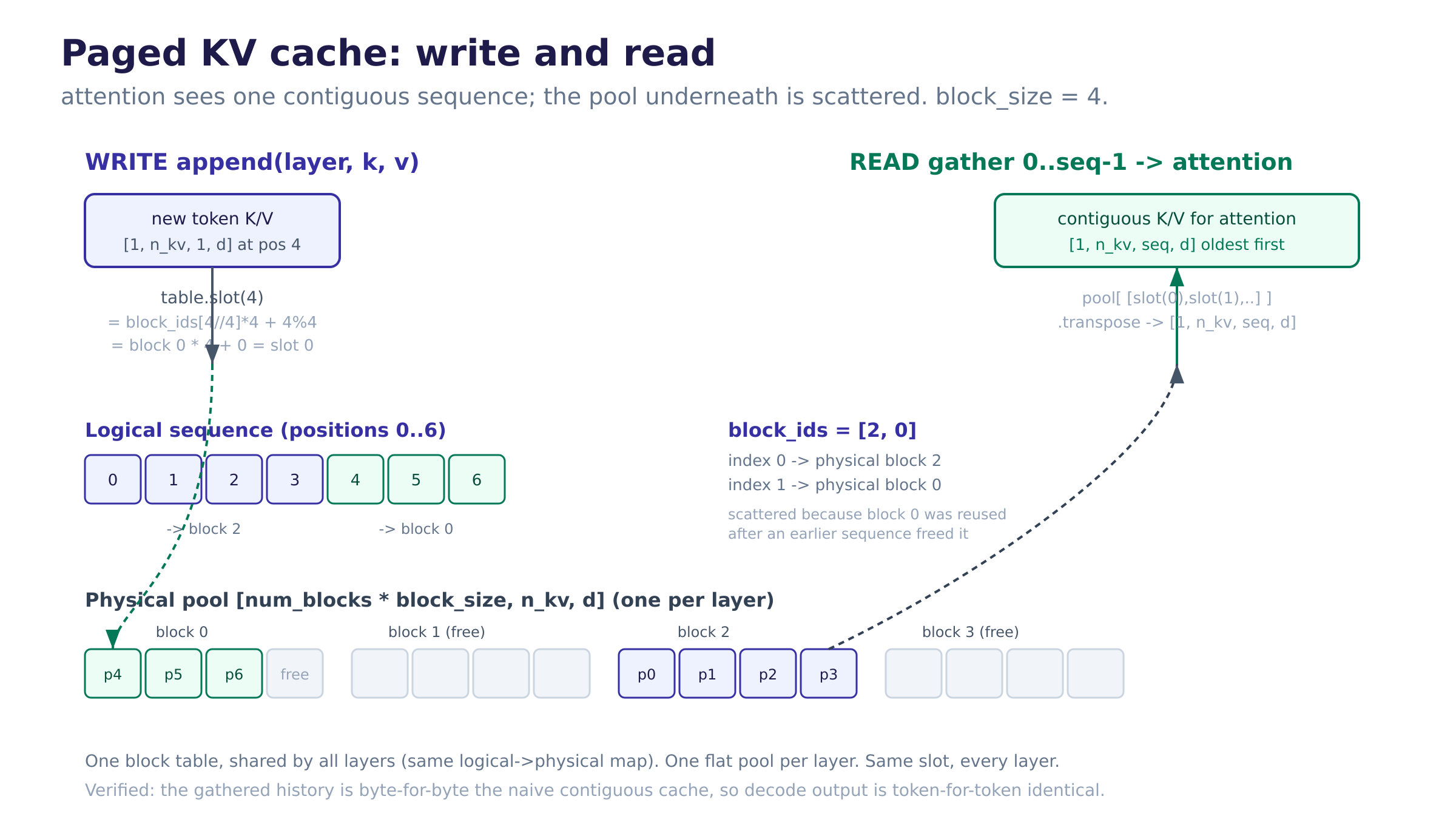
This is the whole point of Weeks 4-5 arriving at once. The allocator owns the pool, the block table maps logical positions to physical slots, and today the K/V actually flow through that map. A sequence’s blocks can sit scattered anywhere in the pool, yet attention still receives one clean contiguous [1, num_kv_heads, seq, head_dim] tensor, oldest token first, byte-for-byte what the naive cache would hand it. That gap, scattered underneath and contiguous on top, is exactly what lets many sequences pack into one shared pool later (Weeks 8-9) instead of each reserving a worst-case buffer. And it is verifiable now, in plain torch, before any kernel exists: if the gathered history is identical, the logits cannot differ.
What I learned
- One block table, shared across all layers. My first instinct was a table per layer, but that is wrong and expensive: every layer stores the same tokens at the same logical positions, so the logical->physical map is identical for all of them. A physical block id therefore names a slot in every layer’s pool at once, which is exactly how vLLM works. One table, grown once per step, and each layer owns only its own K/V pool. A table per layer would have pulled 16x the blocks for nothing.
- The step boundary is layer 0. The table has to grow exactly once per decode step, not once per layer’s
append. Sincemodel.forwardalways walks layers0..15in order, layer 0’s append is the clean step boundary: it grows the table and records the slots for the new tokens, and the other 15 layers reuse those same slots. Encoding that as an explicit, documented invariant kept the code a few lines instead of a stateful mess. - Write is a scatter, read is a gather, and the read is deliberately naive. Write:
pool[slots] = k[0].transpose(0, 1), scatteringnew_seqvectors to their physical slots. Read: gather[slot(0), slot(1), ..., slot(seq-1)]back and transpose to[1, n_kv, seq, d]. Rebuilding the full contiguous history every step is not how the fast path will work, Week 6’s Triton kernel attends over the scattered blocks directly, but doing it the slow, obvious way first is what makes “paged output == naive output” a provable claim before I trust a kernel. - Lazy pool allocation dodges a dtype/device guess. The pools are
Noneuntil the firstappend, then allocated withk.dtypeandk.device. No config flag for precision, no CPU/GPU assumption baked into the constructor; the storage simply matches whatever attention actually produced.
Diagram
paged-write-read.png. Left: the write path, a new token’s K/V routed through table.slot(pos) into one physical cell. Right: the read path, gathering the scattered cells back into the contiguous tensor attention consumes. Middle: block_ids = [2, 0], a two-block sequence whose blocks are out of order because block 0 was reused after an earlier sequence freed it. The logical view stays 0..6 in order; the physical placement is scattered; the gather makes them agree.
Tomorrow
Wire the paged cache into the sampling path too (generate/generate_stream currently build a NaiveKVCache directly), and add a free()-and-reuse stress run so a finished sequence’s blocks provably return to the pool for the next one. That closes Week 5 and sets up Week 6: replace today’s gather-and-reassemble read with a hand-written Triton paged-attention kernel, verified against this exact torch reference.
Post angle: Day 16 of building an LLM inference engine from scratch. The last two days built the allocator (a pool of fixed KV blocks) and the block table (which block holds which token). Today the K/V actually flow through them: a paged KV cache. Here is the trick that makes it verifiable. It is a drop-in for the naive contiguous cache at the one interface attention uses, so nothing in the model changes. Underneath, each layer’s K/V no longer live in one growing tensor; they live in a fixed pool of physical blocks, and every token is written at the flat slot the block table hands back. Those blocks can be scattered anywhere in the pool, reused out of order from sequences that already finished, yet attention still receives one clean contiguous tensor, oldest token first, byte for byte what the naive cache would give it. Two design calls earned their keep. One block table shared across all 16 layers, not one per layer, because every layer stores the same tokens at the same positions, so a block id names a slot in every layer’s pool at once, exactly how vLLM does it; a table per layer would have grabbed 16x the memory for nothing. And the read is deliberately the slow, obvious gather, rebuilding the full history every step, because that is what lets me prove paged output equals naive output token for token before I trust next week’s Triton kernel. It matches HF on Llama-3.2-1B exactly. 107 tests green. #AI #LLM #vLLM #BuildInPublic #PagedAttention #Claude #OpenAI #MachineLearning