Day 33: blocks a step at a time, and the eviction that pays for it
Date: 2026-08-07 · Week 9 · Phase 3 Batching and scheduler
What I added today
Incremental allocation, and the preemption that has to come with it. Week 8 admitted a request by reserving worst_case_tokens, prompt plus every token it was still allowed to emit, which bought one very useful property: a running request already owned every block it could ever need, so no forward could fail and no rollback path had to exist. It also booked the pool for text nobody wrote. Today admission buys blocks_for_length(num_tokens) instead, and Scheduler.blocks_needed_for is the only allocation rule left in the file. It reads the same for every state a request can be in: a fresh request needs its prompt’s blocks, a running one needs 0 on most steps and 1 on the step that crosses a boundary, and a preempted one coming back needs blocks for its prompt plus everything it generated before it lost them.
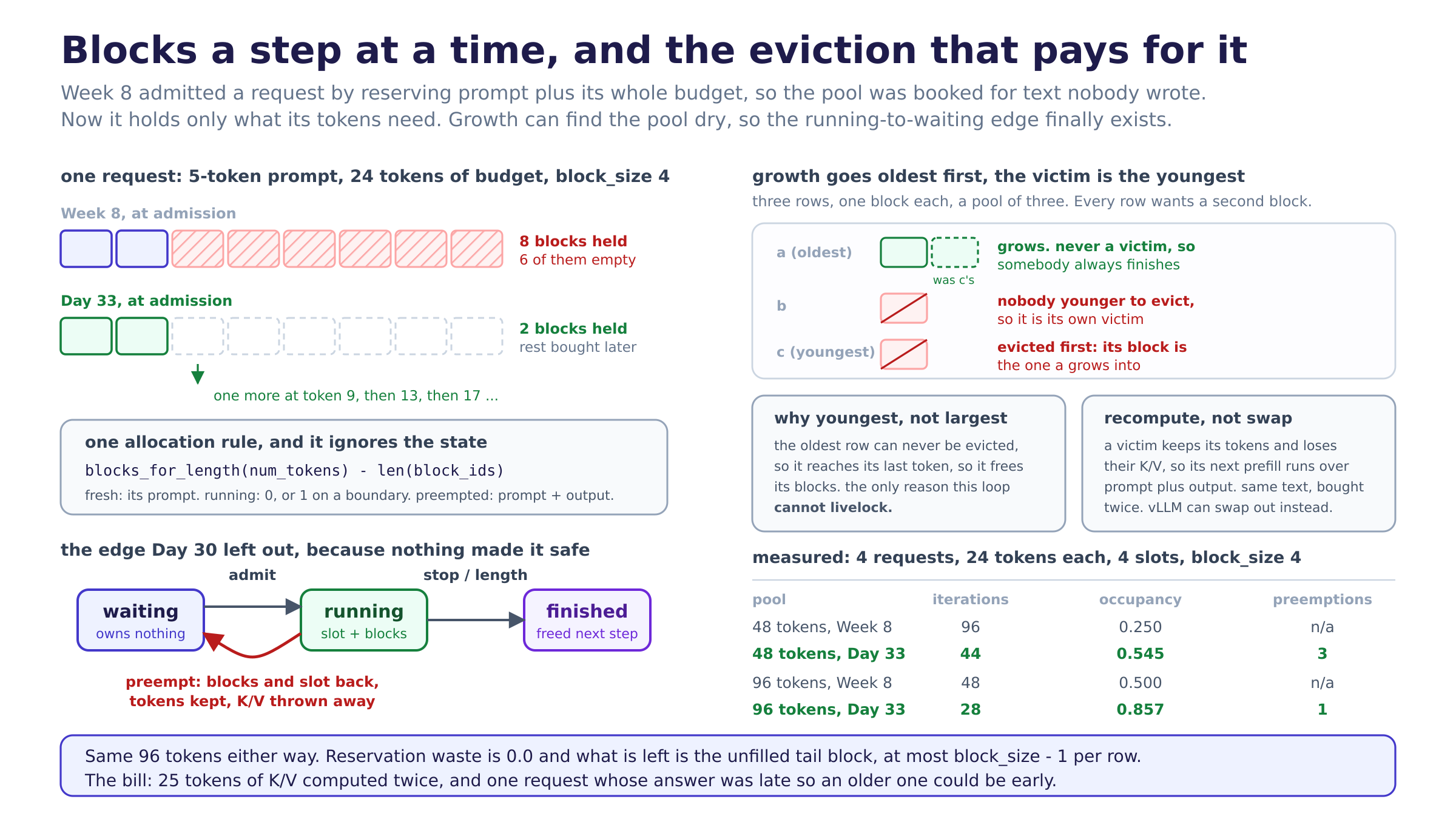
schedule() is now release, then grow, then admit. Growth runs oldest first and takes its blocks from the youngest running request, which is _preempt: blocks back to the pool, slot back to the free list, output_token_ids untouched, and the request pushed onto the head of the waiting queue. That is preemption by recompute, the RUNNING to WAITING edge Day 30 wrote into the transition table as illegal because nothing existed to make it safe. A request with nobody younger to evict is its own victim. The engine side is three things: Scheduler.on_release, a hook the engine fills with its cache-row reset so a row is emptied inside schedule rather than around it, BlockTable.extend so a row learns about the block the scheduler just handed its request, and one word in the prefill, token_ids instead of prompt_token_ids, which is the whole of the resume. Thirty-eight net new tests, mostly tests/test_preemption.py, in the two halves the last few days used: the scheduler over plain integers for allocation, victim choice and queue order, then a tiny LlamaModel for the claim that actually matters. Suite 428 green (5 GPU-gated skips), ruff clean.
Why it matters
Four requests, a 5-token prompt each, 24 tokens of budget each, four slots, block_size 4, and the same 96 tokens collected in every row of this table:
| pool | policy | iterations | occupancy | preemptions | tokens recomputed |
|---|---|---|---|---|---|
| 48 tokens | Week 8 | 96 | 0.250 | n/a | 0 |
| 48 tokens | Day 33 | 44 | 0.545 | 3 | 55 |
| 96 tokens | Week 8 | 48 | 0.500 | n/a | 0 |
| 96 tokens | Day 33 | 28 | 0.857 | 1 | 25 |
| 128 tokens | either | 24 | 1.000 | 0 | 0 |
A request that will end up 29 tokens long reserved 8 blocks on Week 8’s rule, so a 96-token pool held exactly two of them and the engine ran two rows in a four-row batch for the entire run. On today’s rule the same pool starts all four (two blocks each), and the engine averages 3.4 rows per forward instead of 2. The last line is the honest bound: when every request really does use its whole budget, the worst case was right all along, and at 128 tokens the two policies are the same engine. Everything above that line is the gap between what a request might do and what it does, which is where the concurrency was hiding.
On the Day-29 shape (eight requests, 5-token prompts, seven wanting 4 tokens and one wanting 32, eight slots, block_size 4) the same change shows up as a pool size rather than an occupancy: running all eight at once took 31 blocks on Week 8’s rule and takes 16 now, because seven of those requests were holding three blocks each for a 9-token life. That workload never preempts, which is the point of measuring both: preemption is what happens when the pool is genuinely too small, not a cost of the allocation change.
reservation_waste is 0.0 now and stays 0.0, by construction rather than by luck, because held and needed are computed from the same number. What replaces it is fragmentation_waste, the unfilled tail of each sequence’s last block, bounded by block_size - 1 tokens per sequence however long the sequence gets. That is the paging bound vLLM quotes a few percent for, and it is the reason block_size is a knob and not a constant: bigger blocks mean fewer tables and more dead tail.
What I learned
- Incremental allocation and preemption are one feature, not two. I scoped this day as “allocate a block at a time” and tried to leave the eviction path for tomorrow, and there is no such day. Without the worst-case reservation the pool can be drained to a state where a running request has no block for its next token, and no admission-side watermark fixes it: I worked out a one-step lookahead reserve, one block per running row, and it holds for exactly one iteration, then the next boundary crossing arrives with an empty pool anyway. The choice is not “allocate incrementally, and preempt if you feel like it”. It is “reserve the worst case, or have a recovery path”, and everything else is a way of postponing that.
- The victim policy is a liveness proof, not a heuristic. Preempting the youngest running request looks arbitrary next to preempting the largest, which would free more blocks per eviction. Seniority is what makes the loop terminate. The oldest running request is never a victim, so it always reaches its own last token, so it always frees its blocks, so the pool always drains: somebody finishing is the only reason this is not two requests taking turns evicting each other forever. And the door check from Day 30, which refuses a request whose worst case exceeds an empty pool, quietly became the second half of that proof. It was about a blocked FIFO head; it is now what guarantees that a request which has evicted everybody else fits in the pool it is alone with. The worst case did not go away today. It moved from the allocator to the doorman.
- Recompute has to resume, not restart, and the type system will not tell you which one you wrote. The obvious implementation of “put it back on the queue” throws away the generated tokens with the K/V, and the engine still runs, still drains, still returns the right number of tokens per request, and returns different text. The fix is that a preempted request keeps
output_token_idsand its next prefill runs overtoken_ids, so it is admitted as a longer version of itself and the token it samples is the one it would have sampled anyway. The bug I actually hit was one step subtler: the first version re-prefilled the prompt only, and the real 1B happily emitted a duplicate token in the middle of the sequence (... 315, 279, 279, 502 ...where it should have been... 315, 279, 502, 220 ...). The test that catches this compares a cramped engine against a roomy one on identical prompts, and it is the only test in the file I would refuse to ship without. - Two lists that must agree will drift, and the drift is silent. The request’s
block_idsis the scheduler’s record and the cache row’sBlockTable.block_idsis the tensor addressing, and Week 8 got away with copying one into the other once at adoption because reservations never changed size. Now they change every few iterations. Forgetting to sync does not raise:BlockTable.appendsees a table short of capacity and helpfully allocates a block of its own, the pool is booked twice for one sequence, and the damage surfaces later, somewhere else, as a stranger’s K/V in somebody’s context. The same shape of bug lives in the slot: a preempted slot can be handed to a new request inside a singleschedulecall, so the row reset cannot happen before or after that call, which is why the scheduler now calls back into the engine at the moment the slot moves.
Diagram
incremental-allocation.png. Left is one request’s blocks under the two policies: eight held at admission with six hatched empty, against two held with the rest drawn as outlines it will buy at tokens 9, 13 and 17, and under them the one allocation rule and the state machine with the preempt edge drawn in red instead of ghosted. Right is the cascade on a pool of three: a grows into the block c is evicted from, b finds nobody younger and is its own victim, with the two boxes for why the victim is the youngest and why recompute rather than swap. The table underneath is the measured pair of pools, and the banner is the trade: same 96 tokens, reservation waste zero, 25 tokens of K/V computed twice and one request whose answer was late so an older one could be early.
Tomorrow
The preemption path exists and nothing yet reports it where it hurts. batchbench measures occupancy and latency but knows nothing about victims, so a run that recomputes half its tokens looks like a run that scheduled well, and the recompute surcharge lands invisibly inside prefill_tokens. Next is putting preemption into the measurement: preemptions per request, the recompute bill as a share of total forward work, and the latency of a preempted request against one that ran straight through, which is the number a caller actually feels. That is also the first honest comparison of recompute against swap, since swap trades the same latency for PCIe bandwidth instead of FLOPs, and I want the recompute numbers before I argue about which is better on a single GPU. After that, Week 9 owes a stress test: many concurrent sequences through a pool small enough to preempt constantly, checking that the text never changes and no block goes missing.
Post angle
Day 33 of building an LLM inference engine from scratch. Week 8’s scheduler reserved prompt plus the whole token budget when it admitted a request, which made a running row unkillable and booked the pool for text nobody ever wrote. Today it buys blocks a step at a time. Four requests, 24 tokens of budget each, four slots, a 96-token pool: the old rule fit two of them, ran a half empty batch for the whole run and took 48 iterations. The new rule starts all four, averages 3.4 rows per forward and finishes in 28. Same 96 tokens of output. The thing I did not expect is that this is not a feature you can ship on its own. Take away the worst-case reservation and a running request can find the pool dry mid-generation, and no admission-side watermark saves you: I worked out a one-step lookahead reserve and it holds for exactly one iteration. So today also had to build the RUNNING to WAITING edge I deliberately left out on Day 30: preemption by recompute. Blocks and slot back to the pool, tokens kept, and the request goes to the head of the queue to be prefilled again later over prompt plus what it already generated. Two things I would have got wrong. First, the victim policy is a liveness proof, not a heuristic: evicting the youngest means the oldest can never be evicted, so it always finishes, so the pool always drains. Evicting the largest frees more blocks and lets two requests take turns evicting each other forever. Second, recompute has to resume, not restart. My first version re-prefilled the prompt only, and the engine kept running, kept draining, returned the right number of tokens, and returned different text: a duplicated token in the middle of the sequence. The test is a cramped engine against a roomy one on the same prompts, and it is the only one here I would refuse to ship without. Reservation waste is now 0.0. What is left is the unfilled tail of each last block, which is the paging bound vLLM quotes a few percent for, and 25 tokens of K/V bought twice. 428 green.