Day 77: the compiled run passes, and its control arm was not compiled
Date: 2026-10-06 · Week 14 · Phase 5 Benchmark and optimize
What I added today
Yesterday’s “Tomorrow” was the last path of the card run no smoke had reached: a toy run with --compile dynamic, so CompiledDecode builds behind a booted server and the capture records over a compiled forward. Both earlier smokes passed --no-compile.
The first compiled run passed, and it was wrong. Two arms, burst, the toy checkpoint: exit 0, all eight claims ok. Under loading the eager arm the stderr said:
torch._dynamo hit config.recompile_limit (8)
   function: 'inner' (.../torch/_dynamo/external_utils.py:67)
   last reason: 0/7: tensor 'args[0]' size mismatch at index 0. expected 1, actual 4
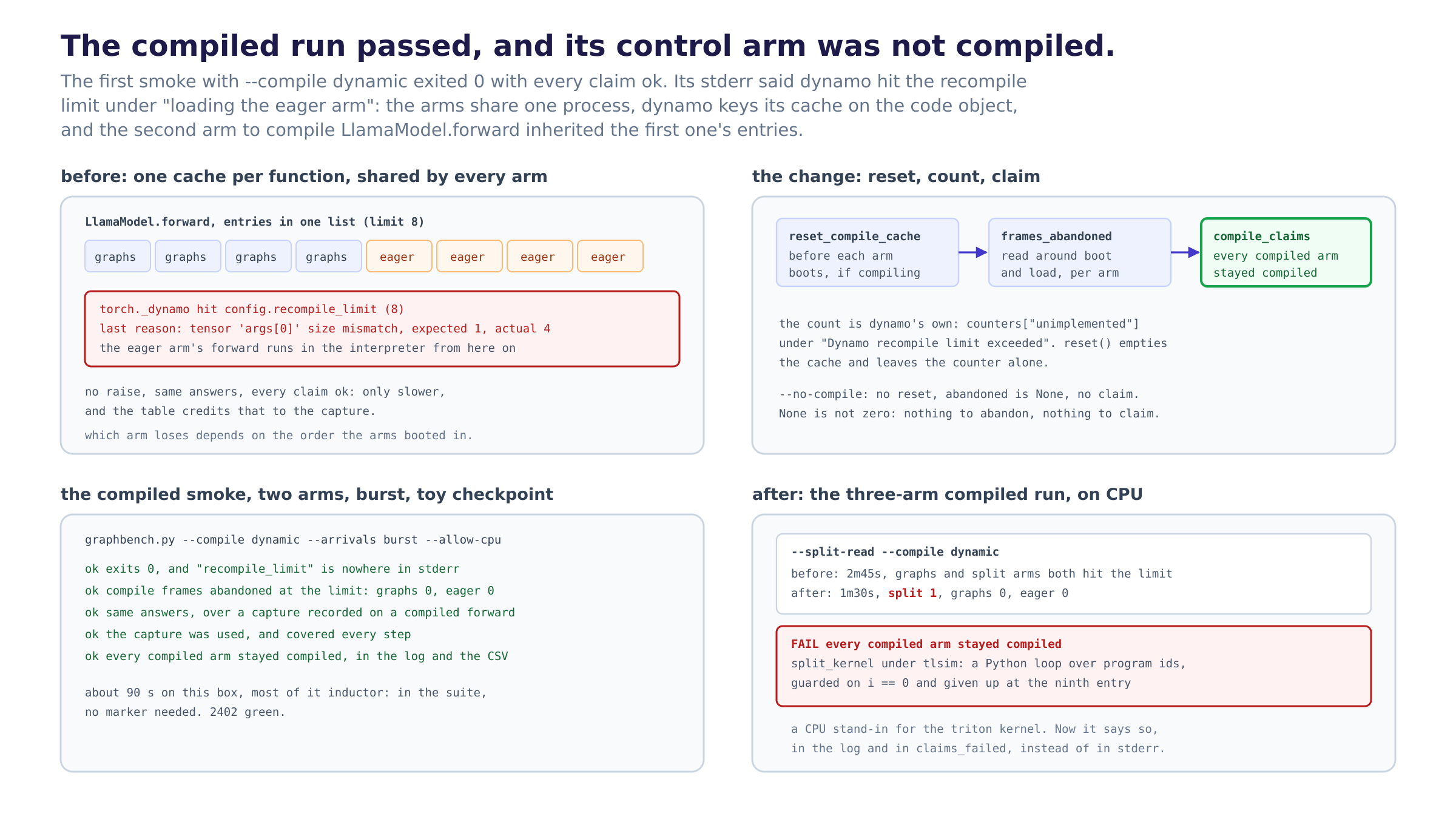
Dynamo keeps its compiled entries per code object, for the life of the process. Every arm runs the same LlamaModel.forward, and the arms boot one after another in one process. The graphed arm’s warm-up filled entries for its buckets, the eager arm’s compile added to the same list, and at eight dynamo gave the frame up and ran the eager arm’s forward in the interpreter. The control arm of a compiled comparison was the one arm not compiled, because it booted second. Nothing raised and the answers matched, so no claim could see it.
The fix, in three parts.
compiled.dynamo_frames_abandoned()reads dynamo’s own count of frames it gave up on at the limit (counters["unimplemented"], keys startingDynamo recompile limit exceeded).compiled.reset_compile_cache()istorch._dynamo.reset(), which empties the cache and leaves the counter alone.graphbench.py’smeasureresets before each arm boots when the run compiles, and charges each arm the frames abandoned between its boot and the end of its load.ArmDelta.abandonedcarries the per-arm counts (Nonewhen the run did not compile), the render printscompile frames abandoned at the limit: graphs 0, eager 0, andcompile_claimsadds one gate, “every compiled arm stayed compiled”, last in the list and only for a compiled run. A--no-compileclaim list is Day 76’s, unchanged, and so is the CSV header: the count reaches the CSV throughclaims_failed.
tests/test_compile_smoke.py has 20 tests: the counter against a real (eager backend) compile walked past a patched limit, the gate and its render, the script’s measure with stubbed servers (resets come before boots, each arm is charged its own frames, no reset and no count when off), and the compiled smoke as a process. The smoke is about 90 s, most of it inductor, so it stays in the suite with no marker. Suite 2402 green (34 GPU-gated skips), ruff clean.
Why it matters
This is the bias that would have shipped in the card run’s CSV. The eager arm running uncompiled is slower for a reason that has nothing to do with CUDA graphs, and the table divides by it. Every itl_p50_speedup would have carried part of a compile the other arm got and this one did not.
Which arm lost depended on boot order. Three-arm runs boot split, graphs, eager. Before the reset, the three-arm compiled run lost frames in the graphs arm too (a paged_attention guard on layer, inherited from the split arm’s entries). A benchmark whose fairness depends on the order of a loop is not measuring the arms.
It also cost time. The three-arm compiled toy run went from 2m45s to 1m30s: the old run spent its minutes recompiling frames whose lists were already full of another arm’s entries.
What I learned
- Dynamo’s cache is per function, not per model. Two engines in one process share the entries for
LlamaModel.forward. The guards keep their graphs apart, and the limit counts them together. A fresh process is what a server gets, so a benchmark that boots several servers in one process has to give each one a reset. - The give-up is a counter, not just a warning.
recompile_limitprints once on stderr and also bumpscounters["unimplemented"]. Reading it around an arm is the measured version of whatCompiledDecode.fell_backcould only predict. - My first counter test counted nothing. It was the Day 49 failure in miniature, an int read off an object, under
dynamic=True. Read through a closure, the int went symbolic and the frame compiled once. A static compile with a new shape per call guards on every version. And the helper resets first, because its function is one code object however many tests call it. - The remaining FAIL is honest. With the reset, the three-arm compiled run still loses one frame in the split arm: tlsim’s
split_kernel, a Python loop over program ids guarded oni == 0. That is the CPU stand-in for a triton kernel, so it may not happen on a card, and now it prints in the log and inclaims_failedinstead of only on stderr.
Diagram
compile-arm-reset.png. Top left: one entry list for LlamaModel.forward, filled by the graphed arm and finished by the eager arm. Top right: reset, count, claim. Bottom left: what the compiled smoke checks. Bottom right: the three-arm compiled run before and after, and the tlsim frame that is left.
Tomorrow
The split arm’s abandoned frame. Under tlsim the kernel is Python that dynamo traces into, one program_id at a time. Either the CPU split read gets torch.compiler.disable around the tlsim launch (the honest move, since it stands in for a launch that dynamo would not trace), or the gate learns that a tlsim frame is not the forward. A test pins whichever is chosen to the three-arm compiled run.
The card run still comes first when hardware is booked, and its CSV now says whether every arm ran the forward it compiled.
Post angle
Day 77 of building an LLM inference engine from scratch. First benchmark run with torch.compile on: exit 0, every claim ok. The stderr said the eager arm hit dynamo’s recompile limit. Dynamo caches per function, every arm runs the same forward in one process, and the second arm inherited the first one’s entries. The control arm wasn’t compiled. Fix: reset per arm, count abandoned frames, fail the run if any. 2402 green.