Day 21: the Triton programming model, modeled on the CPU
Date: 2026-07-06 · Week 6 · Phase 2 Paged memory
What I added today
src/nanoserve/kernels/tlsim.py: a small, stdlib-plus-torch model of the Triton programming model, run on the CPU with no GPU and no Triton installed. It has the five primitives a paged-attention kernel is built from: launch(grid, kernel, *args) that runs the same body once per program id (the SPMD loop), a Program handle that answers program_id/num_programs, masked load/store over a flat 1-D buffer, and arange/cdiv to build offsets and size the grid. On top of it, paged_gather rewrites the Day-18 pool[slot_mapping] read as a grid of programs: each program owns a tile of positions and gathers their K/V through the block table with the ragged last tile guarded by a mask. Eleven new pure tests in tests/test_tlsim.py pin the grid coverage, the masked-load other semantics, the masked-store no-write, and, the payoff, that paged_gather is byte-equal to pool[slot_mapping] for every block size, over physically scattered blocks, feeding the exact paged_attention_reference softmax. Pure suite 141 green, ruff clean.
Why it matters
Week 6’s headline is a hand-written Triton kernel, and Day 20 put the number on the wall it has to beat. But a Triton kernel is not the torch code that surrounds it. It launches a grid of programs, each running the identical body with only its program_id different, and inside it does not slice tensors: it computes flat integer offsets, forms block pointers, and moves data with masked tl.load/tl.store. The mask is the load-bearing idea. A sequence of 10 tokens in tiles of 4 has a last tile that is only half full, and that tile has to read and write without walking off the end of the KV pool. In Triton the mask is what lets a lane point anywhere, get masked off, and quietly return other instead of faulting. Get that wrong and the kernel segfaults or reads garbage that no reference can catch, because the bug is in the addressing, not the math. So before writing the kernel on rented GPU time, I wrote the loop it runs against a CPU model of exactly those primitives and pinned it to the reference. Now the kernel next week is a translation of an understood, tested loop rather than a copied incantation, and the sim is the thing I can single step when the real kernel disagrees with the oracle.
What I learned
- The mask is the whole game, and it has to be safe on both sides. A masked
loadcannot merely blank the output after gathering, because the masked-off lane’s offset may be out of bounds and indexing it would fault before any blanking happens. So the sim neutralizes the offset first (where(mask, off, 0)), indexes the safe copy, then overwrites the masked lanes withother. The store mirror never writes the masked slots at all. That is not a sim detail: it is the exact property the ragged tail depends on, and writing it out by hand is what made it obvious that “masked” means “never touches memory,” not “touches then discards.” - SPMD means order must not matter, and a test can prove it. The programs run sequentially here and in any order on hardware, so a correct kernel gives each program a disjoint tile.
test_paged_gather_is_transparent_to_block_sizemakes that concrete: block sizes of 1, 2, 3, 4, 8, 13, 20 over a 13-token history all return the identical gather. The tile size is a performance knob, never a correctness one, and if it ever were, that test would catch it. A gather that changed with the block size would mean the programs were stepping on each other. - A block pointer is just base + arange, and 2-D is the same trick twice. Each token is
n_kv * dcontiguous channels, so viewing the pool and the output as flat[n, C]matrices lets one program move a[block, C]tile: rows are positions (rows[:, None] * C), columns are channels (arange(0, C)[None, :]), and the mask broadcasts down the rows. That is the identical index arithmetic a Triton kernel writes withtl.arangeand broadcasting; doing it in torch first demystified the pointer math that reads like line noise in real kernels. - Modeling the slow thing is how you understand the fast thing.
paged_gatheris slower than the plainpool[slot_mapping]it reproduces: a maskedwheregather does strictly more work than a direct index. That is fine, because its job is not speed, it is to make the kernel’s loop expressible and testable in terms I can read. The honest framing, same as the Day-18 reference: the CPU model buys understanding and a fixed target, and the speed only arrives when the same loop runs astriton.jitstreaming blocks on the GPU.
Diagram
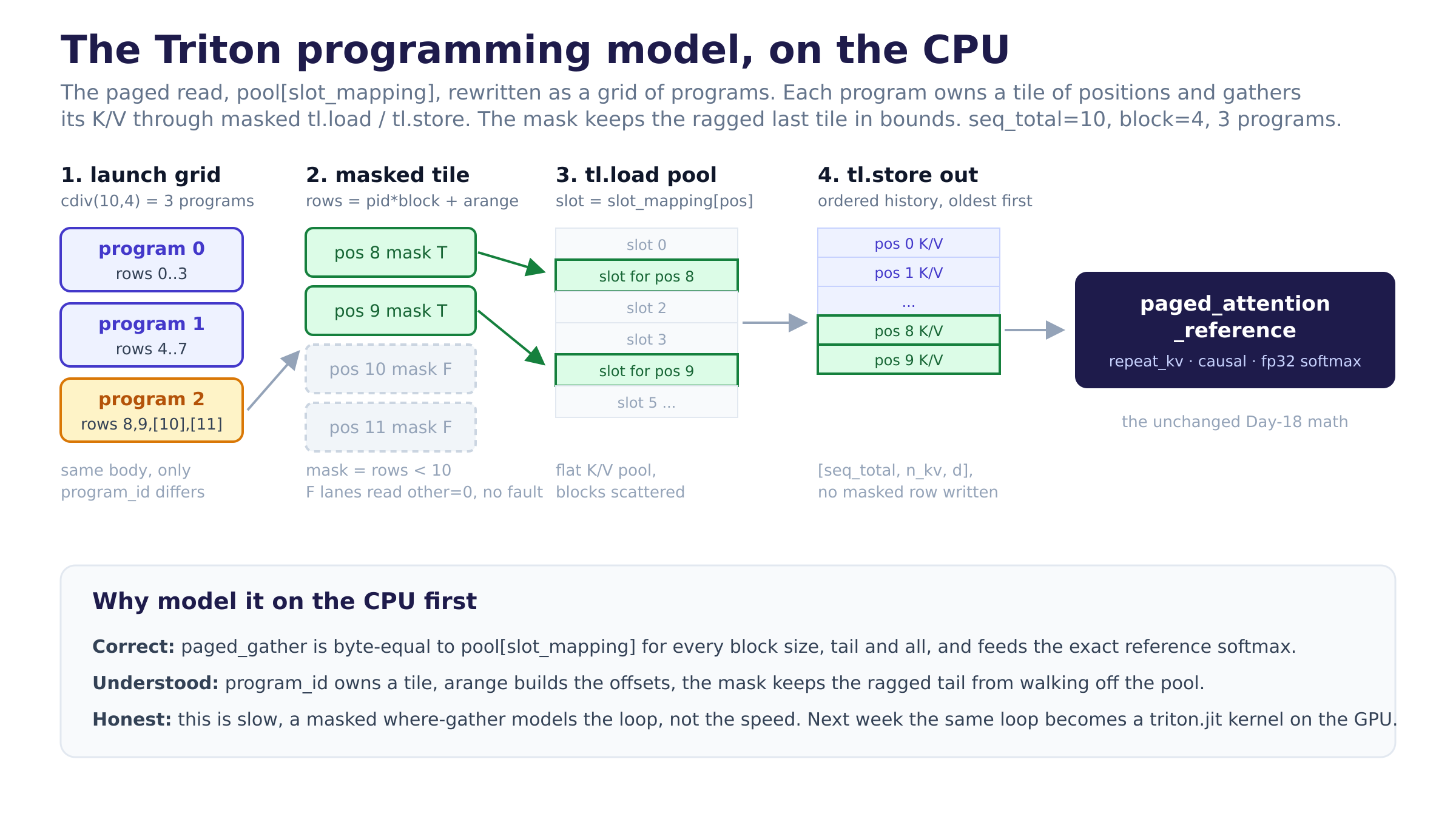
tl-programming-model.png. The paged read as a grid of three programs over a 10-token history in tiles of 4. Program 2 owns the ragged tail (positions 8, 9 valid; 10, 11 masked off), gathers its two live tokens through their scattered pool slots with a masked tl.load, and tl.stores them into the ordered history that feeds the unchanged paged_attention_reference softmax. The three-line takeaway names why the CPU model exists: correct (byte-equal to the torch index for any block size), understood (program_id owns a tile, the mask keeps the tail in bounds), and honest (this is slow, next week the same loop is a GPU kernel).
Tomorrow
The kernel itself, now that the loop is understood and pinned. The next step is the first cut of the triton.jit paged-attention kernel behind the same paged_attention signature, whose inner loop is the paged_gather tile pattern from today folded together with the score and softmax so K/V is streamed block by block and never assembled into a contiguous history. It needs a GPU, so it runs gated like the weights tests, held byte-close to paged_attention_reference and benchmarked against the Day-20 curve with the same readbench harness. Today’s sim is the scaffold it is debugged against: when the kernel disagrees with the oracle, the sim is where the addressing bug is reproduced in plain torch first.
Post angle
Day 21 of building an LLM inference engine from scratch. Week 6 is a hand-written paged-attention kernel, and before renting GPU time to write it I modeled the Triton programming model on the CPU, no GPU, no Triton installed. Because a Triton kernel is not the torch around it: it launches a grid of programs, each running the same body with only its program_id different, and inside it does not slice tensors, it computes flat offsets, forms block pointers, and moves data with masked tl.load / tl.store. The mask is the whole game. A 10-token history in tiles of 4 has a last tile that is only half full, and that tile has to read and write without walking off the end of the KV pool; the mask is what lets a lane point anywhere, get masked off, and return other instead of faulting. So I built launch, program_id, arange, cdiv, and masked load/store as a slow CPU model, then rewrote the paged read pool[slot_mapping] as a grid of programs gathering tiles through the block table, and pinned it byte-equal to the torch index for every block size, over scattered blocks, feeding the exact Day-18 softmax. Two gotchas that only show up when you write it by hand: a masked load must neutralize the out-of-bounds offset before indexing (masked means never touches memory, not touches then discards), and the gather has to be identical for every block size or your programs are stepping on each other. It is slower than the index it reproduces, and that is the point: the CPU model buys understanding and a fixed target, the speed arrives when the same loop runs as a triton.jit kernel on the GPU, the shape vLLM and SGLang ship. Now the kernel is a translation of an understood loop, not a copied incantation. 141 tests green. #AI #LLM #vLLM #BuildInPublic #Claude #OpenAI