Day 65: the third read arrived before its memory did
Date: 2026-09-21 · Week 14 · Phase 5 Benchmark and optimize
What I added today
SPLIT on PagedRead, a third mode beside RECTANGLE and STREAMED, and the three places the wiring turned out to touch.
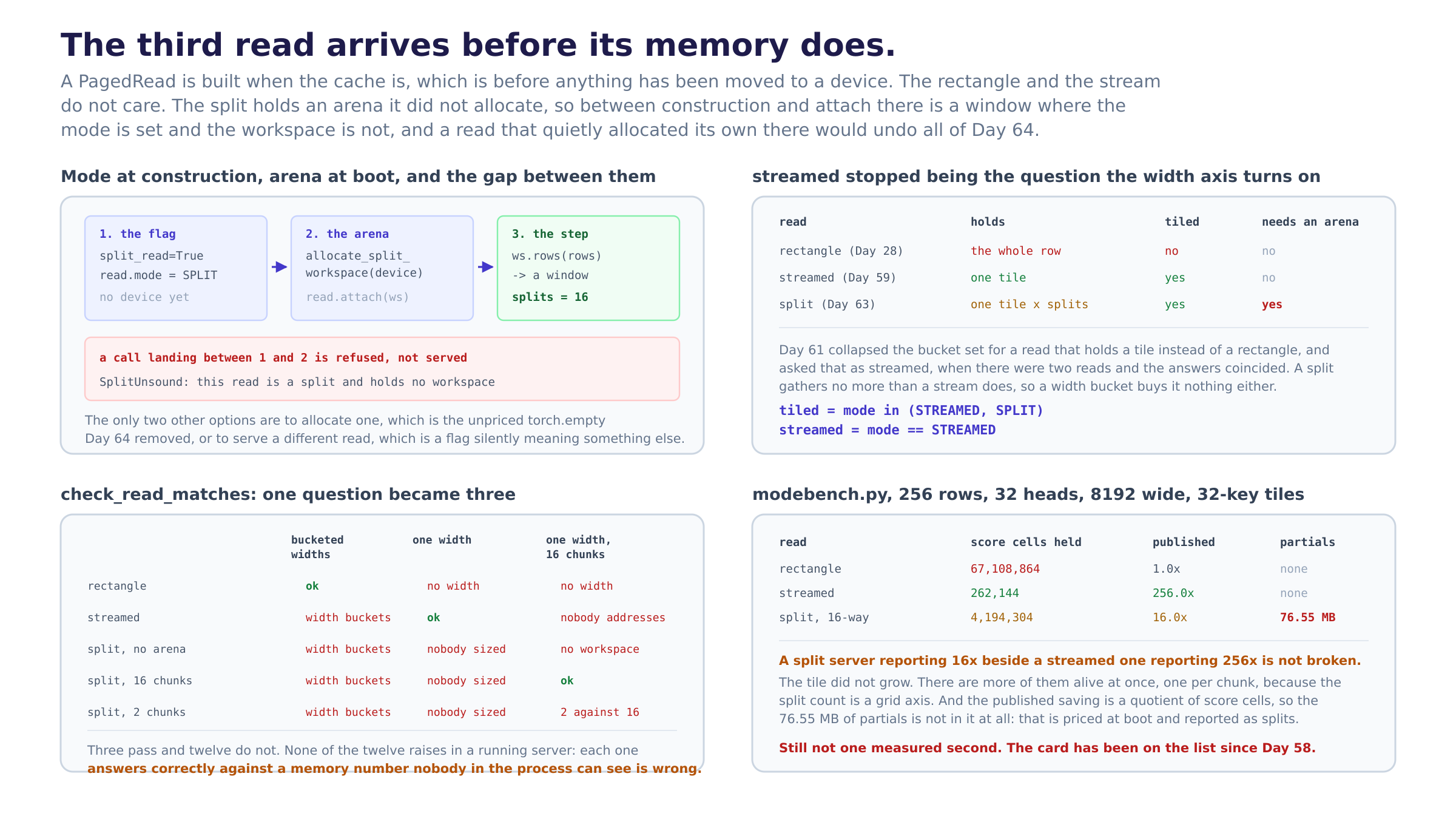
reads.py. PagedRead(mode=SPLIT, block=...) holds a SplitWorkspace it did not allocate. attach takes it, refuses it on a read that would never address it, refuses an arena partitioned in a different tile, and refuses a second arena while tolerating the same one twice. splits reads the chunk count off the workspace and is 0 without one. A call between construction and attach raises SplitUnsound rather than allocating, which is the whole reason the method exists. streamed goes back to meaning “is exactly Day 59’s read” and tiled is the new question, mode in (STREAMED, SPLIT): the width axis turns on whether a read holds a tile, and the split holds tiles too.
ReadStats grows splits, in as_dict, from_dict, render and since, and since refuses a change of it on the mode’s grounds and not the backend’s: a process does not acquire chunks the way it discovers a backend. _charge gains a third arm, split_score_cells(shape, heads, block, splits), so the published saving is the streamed read’s divided by the chunks.
buckets.py. DecodeBuckets(..., splits=), refused without streamed=True for read_workspace_bytes’s reason: a split is a partition of the streamed read’s tile, and a set that still buckets the width has no tile to partition. check_read_matches keys its width clauses on tiled instead of streamed and grows four more: a split set under an unsplit read, a split read under an unsplit set, a split read holding no arena at all, and two chunk counts that disagree. row_axis comes out of the constructor as a function, because the split count is planned over the row axis and has to exist before the set does.
cache.py. split_read=True, refused alongside streamed_read and refused without bucket_decode. read_splits is plan_splits over this cache’s own row axis at its own table width, computed at construction. allocate_split_workspace(device) is the second half: every number an arena needs is already a property of the cache or its model, so device is the only argument, and a caller cannot get the arena wrong without getting the cache wrong first.
tests/test_reads.py grows 30 and tests/test_width_axis.py 9. Suite 2154 green (21 GPU-gated skips), ruff clean.
modebench.py, host only, no weights (day-65-modebench.csv):
one planned decode step, 4 rows over a 2048-wide table, 4-key tiles:
      mode  backend  splits  charged   held  saving  vs oracle
 rectangle    torch       0     4096   4096    1.0x   0.00e+00
  streamed    tlsim       0    65536    128  512.0x   2.38e-07
     split    tlsim       4    65536    512  128.0x   2.38e-07

one decode step at 256 rows, 32 heads, 8192 tokens, 32-key tiles:
      read  splits  held cells  published     partials
 rectangle       0    67108864       1.0x      0.00 MB
  streamed       0      262144     256.0x      0.00 MB
     split      16     4194304      16.0x     76.55 MB

check_read_matches over every pair this repo can build:
                     set             read  verdict
         bucketed widths        rectangle  ok
         bucketed widths         streamed  refused: width buckets
         bucketed widths  split, no arena  refused: width buckets
         bucketed widths            split  refused: width buckets
         bucketed widths  split, 2 chunks  refused: width buckets
               one width        rectangle  refused: no width axis
               one width         streamed  ok
               one width  split, no arena  refused: nobody sized
               one width            split  refused: nobody sized
               one width  split, 2 chunks  refused: nobody sized
    one width, 16 chunks        rectangle  refused: no width axis
    one width, 16 chunks         streamed  refused: nobody addresses
    one width, 16 chunks  split, no arena  refused: no workspace
    one width, 16 chunks            split  ok
    one width, 16 chunks  split, 2 chunks  refused: 2 against 16
Why it matters
This is the first read in the engine that cannot run on its own, and the shape of the day is what that costs. The rectangle needs a pool and a mapping. The streamed read needs those and a tile, which it carries itself because a tile is an integer. The split needs an arena somebody else allocated, at a width somebody else fixed, and a PagedRead is constructed when the cache is, which on the boot path is before anything has been moved to a device. So there is a window where the mode is set and the workspace is not, and it is a real window rather than a theoretical one: it is every line of boot between BatchedPagedKVCache(...) and the call that reserves memory. Only three things can happen in it. The read can allocate its own, which is the unpriced torch.empty the entire previous day existed to remove. It can silently do something else, which is a flag that means one thing in the log and another in the process. Or it can refuse, which is the one that leaves the operator holding a sentence instead of a mystery. Nothing else this week has had two legitimate states before its first step.
streamed was the right question with two reads and the wrong one with three, and that is a specific kind of mistake worth naming. Day 61 collapsed the bucket set for a read that holds a tile instead of a rectangle and called the predicate streamed, because at the time “holds a tile” and “is Day 59’s read” picked out the same object. They are not the same question, they were the same answer, and a third read is exactly the thing that separates them. The split gathers no more than the stream does, so a width bucket buys it nothing either, and a gate still asking the narrower question would have refused every legitimate split server with a message about a rectangle it never builds. Two predicates now, and the one the gate reads is the one about memory.
A gate that had one clause has four, and the four name four different mornings. The width clauses say a set and a read disagree about whether the context is an axis. The new ones say they disagree about an arena, and the arena is the largest thing a split server reserves: 76.55 MB of partials at serving size, next to 8.39 MB of score tiles. A set priced for sixteen chunks under a read that runs one has bought fifteen sixteenths of a workspace nobody addresses; a split read under a set priced in whole tiles is a launch nobody sized; a split read holding no arena is a boot path that stopped one call short. Same class of failure, three different fixes, and the only reason to split them into three messages is that a single “these disagree” would send somebody to the wrong one. Twelve of the fifteen pairs in the matrix refuse, and not one of them would have raised in a running server: every one of them answers correctly, against a memory number nobody in the process can see is wrong.
And the published saving means a third thing now, which makes it more useful rather than less. saving is score_cells / held_cells and has been since Day 60. On the rectangle it is 1.0x because a read that materialises the row holds every cell it was charged. On the stream it is width / block. On the split it is that divided by the chunks, because a split does not make the tile smaller, it makes more of them alive at once: the split count is a grid axis and every program on it is scoring. So a split server reports 16x where its streamed neighbour reports 256x, and a gate that only knew two reads would file that as a broken streamed server. What the quotient does not contain is the arena, and that is deliberate: the partials are not scores, they are constant for the life of the process, and they are priced once at boot. A per-call counter that folded them in would restate a boot number once per layer per step and make the ratio traceable to neither.
What I learned
- The split read agrees with the streamed one on the padded row, including the NaN, and I expected to have to make that true. A bucketed decode step pads rows up to a bucket and gives the padding
context_lens == 0, which ischeck_pad_inert’s contract. Day 63’sreduce_partialsrefuses that row on the host with a good reason: every partial max is-inf, the joint max is-inf, the rescale is(-inf) - (-inf), and the output is NaN rather than an error. I went looking for how to soften it and found that the kernels never call it. Both passes are written as programs, both doexp(m_s - joint)inline, and both produce exactly the NaN the streamed read has produced on a padded row since Day 59.reduce_partialsis the plain-torch oracle the programs are graded against, not the thing on the read path, and the strictness that is right in an oracle would have been wrong in the read. A third read that raised where the second one shrugged would have made the flag change what a server accepts, which is precisely the failure the “both branches refuse what the oracle refuses” rule exists to stop. - The split read needs
bucket_decodeand the other two do not, and I put that in the constructor rather than at the first step. The arena is partitioned once, from one mapping width, and reserved for the life of the process; an unbucketed cache presents whatever width its longest row happens to have this step. The streamed read survives that because its loop bound is each row’s own length, so a width it never reads costs it nothing. A split partitions the width, so a different width is a different partition of the same history, and Day 64’scheck_workspace_coverswould refuse it correctly at the first decode step, in the middle of a warm-up, three files away from the flag that caused it. The reason is a property of the configuration and not of any batch, so the refusal belongs where the configuration is assembled. attachis idempotent on the same workspace and refuses a different one, and the asymmetry is not fussiness. A recorded graph is a list of launches bound to the pointers it recorded. Swapping the arena under a read that has already been captured leaves the replay writing into storage nothing reads and reading storage nothing writes, and what comes out is finite, plausible and one step stale. So the check is on identity rather than on shape: two arenas of exactly the same shape, dtype and device are not interchangeable here, and that is the only gate in this repo where “equal” and “the same” come apart in a way that matters.- The chunk count had to be planned before the bucket set existed, and pulling one line out of a constructor is what fixed it.
plan_splitsis a max overchoose_splitsof every row bucket in the list, andDecodeBucketsnow needs the count to be constructed. Building a throwaway set to read its rows off would work and would also be a second construction whose arguments can drift from the real one’s.row_axis(max_batch_size)is the four lines that were inline since Day 52, named, and both the set and the split count now come off the same call. - The counter was the only witness on Day 60 and the split makes that argument sharper, because now two servers can differ in a field that is not the mode. Day 62 added
backendbecausemodeis what the operator asked for and the backend is what the box could give them.splitsis the third question in that family and it is the one a memory budget turns on: two servers both reportingsplitontritoncan be holding arenas a factor of sixteen apart, androws * heads * splits * (head_dim + 2)is why. Nothing else in the payload would say so. - A read with no arena reports
splits: 0, which is also what a rectangle reports, and I left the ambiguity in on purpose. The alternative is a fourth field or a null, and both of those cost a reader something on every payload to disambiguate a state that lasts a few milliseconds at boot. A process in that state has completed no decode step, socallsis 0 next to it and the pair already says which. That is the cheapest place to put the answer, and the gate that actually cares (check_read_matches) has the mode in hand and does not have to infer anything. - The wiring table’s charges are not comparable across its own rows, and that is Day 61’s note arriving as an inconvenience rather than as a paragraph. The rectangle arm still buckets the width and rounds a 9-token history up to 128; the other two read at the table’s full 2048. So the rectangle is charged 4096 cells and the others 65536, and the savings in that column each describe their own arm and nothing across it. It is the honest way round, because the numerator really is the width that arm’s read would have gathered, but it means the only table where the three reads are directly comparable is the one that holds the width fixed by hand.
Diagram
read-becomes-three-modes.png. Left top is the two-step arrival: the flag at construction, the arena at boot, the step, and the refusal that lives in the gap. Right top is what each read holds and which of them needs an arena, with tiled and streamed side by side. Left bottom is the whole gate matrix, three passes against twelve refusals. Right bottom is the serving-size table in both currencies, the published saving and the partials that are not in it.
Tomorrow
The flag stops at the cache. Day 66 is threading it the rest of the way: Engine.build(split_read=True), build_engine and build_app, a --split-read argument next to --streamed-read, and the one call on the boot path that turns plan_capture(split_read=True) into an allocated arena, which is Day 64’s allocate_for finally having a caller. The gate that comes with it is the one this day did not need: check_capture_ready refuses a split cache whose arena was never attached, and the boot line should print SplitWorkspace.render next to CapturePlan.pool_bytes so the two numbers a split server reserves appear together rather than one of them appearing at all.
The acceptance run wants a third arm after that. test_the_same_engine_answers_the_same_bytes_on_either_read is two live servers over a socket and the split makes it three, which is the only comparison that settles whether a read that agrees to 1e-5 puts the same token on the wire. It is slow on this box because every arm is a tlsim loop in Python, so it is a day’s decision and not a footnote.
And the caveat is unchanged and I am not going to dress it up. The split is wired, the counters publish it, fifteen (set, read) pairs are enumerated and twelve of them refuse, and not one of those is a second. graphbench.py --weights ./weights --device cuda --rates 1,2,4,8 on all three arms is still the first run to book hardware for, and it has been the first thing on that list since Day 58.
Post angle
Day 65 of building an LLM inference engine from scratch. Today the flash-decoding read finally got wired into the engine as a third mode beside the rectangle and the stream, and the interesting part was not the dispatch. It was that this is the first read in the whole repo that cannot run on its own. The rectangle needs a pool and a mapping. The streamed read needs those plus a tile width, which it carries itself, because a tile is just an integer. The split needs an arena somebody else allocated, at a width somebody else fixed, and yesterday is why: three torch.empty calls inside a captured read are perfectly legal and completely unpriced, so the workspace became something the plan owns. But a read object is constructed when the cache is, and on the boot path that is before anything has been moved to a device. So there is a window where the mode is set and the memory is not, and only three things can happen in it. The read allocates its own, which undoes the entire previous day. It quietly does something else, which is a flag that means one thing in the log and another in the process. Or it refuses, and the operator gets a sentence instead of a mystery. The second thing I did not see coming: my width-axis gate had been asking the wrong question for four days without being wrong. Day 61 collapses the bucket set for a read that holds a tile instead of a rectangle, and I called that predicate streamed, because with two reads “holds a tile” and “is the streamed read” pick out the same object. They are not the same question, they were the same answer, and a third read is exactly what separates them. And the saving a server publishes means a third thing now. A split does not make the tile smaller, it makes more of them alive at once, because the split count is a grid axis. So a split server reports 16x where its streamed neighbour reports 256x, and that is not a broken streamed server, it is the trade: 4,194,304 score cells held instead of 262,144, plus 76.55 MB of partials the quotient does not contain at all. vLLM and SGLang both ship the split and the unsplit kernel side by side rather than replacing one, and building the wiring is what made me understand why that is a scheduling decision and not a leftover. 2154 green, fifteen (set, read) pairs enumerated and twelve of them refused, and still not one measured second.