Day 25: the fused read dispatches to the kernel backend
Date: 2026-07-16 · Week 6 · Phase 2 Paged memory
What I added today
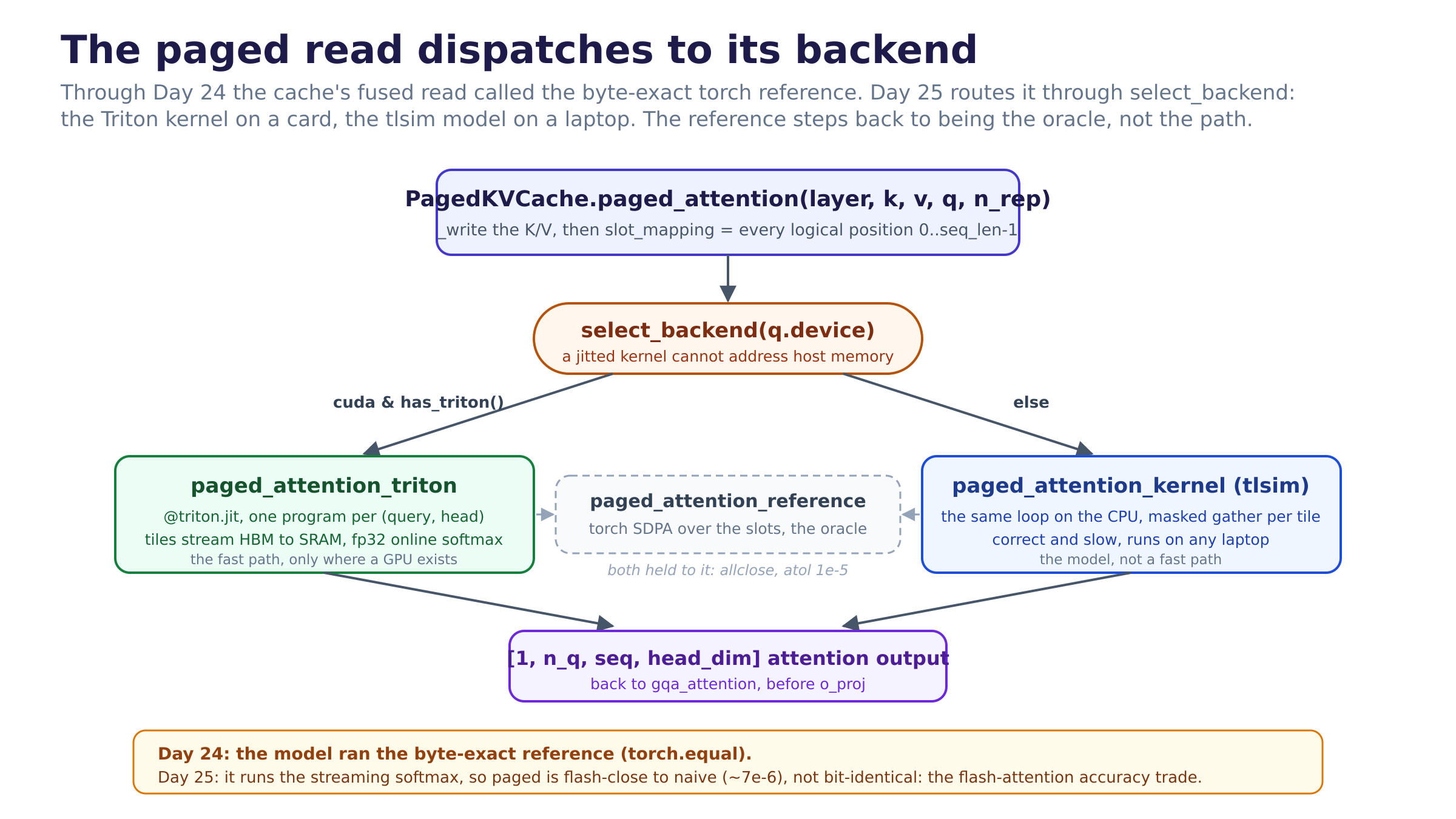
One line moved in src/nanoserve/cache.py, and it is the line the whole of Week 6 was building toward. PagedKVCache.paged_attention, the cache’s fused read, called paged_attention_reference directly through Day 24: the byte-exact torch oracle, the same SDPA over the assembled slots the tests compare against. Day 25 routes it through paged_attention_dispatch, the Day-23 entry point that asks select_backend(q.device) which read this device can actually run. On a CUDA tensor with Triton installed that is the @triton.jit kernel; on a CPU it is the Day-22 tlsim model, the same streaming loop written in torch. The engine gets the kernel on a card and the correct-and-slow model on a laptop, and the cache never learns which.
Two new tests in tests/test_cache.py pin the wiring. One spies on the dispatcher symbol the cache imports and asserts the read calls it exactly once, handed this layer’s own K/V pools and the slot mapping for the whole history, then hands its result straight back. The other feeds the cache’s pool through both the dispatched read and paged_attention_reference and pins them to atol=1e-5, the same tolerance the kernel itself is held to. The consequence rippled into three older equality tests that had pinned the cache read torch.equal against a contiguous SDPA: they now carry the flash tolerance, because the model no longer runs the byte-exact reference. Suite 186 green (5 GPU-gated skips), ruff clean.
Why it matters
Until today Week 6 was a kernel in a file. Day 22 wrote the fused CPU model, Day 23 wrote the real Triton kernel, Day 24 built the instrument to read its scaling, and every one of them was reachable only from a test. The model’s actual attention still ran paged_attention_reference, the oracle. This is the wiring step that turns the kernel into the engine’s real attention: the paged forward now dispatches, so the same code path picks up the GPU kernel when a card is present and falls back to the model that runs anywhere when it is not. The reference did not disappear, it changed jobs. It is the oracle both backends are graded against, not the path either one runs.
The honest cost is that paged attention is no longer bit-identical to the naive contiguous path. Both backends stream the online softmax, which reassociates the exponent sums, so the output lands a few ulps off a plain SDPA (about 7e-6 on the two-layer test model) rather than exactly on it. That is not a regression, it is the accuracy trade every flash-attention kernel makes, and it belongs on the model’s path precisely because that is where the kernel now lives. The token-level tests still hold because argmax over these logits does not flip at 1e-5; the logit-level test that asked for 1e-6 now asks for 1e-5, the tolerance the streaming softmax actually delivers.
What I learned
- Byte-identity was a property of the oracle, not of paging. Every “paging changes nothing” test through Day 24 passed
torch.equalbecause the cache read was the reference, running the identical causal fp32 softmax by exact index. The moment the model runs the streaming kernel instead, the scatter and gather stay exact (same K/V, same slots) but the softmax summation order moves, and equality becomes closeness. The tests that flipped fromequaltoallclosewere not loosened to hide a bug; they caught exactly the numerics change the dispatch introduced, which is what a good test does. - The right tolerance is the one the backend is already held to. The kernel tests pin tlsim and Triton to
paged_attention_referenceatatol=1e-5, rtol=1e-4. When the cache read started running that same backend, the correct new tolerance for the cache tests was not a number I picked to make green, it was that same 1e-5, propagated up one level. A tolerance that means something is a tolerance borrowed from where the approximation is defined. - A dispatcher makes the fallback the default and the kernel the exception. The branch reads
"triton" if device.type == "cuda" and has_triton() else "tlsim", so the CPU model is what runs unless both a card and the package are present. That is the right default for a repo that must run on a laptop: the slow-and-correct path is the one you get for free, and the fast path is the one that has to prove its preconditions. The engine is portable first and fast where it can be, not the other way around.
Diagram
paged-read-dispatch.png. The cache read at the top, the select_backend pill below it, and the two branches: the Triton kernel on cuda & has_triton(), the tlsim model on else. The reference sits dashed in the middle, with both backends held to it at atol=1e-5, no longer on the path. Both converge to the one attention output that flows back to gqa_attention. The banner carries the trade: Day 24 ran the byte-exact reference, Day 25 runs the streaming softmax, so paged is flash-close to naive, not bit-identical.
Tomorrow
Measure the dispatch where it matters. The read benchmark and the scaling fit (Days 20 and 24) time gather and fused as standalone functions; wire the runner to time the cache’s dispatched read end to end, so the sweep reports the path the engine actually takes rather than a function called in isolation. On CPU that pins the tlsim constant against the gather constant under the real slot mapping; on a card it is the first number that shows the kernel bending the constant down, which is the whole claim Week 6 has been setting up to make. Keep the reference as the correctness gate the timed path is checked against before any number is trusted.
Post angle
Day 25 of building an LLM inference engine from scratch. Today was one moved line and it is the one the whole kernel week was for. My paged cache’s attention read was still calling the byte-exact torch reference, the oracle. The real Triton kernel and its CPU model existed but only the tests ever touched them. Today the cache read dispatches: select_backend(q.device) picks the Triton kernel on a card and the streaming CPU model on a laptop, and the model’s actual attention runs whichever the box can run. The reference did not go away, it changed jobs, from the path the model runs to the oracle both backends are graded against. The honest part: paged attention is no longer bit-identical to the naive path. Both backends stream the online softmax, which reassociates the exponent sums, so the output lands about 7e-6 off a plain SDPA rather than exactly on it. That is not a bug, it is the accuracy trade every flash-attention kernel makes, and three of my “paging changes nothing” tests flipped from torch.equal to allclose to carry it. The tolerance I gave them was not invented, it is the same 1e-5 the kernel is already held to against the reference, propagated up one level. This is the shape vLLM and SGLang ship: a dispatcher that runs the fast kernel where the hardware allows and a correct fallback everywhere else, with the reference kept as the gate, not the path. 186 green.