Day 04: RMSNorm and RoPE, position as a rotation
Date: 2026-06-19 · Week 1 · Phase 0 Foundations
What I added today
src/nanoserve/layers.py: rms_norm (the bias-free normalizer every block uses twice) and the RoPE stack: RotaryEmbedding (precomputes inverse frequencies with the Llama-3.2 “llama3” rescaling, builds the cos/sin table per call), rotate_half, and apply_rotary. Plus tests/test_layers.py (9 tests): pure math checks that run anywhere, and four gated against the real Llama-3.2-1B.
Why it matters
These are the first two pieces that turn loaded weights into computed activations. RMSNorm is trivial. RoPE is where attention learns where a token is, and it is the classic place to be quietly, untestably wrong, so it gets verified hard before any attention math sits on top of it.
What I learned
Position is a rotation, not a vector you add. RoPE rotates each (x, y) pair of a query/key by an angle proportional to the position. A dot product only cares about the angle difference between two rotated vectors, so attention between positions m and n comes out depending on (m - n): relative position falls out of absolute rotations for free, with no learned position table.
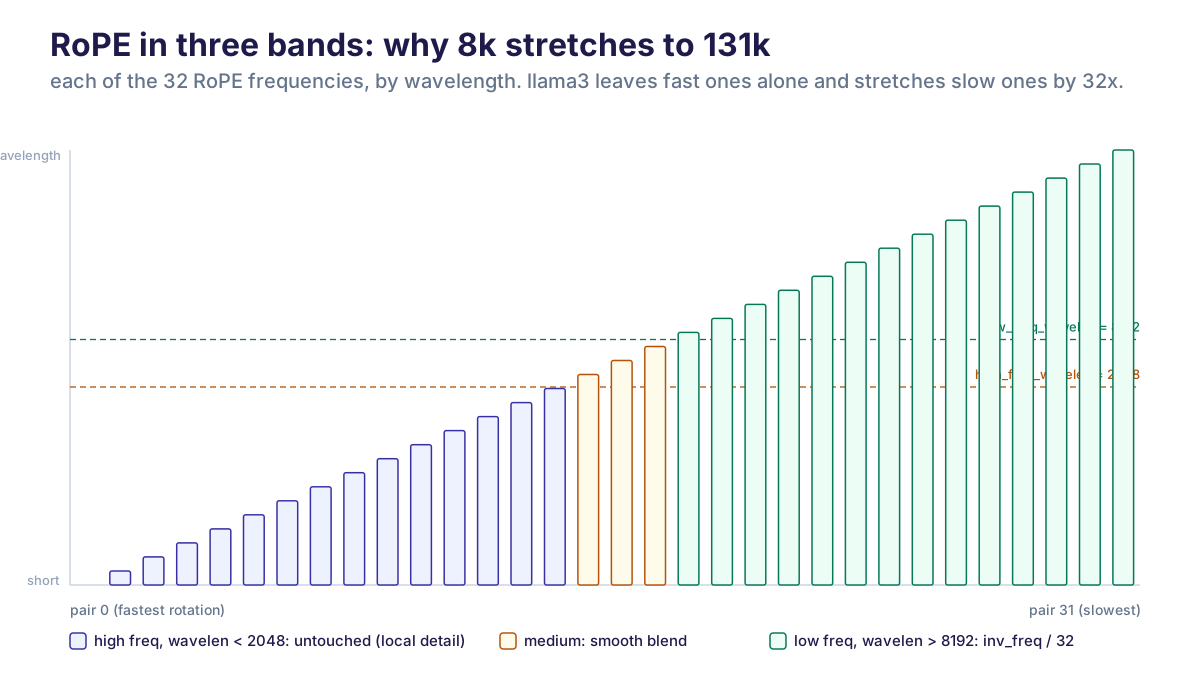
The Llama-3.2 wrinkle is the “llama3” frequency rescaling. Plain RoPE picks one frequency per pair, geometrically spaced. Llama leaves the fast (short wavelength, local) frequencies alone, divides the slow (long wavelength, global) ones by 32, and smoothly interpolates the band between, so an 8k-pretrained model addresses a 131k context without retraining. My test pins exactly that: pair 0 (fastest) is untouched, the slowest pair is divided by precisely factor.
The convention is the other trap. The cos/sin table is cat((freqs, freqs)) and rotate_half pairs dim i with dim i+32 (the GPT-NeoX layout HF uses), not the interleaved (x0, x1) pairing you would write from the paper. Get that backwards and short prompts still look plausible while every number is wrong. So one test feeds identical random q/k/cos/sin into my apply_rotary and transformers’ own apply_rotary_pos_emb and demands they agree: that isolates the convention from the weights entirely.
Best part: the match is not “within 1e-5”, it is bit-exact, 0.00e+00 on RMSNorm output, on the cos/sin table, and on inv_freq. That is the payoff of mirroring HF op-for-op in fp32 instead of writing my own clever version: there is no rounding to argue about, the bytes are identical.
Diagram
rope-frequency-bands.svg — the head_dim/2 RoPE frequencies, the three llama3 regimes (high freq untouched, medium smoothly interpolated, low freq divided by 32), and why that buys an 8k to 131k context stretch.
Tomorrow
Day 5: SwiGLU MLP in layers.py (gate, up, down; silu(gate) * up then down), verified within 1e-5 of the HF layer’s mlp hook. Short one, per the buffer rule, so I may start Day 6’s GQA attention if there is time.
Post angle: Day 4 of building an inference engine from scratch. Today: RoPE, the trick that tells attention where each token is. The idea that finally clicked is that position is a rotation, not a number you add. You spin each query and key by an angle set by its position, and because a dot product only sees the angle between two vectors, attention ends up depending on the distance between tokens, not their absolute spots. Relative position for free, no lookup table. Llama 3.2 adds one move on top: it leaves the fast local frequencies alone and stretches the slow global ones by 32x, which is the whole reason a model trained on 8k tokens can read 131k. I rebuilt it in about 40 lines and it matches Hugging Face to the bit, 0.00 difference, because I mirrored their math step for step instead of inventing my own. The unglamorous lesson under the cool one: most of “getting RoPE right” is getting the pairing convention right, and the only way you know is to put your output next to theirs and diff it.