Day 71: the split server grades its own passes before it serves
Date: 2026-09-29 · Week 14 · Phase 5 Benchmark and optimize
What I added today
Yesterday’s “Tomorrow” was a boot probe. Days 69 and 70 gave each pass of the split read its own entry point and its own test file, but on this box those files only reach the tlsim programs. The jitted _paged_attention_split_fwd and _split_reduce_fwd are gated tests that only run if somebody remembers to run pytest on a card. A server knows its device before it serves, so now it runs the check itself.
flash_decoding.py. Three additions:
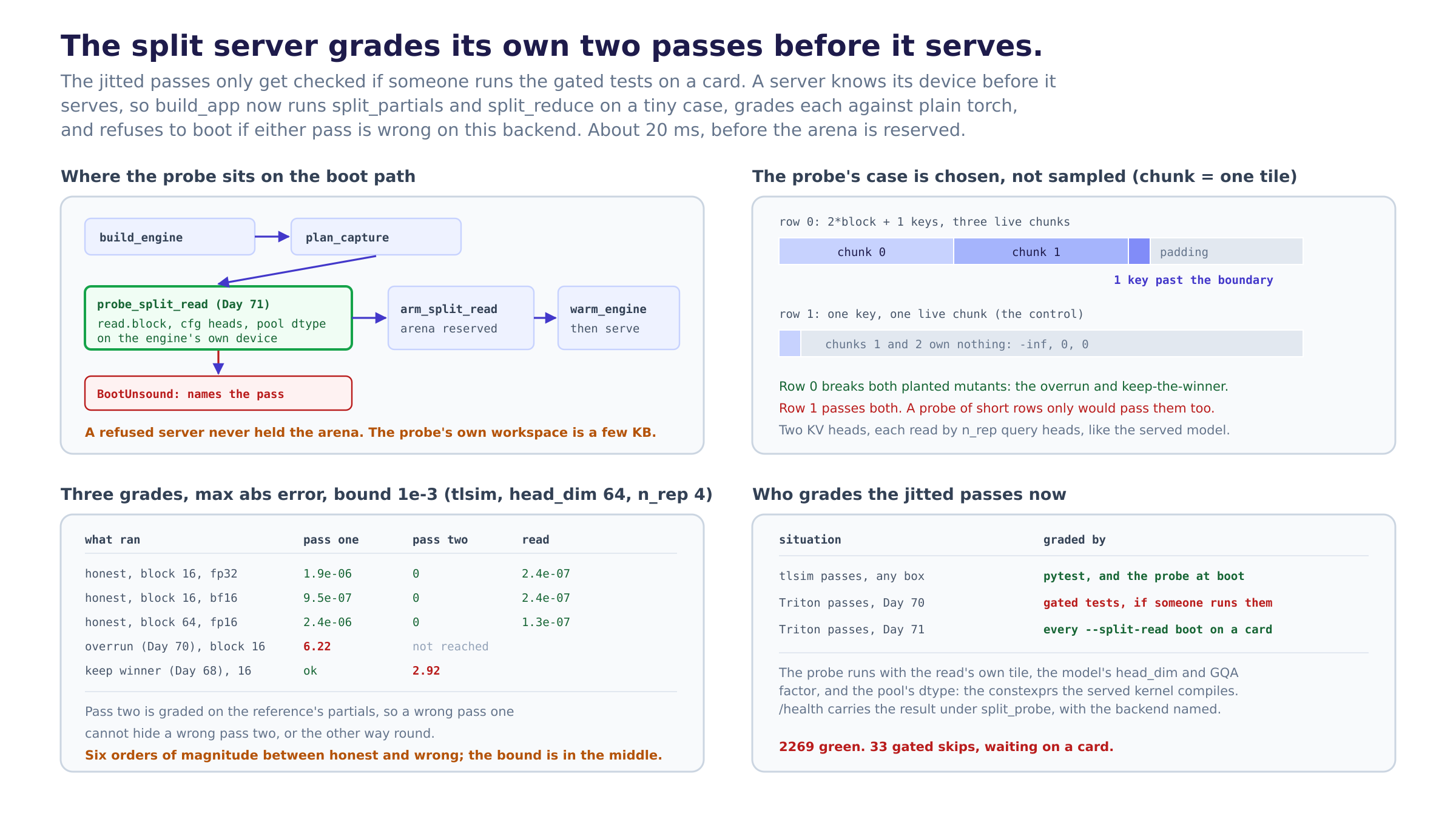
chunk_partials_referenceis Day 70’s test oracle moved into the module unchanged: loops over(row, head, split), a direct softmax over exactly the keys chunksowns, no launch. It deliberately shares no code with either pass one, so a bug in the tile walk or the online rescale would have to be written twice, in two different shapes, to get past it.probe_split_passes(device, block, head_dim, n_rep, dtype)builds a fixed case and grades three things in the order a failure should be blamed. Pass one:split_partialsagainst the reference, slot by slot. Pass two:split_reduceover the reference’s partials againstreduce_partialsover the same, so a broken pass one can’t hide a broken pass two, or the other way round. The read: both passes composed, against the fp32 attention over the whole row. It raisesSplitUnsoundnaming the pass, or returns aSplitProbewith the backend, geometry, live chunks per row and all three errors.PROBE_ATOL = 1e-3, the bound all three are held to.
The case is chosen, not sampled. Two rows over a three-tile mapping, with the chunk one tile wide. Row 0 holds 2 * block + 1 keys, so all three chunks are live and the last one owns exactly one key. Row 1 holds one key and is the control: every mutant this repo has planted is exact on it. Two KV heads, each read by n_rep query heads.
launch.py. probe_split_read(engine) runs the probe on the engine’s device, using the read’s own tile, the model’s head_dim and GQA factor, and the weights’ dtype. build_app calls it right before arm_split_read, so a failed probe is a BootUnsound and a refused server never reserved its arena. The report goes on app.state.split_probe and into /health as split_probe, and check_boot_info refuses a payload whose recorded probe is over its own bound.
tests/test_split_probe.py. 22 new tests run here and 2 more are GPU-gated. The mutants are Day 70’s overrun and Day 68’s keep-the-winner reduce, monkeypatched into the module where the probe looks them up, and each has to be refused by name. A third plants a 1e-2 nudge into one accumulator to show the bound is the number the report states. Suite 2269 green (33 GPU-gated skips), ruff clean.
The probe on the host (tlsim, head_dim 64, n_rep 4, max abs error, bound 1e-3):
what ran                    pass one   pass two     read    time
honest, block 4, fp32        9.5e-07          0   2.5e-07   22 ms
honest, block 16, fp32       1.9e-06          0   2.4e-07   15 ms
honest, block 16, bf16       9.5e-07          0   2.4e-07   16 ms
honest, block 64, fp16       2.4e-06          0   1.3e-07   19 ms
overrun, block 16               6.22          -         -   refused
keep winner, block 16             ok       2.92         -   refused
Why it matters
A test that only runs on request doesn’t run. The four gated tests from Days 69 and 70 are the only thing that grades the jitted passes, and the first card this project boots on will be a rented box where the first command is serve.py, not pytest. The probe moves the check into a place that runs every time: a --split-read server on a card now can’t serve without first showing that split_partials_triton and split_reduce_triton agree with plain torch on this device.
It grades the kernel that will actually serve, not a nearby one. BLOCK_N, HEAD_DIM and N_REP are constexpr in the jitted pass one, so each combination is a different compiled kernel. A probe run at head_dim=64 on a server whose model has head_dim=128 would test a specialisation that never launches in production. So the probe takes all four numbers from the engine rather than defaults.
Before the arena, not after. A refused boot that had already reserved its partials would hold device memory until the process exited. Putting the probe one line earlier costs nothing and means a failed server never holds the arena.
What I learned
- The control row matters as much as the long row. Both mutants this repo has planted are exact on a row with one live chunk, so a probe case built from “realistic” short prompts would pass both. The case needs one row that crosses two boundaries, and a test asserts the probe’s own
live_chunkshas a 3 and a 1 in it, the same “check the control first” pattern as Days 69 and 70. - Grading pass two on the reference’s partials separates blame. If pass two read pass one’s output, a wrong pass one would make pass two look wrong too, and the error message would point at the wrong kernel. Feeding it the reference’s workspace means each error names the pass that actually broke.
- The gap between honest and wrong is six orders of magnitude. Honest passes sit at 1e-6 because both sides upcast the same pool values and fold in fp32; the mutants are off by 2 to 6. That’s why a single absolute bound works across fp32, bf16 and fp16 pools. The whole-row reference also has to run in fp32: in bf16 it would be the least accurate number in the comparison.
- Monkeypatching needs a module-level lookup. The probe calls
split_partialsandsplit_reduceby their module names at call time, so a mutant planted on the module is the one that runs. Binding them as default arguments would have made the probe impossible to test against a planted bug.
Diagram
split-boot-probe.png. Top left: where the probe sits on the boot path, and the refusal it can raise. Top right: the probe’s two rows and which chunks each one makes live. Bottom left: the three grades, honest and under both mutants. Bottom right: who grades the jitted passes, before today and after.
Tomorrow
The probe says “correct” and nothing about “worth it”. The split read exists to shorten the longest program in a decode launch, and SplitPlan.wave_speedup predicts that from the tile counts. The next step is to time the probe-sized case both ways (paged_attention_split and the unsplit batched read) at boot and put the measured ratio in /health next to the prediction, so the first boot on a card also says whether the split pays for itself there.
The hardware caveat hasn’t changed: graphbench.py --weights ./weights --device cuda --rates 1,2,4,8 on all three arms, with prompts past 514 tokens, is still the first run to book. Today adds one thing to that list: read split_probe.backend off /health and confirm it says triton.
Post angle
Day 71 of building an LLM inference engine from scratch. My flash-decoding kernels have gated tests that only run if someone remembers to run pytest on a GPU. A server doesn’t need to remember. So a split-read server now runs both passes on a tiny case at boot, grades each against plain torch, and refuses to start if either is off. The case matters: one row crosses two chunk boundaries and one fits in a single chunk, because every bug I’ve planted is exact on the short row. Honest error is 1e-6, the bugs are off by 2 to 6, and it all takes 20 ms. vLLM and SGLang ship the split; I’m learning how to make it prove itself on the card it runs on. 2269 green.