Day 80: a row that lost is not a row that could not measure
Date: 2026-10-09 · Week 14 · Phase 5 Benchmark and optimize
What I added today
Day 79 got every toy smoke passing every claim but one, and pinned that one to its reason by reading the line under each FAIL. That made the log able to tell a noisy tail from a broken one. The CSV could not do the same. claims_failed carries notes, and “the tail did not get worse” is the same note whether the graphed p99 came out slower (a result) or there were no frame gaps to compare (no result at all).
The gates already say which is which, by the type they raise:
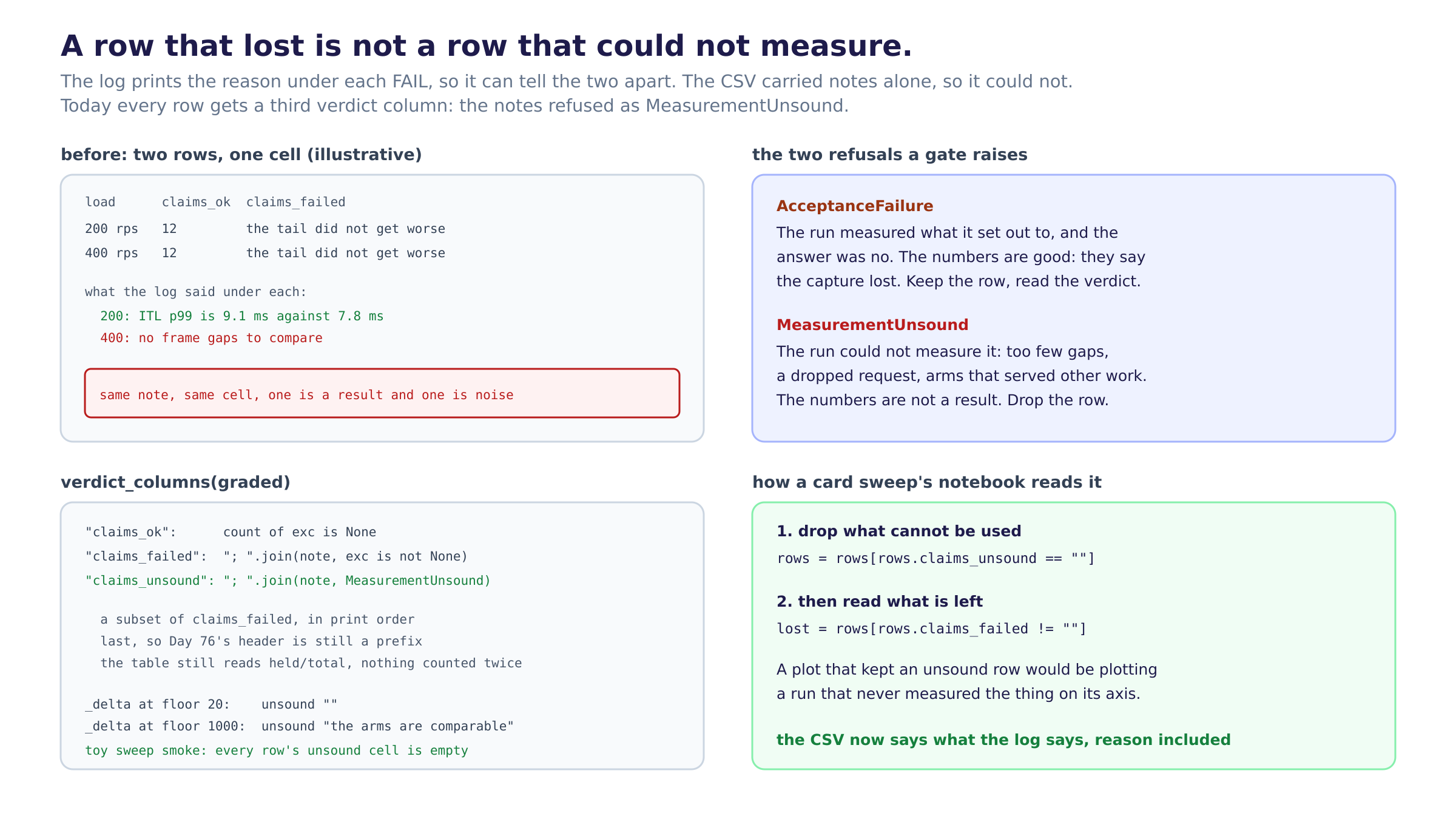
AcceptanceFailure: the run measured what it set out to and the answer was no. The numbers on the row are good, and they say the capture lost.MeasurementUnsound: the run could not measure it. Too few gaps, a dropped request, arms that served different work. The numbers on the row are not a result.
verdict_columns in graphbench.py now returns a third column, claims_unsound: the notes refused as MeasurementUnsound, in print order, joined with the same FAILED_SEP. It is a subset of claims_failed, so a notebook drops the rows where it is non-empty, then reads claims_failed on what is left. It goes last, so Day 76’s header is still a prefix of today’s.
tests/test_sweep_unsound.py has 9 pure tests: the column order, a clean row, a row that lost (failed, not unsound), a row that could not measure (both), order and separator, the subset property over the real claims, _delta at the default floor (three capture claims lose, nothing unsound), the same _delta under a floor of 1000 (the comparability gate is the one unsound note), and the table still counting held over total without counting an unsound note twice.
The toy sweep smoke’s header test now expects the three verdict columns at the end, and a new smoke test asserts every sweep row’s claims_unsound is empty: the one FAIL a toy smoke may print is an AcceptanceFailure, so every row it writes is usable.
Suite 2436 green (34 GPU-gated skips), ruff clean.
Why it matters
The CSV is the part that leaves the box without the log. Day 76 put the verdict on the row because a notebook reads the CSV, not stdout. A verdict that only says which gate refused, and not how, sends a plot two kinds of row under one label.
“Lost” and “could not measure” call for opposite actions. A row that lost is a finding: keep it, plot it, explain it. A row that could not measure is a rerun: drop it, fix the load, run again. Mixing them either hides a regression behind noise or plots noise as a regression.
The distinction was already in the code, one layer down. Day 42 split the two refusals into two exception types for exactly this reason. The row was the one place that flattened them back into a string.
What I learned
- A type is a column waiting to happen.
gradealready kept the exception, not just a bool. Keeping the richer value on Day 76 made today oneisinstance. - A subset column beats a per-note kind column. A “kind” column parallel to
claims_failedwould need a reader to zip two split strings. A subset reads as one filter, andclaims_unsound == ""is the whole question most readers ask. _delta’s capture claims are AcceptanceFailures, not Unsound. Its graphed arm has no capture, and that is a measured fact about the arm. I had half expected them to be unsound, and the test that checks it is now the record of why not.
Diagram
csv-unsound.png. Top left: two illustrative rows with the same note and the two different reasons the log printed under them. Top right: the two refusals and what each means for the row. Bottom left: verdict_columns with the new column. Bottom right: how a card sweep’s notebook reads the three columns.
Tomorrow
The verdict is complete on the row now: held, failed, and unusable. The next gap is on the reader’s side: there is still no code that loads one of these CSVs back. Next: a small read_sweep(path) that parses the three verdict columns into lists and refuses a CSV whose header is not a known prefix, so a card sweep’s notebook starts from the same parser the tests use.
The card run still comes first when hardware is booked.
Post angle
Day 80 of building an LLM inference engine from scratch. My benchmark CSV said “the tail did not get worse: FAIL” on two rows. One was a real slower p99. The other had no samples to compare at all. Same cell. Now a third column names the claims the run could not measure, so a notebook drops those rows before it plots anything. 2436 green.