Day 69: pass two got its own door
Date: 2026-09-25 · Week 14 · Phase 5 Benchmark and optimize
What I added today
Yesterday’s “Tomorrow” was a GPU-gated test that holds the jitted reduce, _split_reduce_fwd, equal to reduce_partials on rows that cross a chunk. Writing it hit a problem first: there was nothing to call. The reduce was only reachable from inside the read, so any test of it was a test of the read, and it only reached the reduce with rows long enough to fill two chunks. So today pass two got its own entry point on both backends, and the reads now go through it.
flash_decoding.py. Four functions:
check_reduce_workspaceis Day 64’scheck_partialswithout a launch to check against. The reduce’s grid is the workspace’s leading axes, so the accumulator’s[rows, n_q, splits, head_dim]is taken as the claim and the other two buffers are held to it. Contiguity, fp32 and the device are all still enforced, because pass two addresses the partials with the same flat(row * n_q + head) * splits + splitthat pass one used to store them.split_reduce_kernelis the tlsim pass two, moved out ofpaged_attention_split_kernelwithout changes. The read now calls it on views of its flat buffers, without_dtype=q.dtype.split_reduce_tritonlaunches_split_reduce_fwdby itself. It refuses host tensors with aValueErrorand a missing Triton with aRuntimeError, like every other jitted entry point.paged_attention_split_tritonnow calls it for its second pass.split_reducedispatches on where the partials live, since they are the only tensors pass two touches.
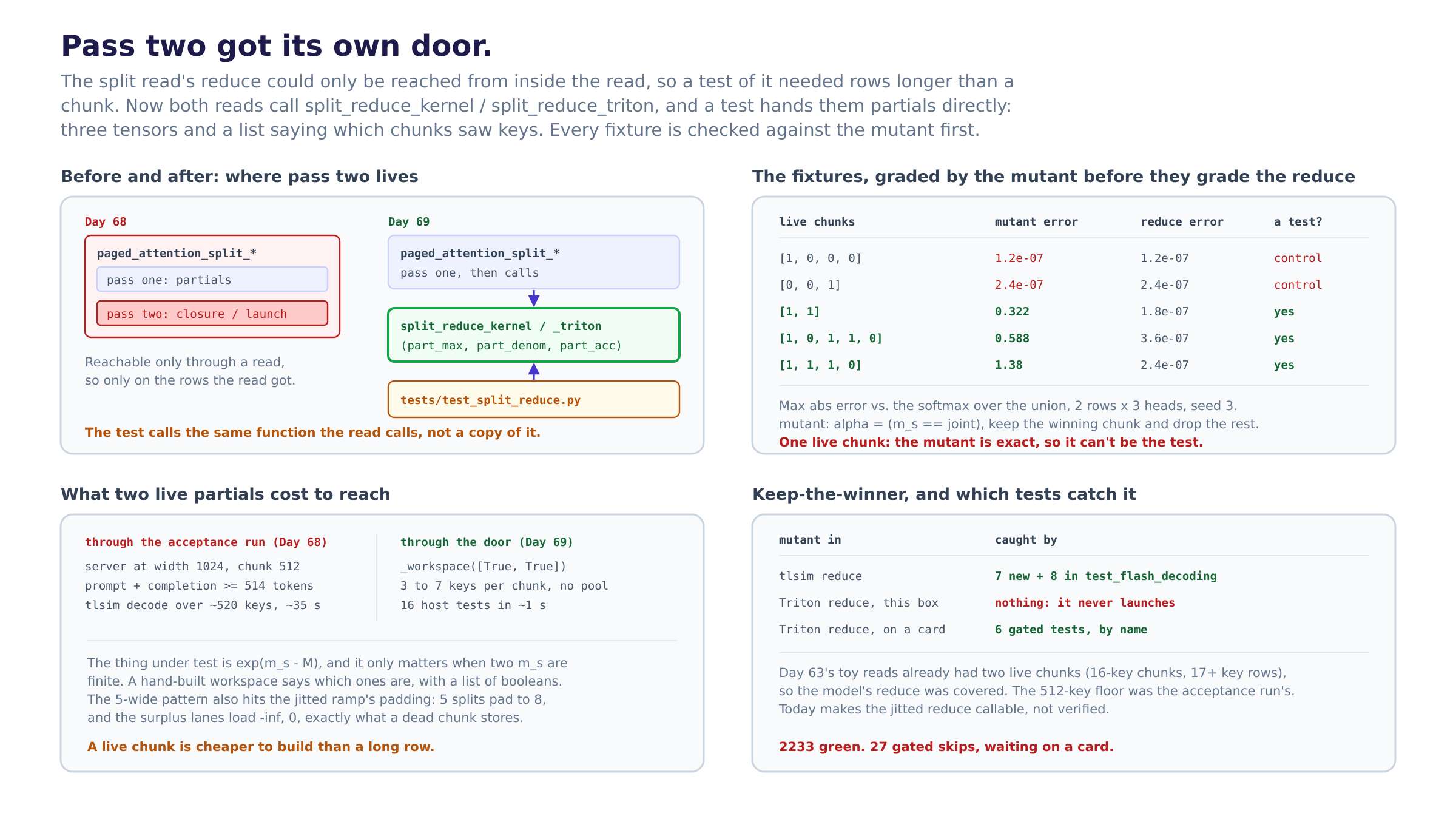
tests/test_split_reduce.py. A _workspace(live) fixture builds partials by hand. Each live chunk is the real partial softmax of its own random keys, and each dead chunk is -inf, 0, 0, so the right answer is the softmax over the union. The file also includes _keep_the_winner, Day 68’s mutant written as a function, and every fixture is checked against it before it’s used: a workspace with one live chunk is kept as a control that the mutant gets right, and the multi-live patterns are asserted to be ones it gets wrong. One test swaps the mutant in through the module and shows that the read breaks on a 40-key row split three ways but stays exact on a 3-key row. That proves the read calls this function, rather than assuming it.
16 new tests run here and 6 more are GPU-gated. Suite 2233 green (27 GPU-gated skips), ruff clean.
The fixtures, reduced two ways (seed 3, 2 rows x 3 heads, max abs error against the whole softmax):
live chunks        mutant error   reduce error
[1, 0, 0, 0]            1.2e-07        1.2e-07
[0, 0, 1]               2.4e-07        2.4e-07
[1, 1]                    0.322        1.8e-07
[1, 0, 1, 1, 0]           0.588        3.6e-07
[1, 1, 1, 0]               1.38        2.4e-07
With the mutant put into the tlsim reduce, 7 of the 16 new host tests fail. So do 8 of Day 63’s and Day 64’s in test_flash_decoding.py, which was news to me: see What I learned.
Why it matters
Yesterday’s lesson says the reduce needs more than one live chunk, and a live chunk is cheaper to build than a long row. Through the read, getting two live partials takes a row longer than one chunk, which at the serving partition means a 514-token request, a server at width 1024, and a tlsim decode loop over 520 keys. Handed a workspace directly, it takes three tensors and a list of booleans. The thing under test is alpha = exp(m_s - M), and it’s only exercised when two of the m_s are finite. _workspace([True, True]) is exactly that and nothing more.
The test is only worth something if the read calls the function it tests. Before today the tlsim reduce was a closure inside the read and the Triton reduce was a launch inside another function. A standalone copy written just for a test would be one more thing that can drift. So the read’s own second pass was moved out, both reads call it, and one test checks the wiring by putting the mutant in the module and watching the read go wrong.
The fixtures are graded before they grade anything. Day 68’s controls passed every earlier gate and failed only the new one. Here the fixture itself is the control: _discriminates asks whether the mutant gets it wrong, and the one-chunk workspace is kept around to show what a fixture that fails that check looks like. If someone later “simplifies” the fixtures down to one live chunk, those assertions fail before the reduce tests quietly stop meaning anything.
What I learned
- The tlsim reduce was already covered, and Day 68 undersold that. With the mutant in the model’s pass two, 8 tests in
test_flash_decoding.pyfail. They run the read at toy sizes:block=8, splits=3over a 40-key width makes 16-key chunks, so a 17-key row is already two live partials. The 512-key floor only exists at the default partition. What Day 68 found was true for the acceptance run, not for the kernel tests. The Triton reduce is still the gap, and today makes it callable, not verified. - A reduce needs no launch description, because its grid is its input. Pass one has to be told rows, heads, splits and head_dim, since it reads a pool. Pass two reads only the workspace, so all four numbers come off
part_acc.shape.check_reduce_workspaceischeck_partialswith the accumulator as the claim. - The empty chunk and the padding are the same case in both reduces, on purpose. The jitted ramp pads 5 splits to 8 and loads
-infand0into the surplus lanes, which is exactly what a dead chunk stores.[True, False, True, True, False]exercises both at once on a card: two dead chunks and three padding lanes, all folding to zero with no branch. - Some mutants live in the fixture, not the kernel. The first version of the “maxima far apart” test used
spread=30and asserted a gap over 60. The widest gap it produced was 59.6. The assertion caught that before any reduce ran, which is the reason it’s there: a test named “far apart” whose inputs weren’t far apart would pass for the wrong reason.
Diagram
split-reduce-door.png. Top left: before and after, the reduce as a closure inside the read, then as its own entry point both reads call. Top right: the five fixtures, with the mutant’s error next to the reduce’s. Bottom left: what reaching two live partials costs through the read and through the door. Bottom right: which mutant is caught where, today and on a card.
Tomorrow
The same move for pass one. _paged_attention_split_fwd can only be reached through the read too, and its contract is simpler to state than the reduce’s: it takes a pool, a mapping and one chunk, and returns that chunk’s (m, denom, acc). That’s what the model’s split_kernel closure already computes. Lifting it into split_partials_kernel gives the jitted pass one a named target to be held to on a card, with a test that feeds it one chunk of a row and compares against a direct softmax over those keys.
The hardware caveat hasn’t changed: graphbench.py --weights ./weights --device cuda --rates 1,2,4,8 on all three arms, with prompts past 514 tokens, is still the first run to book. Today adds pytest tests/test_split_reduce.py to the list that has to go green on the first card before any number from it counts.
Post angle
Day 69 of building an LLM inference engine from scratch. Yesterday a broken merge in my flash-decoding kernel passed every test, because the tests never produced two live chunks for it to merge. Today I gave the merge its own entry point. It takes the per-chunk (max, denominator, accumulator) directly, so a test can say “chunks 0, 2 and 3 saw keys” with a list of booleans instead of a 514-token prompt. Each fixture is first checked against the broken merge: if the mutant gets it right, it isn’t a test. One-chunk workspaces: mutant error 1e-7. Two or more live chunks: 0.3 to 1.4. vLLM and SGLang run this same two-pass split for long contexts. The part I’m learning by building it is how to test the second pass on its own. 2233 green.