Day 06: GQA attention, the one sublayer that mixes tokens
Date: 2026-06-21 · Week 1 · Phase 0 Foundations
What I added today
src/nanoserve/layers.py: gqa_attention, the single-block prefill attention (Q/K/V projections, RoPE on q and k, the KV-head repeat, a causal mask, softmax, and o_proj), plus the repeat_kv helper. Five new tests in tests/test_layers.py: three pure-math (the contiguous KV repeat, a full attention recompute via an independent path, and a causality trap) and one gated against the real Llama-3.2-1B self_attn hook to 1e-5. Full suite is 41 green.
Why it matters
A transformer block has two sublayers. The MLP (Day 5) transforms each token on its own; attention is the only place where tokens look at each other. With attention done, all four computed pieces of a block exist (RMSNorm, RoPE, SwiGLU, attention), and tomorrow they assemble into one verified block. This is also the sublayer the rest of the project is really about: the KV cache, continuous batching, and the paged-attention kernel all exist to make this one operation cheap at serving time.
What I learned
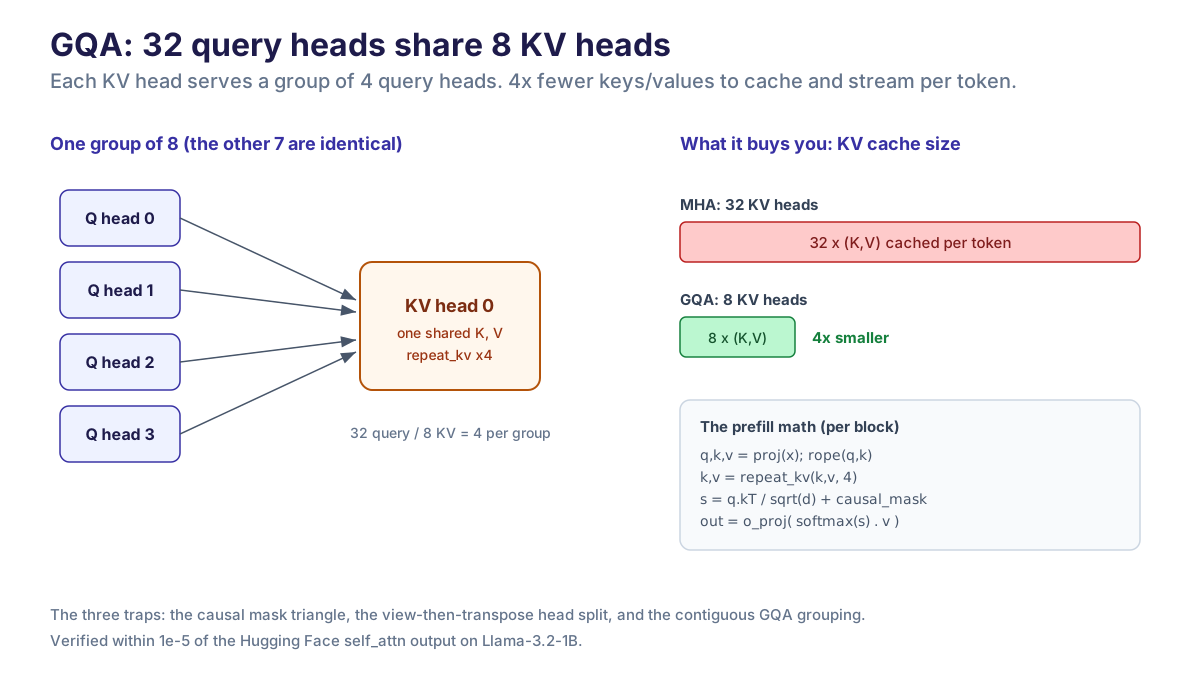
Grouped-query attention is a memory decision wearing a math costume. Plain multi-head attention gives every query head its own key and value head; the problem is that at serving time you cache K and V for every past token, so the cache grows with the number of KV heads. Llama-3.2-1B keeps 32 query heads but only 8 KV heads, and shares each KV head across a group of 4 query heads. The attention math is unchanged; you just store and stream 4x fewer keys and values. That single ratio is why the rest of this engine (the paged cache, the kernel) is even tractable, so it was worth getting the grouping exactly right.
The way GQA actually runs is almost an anticlimax: you project k and v as 8 heads, then repeat_kv expands them back to 32 right before the scores, so the score matmul is plain 32-head attention again. The only thing that matters is which query heads share a KV head. They must be contiguous: query heads 0-3 share KV head 0, 4-7 share KV head 1, and so on. The expand-then-reshape in repeat_kv (insert a length-4 axis next to the head axis, then fold it in) produces exactly that grouping; a stray tile/repeat would interleave the heads and the model would still run while quietly attending with the wrong keys. So the first test builds two KV heads with distinguishable values and asserts head 0 lands in output slots 0-2 and head 1 in 3-5.
The three classic mismatch suspects all showed up as things to be careful about:
- The causal mask. Add a
-infupper triangle (diagonal=1) to the scores before softmax so position i never sees a later token. The diagonal stays unmasked, so no row is ever entirely-infand softmax never returns NaN. I wrote a dedicated trap for this: perturb only the last token’s input, and every earlier output row must be bit-identical. A flipped triangle or a missing mask fails it loudly. - The head reshape. It has to be view-to-
[b, seq, heads, d]then transpose to[b, heads, seq, d]. A bare reshape straight to[b, heads, seq, d]interleaves positions and heads and silently corrupts everything downstream. - The GQA repeat itself, above.
For the pure-math equivalence test I recomputed attention by an independent path (repeat_interleave for the KV repeat instead of the production expand+reshape, identity RoPE so the rotary convention stays out of it) and matched to 1e-6. Then the real test: feed the layer’s true input (the input_layernorm output) through gqa_attention with the loader’s q/k/v/o weights and our own RoPE table, and compare to the HF self_attn output. 1e-5 on the first run. The softmax-in-fp32 detail (HF upcasts even in a low-precision model, then casts back) is a no-op in this fp32 pipeline but I mirrored it so the bf16 path matches later without surprises.
Diagram
gqa-attention.svg — one group of 4 query heads feeding a single shared KV head, the 32-vs-8 KV-cache size comparison (the 4x saving), and the five-line prefill math, with the three traps called out.
Tomorrow
Day 7, the Week 1 done line: assemble the full transformer block in layers.py / model.py (attn_norm, attention, residual, mlp_norm, SwiGLU, residual) on the real loaded weights, and verify the whole block output within 1e-5 of HF model.layers[0]. Then a Week 1 recap: the map, the weights, the four pieces, the block.
Post angle: Day 6 of building an inference engine from scratch. Today: attention, the one part of a transformer block where tokens actually look at each other. Modern models use a memory trick called grouped-query attention. Plain attention gives every one of the 32 query heads its own key and value, and at serving time you have to cache a key and value for every token you have seen, so that cache balloons. Llama-3.2-1B keeps the 32 query heads but only 8 key/value heads, and lets each key/value head be shared by a group of 4 query heads. The math you run is identical (you just copy each shared head back up to 32 right before the scores), but you store and stream 4x fewer keys and values. That one ratio is the reason a KV cache is affordable at all, which is the whole rest of this project. The part to get right is not the math, it is the bookkeeping: which query heads share a head, that the causal mask actually stops a token from seeing the future, and that splitting the projection into heads does not scramble positions and heads together. It matches Hugging Face to 1e-5, and I wrote a test that pokes a future token and demands every earlier output stay frozen, to prove the mask really is causal.