Day 38: how many blocks fit
Date: 2026-08-18 · Week 10 · Phase 4 Serving layer
What I added today
src/nanoserve/launch.py and serve.py. Day 37 built a bridge and an app that both take their engine and their tokenizer by injection, which is why neither has ever met Llama-3.2-1B. The launcher is the thing that does: read the config, put the weights on the device, size the block pool against what the card has left, build the HF tokenizer, hand the three to create_app, and run it under uvicorn. tests/test_launch.py (33 tests) covers all of it without ./weights and without a GPU, because the memory probe and the peak allocator stats are injected and the sizing is arithmetic over a config. Suite 598 green (5 GPU-gated skips), ruff clean. server.py’s third and last TODO is closed.
It runs. On CPU, fp32, 2 slots, a 64 MiB pool, the real Llama-3.2-1B loads in 4.5s and POST /v1/completions with "The capital of France is" comes back in 4.6s with " Paris. It is the most populous city in France and the". That is the first time in 38 days that a socket has talked to this engine and gotten English out.
The interesting half is one question with a number for an answer: how many blocks fit? Every day until now took num_blocks as an argument and believed it. Every test, every benchmark, every fixture picked whatever made the scenario work. A launcher does not get to do that.
Why it matters
A block’s size is arithmetic over the config, and GQA is a factor of four in it. A block holds block_size tokens of K and V, for every layer, for every KV head:
2 * num_hidden_layers * block_size * num_key_value_heads * head_dim * itemsize
For Llama-3.2-1B at block_size 16 in bf16 that is exactly 512 KiB, which makes everything downstream readable: a gibibyte of KV is 2048 blocks, and 2048 blocks is 32768 tokens. Write num_attention_heads there instead and a block is 2 MiB, the pool comes out a quarter the size the card could hold, and nothing raises. The server is correct, four times less concurrent, and preempts under a load it should have absorbed. Week 5 built GQA because 8 KV heads is 4x less cache than 32; this one line is where that saving is either taken or thrown away.
The budget is what is free after the weights land, minus what a forward will transiently want. Two subtractions, and only one of them is obvious:
budget = free_after_load - (1 - utilization) * total - activation_bytes
The order matters more than the formula. free is asked of the driver after the model is on the card, which means the weights, the CUDA context, the allocator’s fragmentation and any co-tenant process are already subtracted by something that knows the real numbers. Sizing first and subtracting an estimate of the weights would be remodelling all of that badly. utilization is vLLM’s gpu_memory_utilization and it is multiplied by total, not by free, on purpose: it is a promise about the whole device, so a co-tenant comes out of your budget rather than out of your safety margin, which is the conservative direction.
activation_bytes is the term people leave out, and on this model it is not small. Measured by a profile run at the largest shape the scheduler can produce (which is what vLLM does) or estimated on paper for a box with no CUDA:
| the reserve at 8 x 2048, bf16 | bytes | what it is |
|---|---|---|
| logits | 3.91 GiB | [batch, len, vocab], all 128256 of it, every position |
| scores | 2.00 GiB | [batch, heads, len, len], quadratic in the prompt |
| swiglu | 0.75 GiB | gate, up and their product, all three live at once |
| total | 6.66 GiB | against 2.30 GiB of weights |
The transient beats the weights by 2.9x, and 59% of it is a tensor the engine throws away: LlamaModel.forward returns logits for every position so a prefill can be diffed against HF token for token, and last_token_logits reads one row per sequence. Returning only the last row would take the reserve from 6.66 GiB to 2.75 and the pool from 24,645 blocks to 32,657, a 33% larger cache for a slicing change. That is a Week 13 optimization with a number on it now.
Both knobs are memory limits, not just admission limits. On a 24 GiB card:
| slots x length | reserve | KV pool | blocks | requests at that length |
|---|---|---|---|---|
| 4 x 2048 | 3.33 GiB | 15.37 GiB | 31,469 | 245 |
| 8 x 2048 | 6.66 GiB | 12.03 GiB | 24,645 | 192 |
| 16 x 2048 | 13.33 GiB | 5.37 GiB | 10,997 | 85 |
| 8 x 4096 | 17.33 GiB | 1.37 GiB | 2,805 | 10 |
Doubling the served length doubles the KV each request wants and quadruples the score rectangle it is reserved against, so the pool collapses 8.8x and the number of full-length requests that fit goes from 192 to 10. --max-batch-size and --max-model-len look like policy and are spending the same bytes.
A pool that cannot hold one request is a server that refuses everything. Day 33’s Scheduler.add_request rejects any request whose worst case exceeds the whole pool, because FIFO admission would otherwise park behind it forever. So a pool sized under blocks_for_length(max_model_len) produces a process whose /health says ok and whose every completion is a 400. plan_kv_pool refuses to boot there and names the length it could have served, so the flag to change is in the failure.
What I learned
{k: v.to(device) for k, v in weights.items()}breaks the tie, and the only symptom is a smaller pool. Llama-3.2-1B ships nolm_head.weight; Day 3’s loader aliases it toembed_tokens.weight, one storage under two names. The obvious dict comprehension calls.toonce per name, so the tie lands on the card as two independent copies. That is 501 MiB of duplicated embedding, which at 512 KiB a block is 1002 blocks and 16,032 tokens of KV pool spent on a matrix that was already there. Nothing detects it: the model is correct, the logits are identical to the last bit, the server is just quietly less concurrent.place_weightskeys on storage so a shared one moves once.max_memory_allocatedis a high-water mark, not a delta. Reading it after the profile forward charges the activation reserve for the resident weights too, which subtracts them twice: once by the driver infree, once by me. Reset, read the level, run, read the peak, subtract. On this model that mistake is 2.30 GiB, 4,714 blocks, and it is invisible because a too-small pool never fails, it just preempts.max_model_lenis a serving decision that looks like a model property. The config says 131072, and a pool that can hold one such request is 8192 blocks and 4 GiB before a second caller exists. So it is a flag, clamped tomax_position_embeddings(which is the half that really is a model property: more context than the weights were trained for is not a memory question and cannot be bought). The plan reportsconcurrency_at_max_lendeliberately unclamped by the slot count, because the useful thing is knowing which of the two limits binds first. At 8 x 2048 it is the slots, and Day 33’s preemption is not what sheds load. At 8 x 4096 it is the pool, and preemption is the whole story.- The profile run happens with no cache, and that is right rather than a compromise. The pool it is sizing does not exist yet, so the dummy forward goes down the Week-2 recompute path. Same score rectangle, same MLP rectangles, same logits, because a prefill attends over exactly its own context whether it reads it from a cache or recomputes it. What it misses is the cache write, which is a scatter into the pool being sized and allocates nothing new.
- A CPU launch has no VRAM to divide, so it has to say so. There is no per-device free-memory number on CPU and taking a fraction of system RAM is a promise the allocator cannot keep.
kv_budget_bytesraises instead of guessing and names the flag (kv_cache_bytes) that answers it, which also happens to be why the whole sizing path is testable on this box.
Diagram
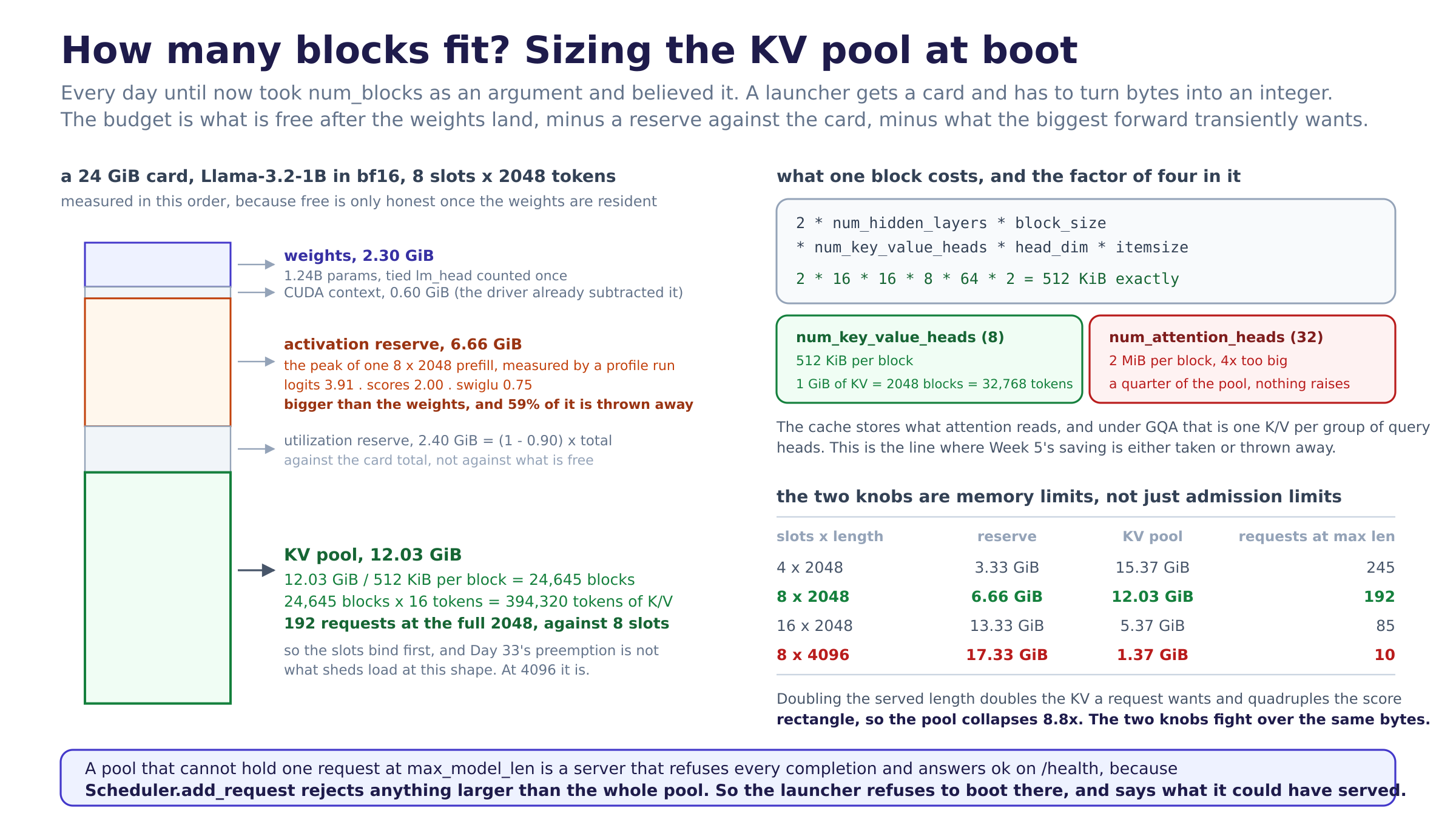
kv-pool-sizing.png. Left is a 24 GiB card drawn as a stack in the order the launcher subtracts it: weights, CUDA context, the activation reserve, the utilization reserve, and the KV pool that is what is left, with the division into blocks and tokens spelled out. Right top is the bytes-per-block formula with the GQA trap next to it, 512 KiB against 2 MiB. Right bottom is the slots-by-length sweep and the 8.8x collapse. The banner is the floor rule: a pool under one request’s worth is a server that answers ok on /health and 400 to everybody.
Tomorrow
Day 39 opens Week 11 with the thing the bridge was already shaped for: streaming. stream=true is currently a 400 that says “Week 11”, and the change it needs is one future becoming one queue, plus an SSE response that yields data: frames in OpenAI’s chunk shape and a [DONE] sentinel. The gotchas are detokenization (Llama’s BPE emits multi-byte characters across token boundaries, so a naive per-token decode prints replacement characters) and the disconnect path, which already works for the unary case and has to keep working when the cancellation arrives mid-stream rather than mid-await.
Post angle
Day 38 of building an LLM inference engine from scratch. Today the engine got a launcher, so for the first time an HTTP request reached the real Llama-3.2-1B and came back with English. The whole day is one question: how many KV blocks fit? Every day until now took num_blocks as an argument and believed whatever number made the test pass. A launcher does not get to. First: a block costs 2 * layers * block_size * num_key_value_heads * head_dim * itemsize, which for Llama-3.2-1B at block_size 16 in bf16 is exactly 512 KiB. Use num_attention_heads there and you get 2 MiB, a pool a quarter the size the card could hold, and no error anywhere. That single line is where GQA’s saving is taken or thrown away. Second, and this is the part I got wrong first: the budget is not “card minus weights”. It is what the driver reports free after the weights are resident, minus a reserve against the card total, minus what the biggest forward transiently wants. That last term is huge. At 8 requests x 2048 tokens this model wants 6.66 GiB of activations against 2.30 GiB of weights, and 3.91 GiB of that is the [batch, len, vocab] logits rectangle, which the engine reads exactly one row of per sequence. Returning only the last row would grow the pool 33%, from 24,645 blocks to 32,657. Third: --max-batch-size and --max-model-len look like admission policy and are actually spending the same bytes. Going from 8x2048 to 8x4096 takes the pool from 12.03 GiB to 1.37, because doubling the length doubles the KV per request and quadruples the score rectangle it is reserved against. And the one that would have bitten me silently: moving the weights with {k: v.to(device) for k, v in weights.items()} calls .to twice on the tied lm_head/embed_tokens tensor and puts two copies on the card. 501 MiB, 1002 blocks, 16,032 tokens of cache, spent on a matrix you already had, with identical logits and no error. vLLM’s profile run is where I stole the measurement idea from. 598 green.