Day 82: the sweep’s numbers come back as numbers
Date: 2026-10-11 · Week 14 · Phase 5 Benchmark and optimize
What I added today
Day 81 gave a sweep CSV one parser, read_sweep, and typed the verdict on the way back. Everything else in the row still came back as the string the file held, so the first cell of a card notebook would have been a cleaning step: float on every _ms column, int on the counts, and a guess about what an empty split cell means.
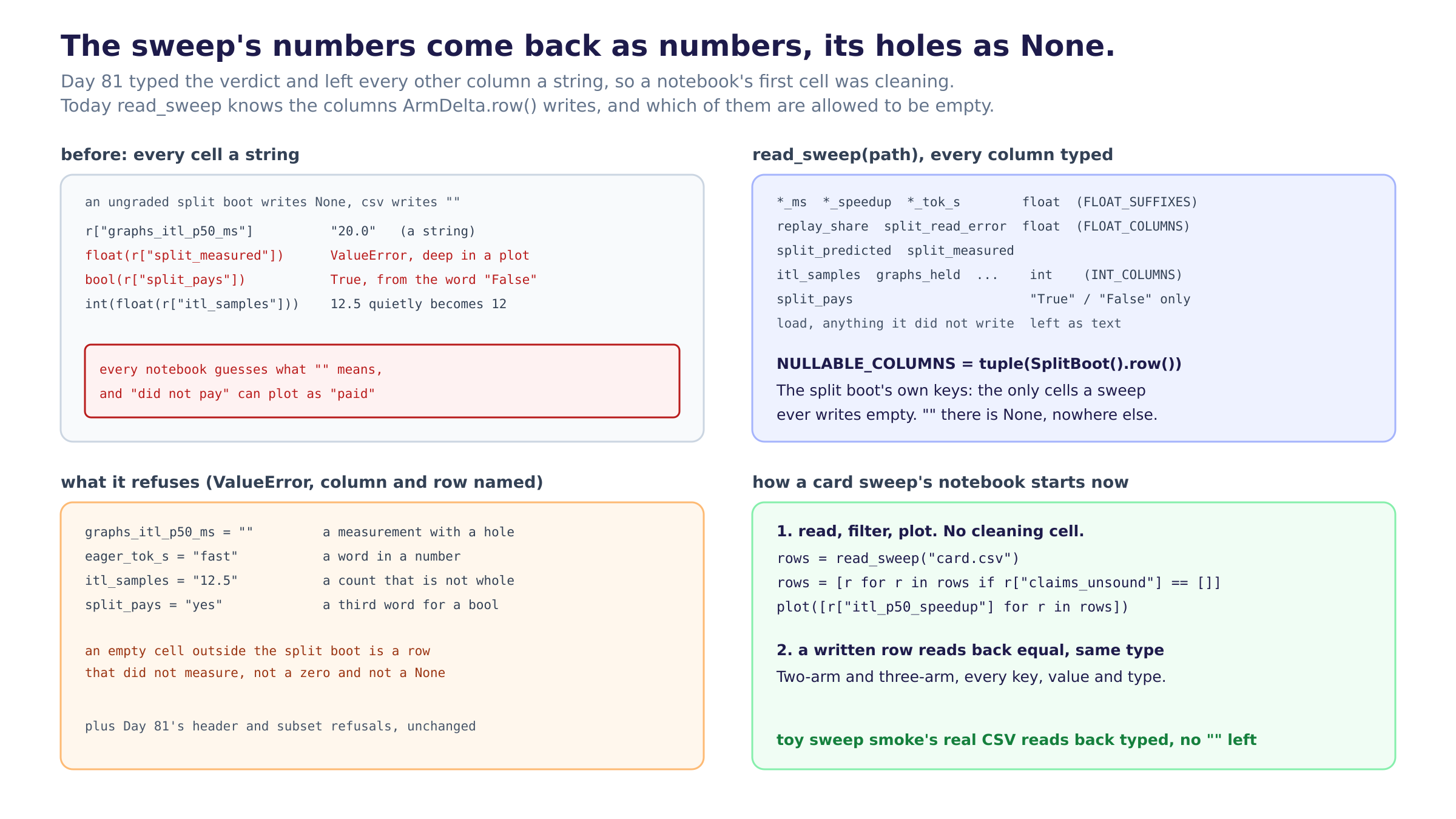
read_sweep now knows the columns ArmDelta.row() writes:
- Measurements are floats. A suffix rule,
FLOAT_SUFFIXES(_ms,_speedup,_tok_s), so a new latency column is typed the day it is added, plusFLOAT_COLUMNSfor the four that do not follow it:replay_shareand the split boot’ssplit_read_error,split_predicted,split_measured. - Counts are ints.
INT_COLUMNS:itl_samples,graphs_held,recorded_while_serving.12.5in one is refused, not rounded. split_paysis a bool, read from the two wordscsvwrites for one, and any third word is refused.- Only the split boot’s cells may be empty.
NULLABLE_COLUMNSistuple(SplitBoot().row()), the key set of an ungraded boot, so it cannot drift from the writer. An empty cell there isNone. An empty cell anywhere else is a measurement that is missing, and it is aValueErrornaming the column and the row. - Anything else is left alone.
load, and any column this code did not write.
The conversion lives in one helper, _typed(name, cell, where), and the verdict columns keep Day 81’s handling.
tests/test_read_sweep_numbers.py has 14 pure tests: the nullable set is the split boot’s own keys, a written two-arm and three-arm row read back equal in value and in type for every key, measurements are floats and counts ints, an ungraded boot gives five Nones, a graded untimed boot keeps its grade and nulls its clock, split_pays reads True, False and "" correctly and refuses "yes", and a hole, a word, and a fractional count are each refused by column name. One Day 81 test changed its expectation from "1.5" to 1.5, which is the point of the day.
The toy sweep smoke gets one more test: its real three-arm CSV reads back with float latencies and ratios, an int sample count, and no split boot cell left as "".
Suite 2466 green (34 GPU-gated skips), ruff clean.
Why it matters
bool("False") is True. The split boot’s split_pays is the one column on the row that says whether the split read earned its keep, and the obvious way to read it back gets it wrong on exactly the rows where the answer is no. Typing it in the parser means a notebook cannot plot “did not pay” as “paid”.
An empty cell has two meanings, and only the writer knows which. In the split boot columns it means “this boot graded nothing”, which is a fact about the arm. In graphs_itl_p50_ms it means the file is broken. A notebook guessing would treat them the same. The parser does not guess, because the set of columns allowed to be empty is derived from the code that writes them empty.
Errors belong where the file is read. float("") raised inside a plotting call is a stack trace about matplotlib. Raised in read_sweep, it is a sentence naming the file, the row, and the column.
What I learned
- Derive the schema from the writer when you can.
NULLABLE_COLUMNSis not a list I typed, it isSplitBoot().row()’s keys. The day the boot grows a column, the parser already knows it may be empty. - A suffix rule is a convention made load-bearing. Every latency column already ended in
_ms. Leaning on that means the convention now has a test behind it, and a column that breaks it comes back as text where someone will notice. - Round-trip equality must check the type too.
1 == 1.0in Python, so a test that only compares values would pass withgraphs_heldread back as a float. The round-trip test assertstype(row[k]) is type(written[k])for every key.
Diagram
read-sweep-numbers.png. Top left: the string cells and the three ways reading them by hand goes wrong. Top right: the column families and NULLABLE_COLUMNS. Bottom left: the four cells it refuses. Bottom right: a card notebook that goes from file to plot with no cleaning cell.
Tomorrow
The parser now gives back typed rows, and print_table still reads the raw row the script built, splitting claims_failed on the separator by hand. Next: let print_table take what read_sweep returns, and add a --table <csv> mode to graphbench.py that reprints an old sweep’s table from its file, so a card run can be looked at again without being run again.
The card run still comes first when hardware is booked.
Post angle
Day 82 of building an LLM inference engine from scratch. My benchmark CSV came back as strings. An ungraded split arm writes None, csv writes that as “”, and then bool("False") is True: the row that says a kernel did not pay plots as paid. Now the parser types every column, and only the columns the writer can leave empty may be None. 2466 green.