Day 39: the stream, and the token that is half a character
Date: 2026-08-19 · Week 11 · Phase 4 Serving layer
What I added today
src/nanoserve/detokenizer.py, AsyncEngine.stream in serving.py, and the SSE half of POST /v1/completions in server.py. stream=true was a 400 that said “Week 11”; this is Week 11. tests/test_detokenizer.py (25 tests) and tests/test_stream.py (31) are the new files, and Day 37’s test_streaming_is_refused_rather_than_silently_batched became test_streaming_is_no_longer_refused. Suite 654 green (5 GPU-gated skips), ruff clean.
It streams. Against the real Llama-3.2-1B on CPU, fp32, a 128-block pool:
[ 1.568s] ' Paris'      [ 2.132s] ' It'      [ 3.259s] ' populous'
[ 1.848s] '.'           [ 2.413s] ' is'      [ 5.792s] '' finish=length
...                                          [ 5.793s] data: [DONE]
Same sixteen tokens the unary endpoint returns for the same prompt, and the first one is readable at 1.568s instead of at 5.793s. Nothing about the engine changed to get that: streaming is a delivery schedule, not a different model. Which is the property the whole test file exists to hold down, because the moment streaming changes a token it has stopped being a delivery decision.
The day has two halves and only one of them is the queue.
Why it matters
One future becomes one queue, and it must not have a bound. The loop already had the right shape: _settle walks the live requests at every iteration boundary and hands each finished one to its own caller. Streaming adds one line to it, waiter.deliver(), which pushes whatever output tokens this request has emitted since the last look. Everything hard about the bridge (the inbox, the single-writer rule, the per-request error routing) is unchanged and paid for.
The one new design call is the queue’s depth, and it is unbounded on purpose. A bounded queue is backpressure, and backpressure on a stream is backpressure on everybody: there is no way to pause one row of a batch, so a slow reader would become the pace of a forward pass that a dozen other requests are rows of. The tokens wait in memory instead, which is a few bytes per token for a request that is already holding blocks. The test for this reads nothing until the engine has parked, then drains, and asserts nothing was lost.
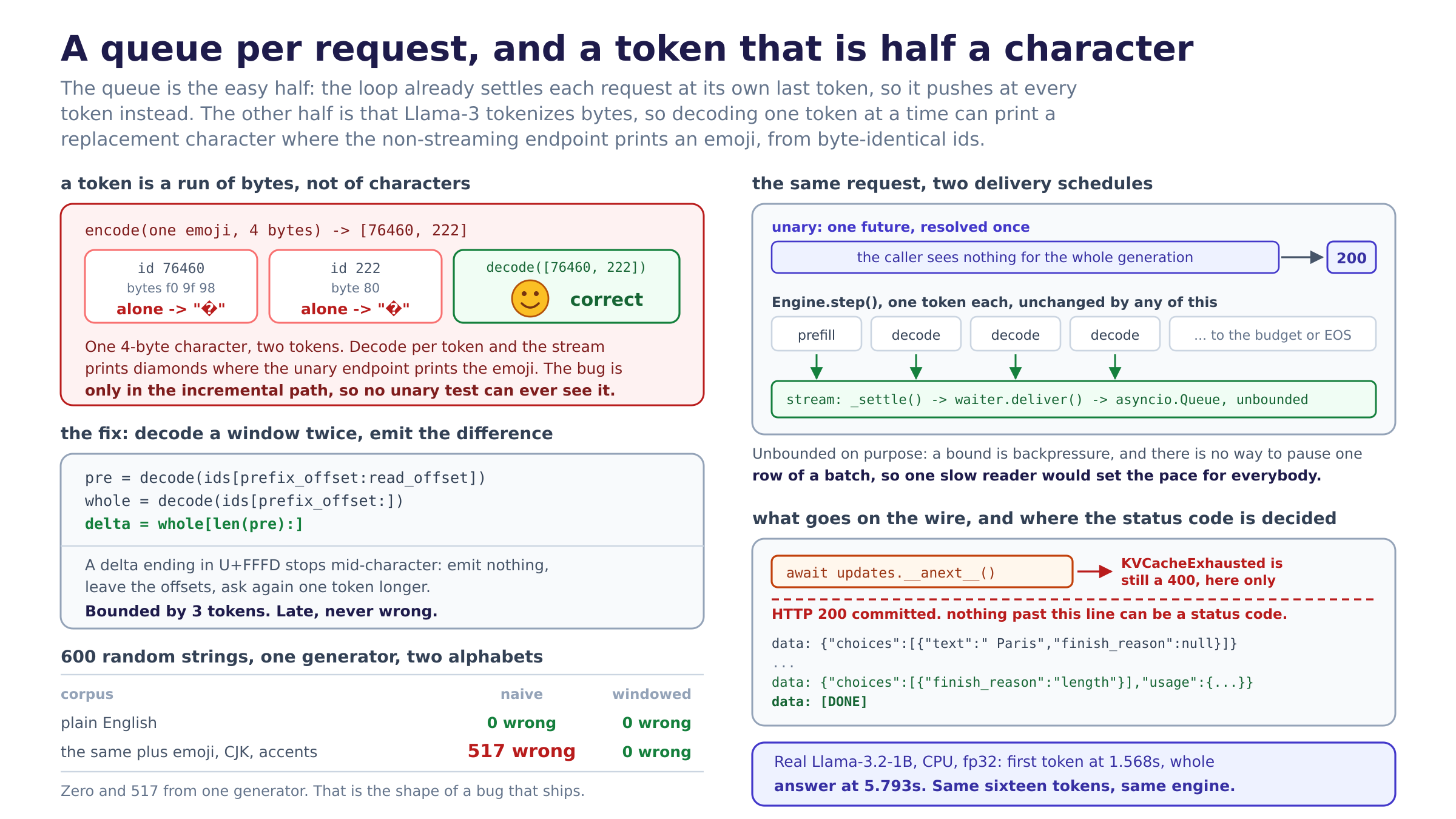
A token is a run of bytes, not a run of characters, and this is where a naive stream lies. Llama-3’s tokenizer is byte-level BPE. The vocabulary is built over the 256 byte values and a merge never checks whether the run it just made ends on a UTF-8 boundary, so a 4-byte emoji is routinely two tokens:
"\U0001f600"  ->  [76460, 222]
decode([76460]) = "�"      decode([222]) = "�"
decode([76460, 222]) = "\U0001f600"
Decode per token and the stream prints two black diamonds where the model wrote one emoji, while /v1/completions prints the emoji, from the same ids. The bug lives entirely in the incremental path, so no amount of unary testing finds it, and it is invisible until it isn’t:
| 600 random strings over | naive per-token decode wrong | incremental wrong |
|---|---|---|
| plain English | 0 | 0 |
| the same plus emoji, CJK, accents | 517 | 0 |
Zero and 517 out of the same generator with a different alphabet. That is the shape of a bug that ships.
The fix is to never decode a token alone. Keep the ids, decode a small window of them twice, and emit the difference:
pre   = decode(ids[prefix_offset:read_offset])
whole = decode(ids[prefix_offset:])
delta = whole[len(pre):]
Two decodes of a handful of ids per token, against a forward pass measured in tens of milliseconds. It is free. What it buys is that the decoder always sees the bytes on both sides of every boundary it is asked about, which is the only way it can tell a character from the front of one. And then the hold-back: a window that ends mid-character still decodes to a trailing U+FFFD, so a delta ending in one is not emitted at all and the offsets do not move. The cost of that is bounded by 3 tokens, because UTF-8 is at most 4 bytes and a token carries at least one. Late, never wrong, and never more than three tokens late. vLLM’s detokenize_incrementally is this, with the same two offsets and the same U+FFFD test.
A stream chooses its status code before it has an answer. This is the one thing about SSE that changes the shape of a handler. A response’s status line goes out with its first byte, so the instant the first frame is written the server has committed to a 200 and every later failure has to be reported inside a body that already claims success. So the handler pulls the first update from the bridge before it constructs the StreamingResponse. That costs nothing (the first update is the first token, so the headers leave when the caller had something to read anyway) and it keeps “this prompt can never fit the pool” a 400 instead of an error frame buried in a 200. What is left after that becomes data: {"error": ...} and then [DONE], because the alternative is a body that simply stops, which is byte-for-byte indistinguishable from a complete one.
A stopped reader is not a stopped request. Day 37 gets the disconnect from CancelledError at the await inside generate. A stream never awaits there. It gets it from the generator being closed, by break, by aclose, or by Starlette cancelling the response body when http.disconnect arrives, and the finally in AsyncEngine.stream is what turns any of those into an abort. Measured against the live server with a raw socket, asking for 200 tokens and hanging up after two frames:
iterations before the request:   16
iterations 3s after hanging up:  19
iterations 7s after hanging up:  19   (a 200-token budget would have been ~216)
Without that finally the row keeps generating into a queue nobody will ever read, holding a slot and blocks that nothing collects, and a server under flaky clients leaks its whole pool one hang-up at a time.
What I learned
- Three of my disconnect tests passed before the abort existed. They asserted “no active requests, every block back” after hanging up, and a request that simply ran out of budget also ends with no active requests and every block back, forty forwards later. The assertion with teeth is the step count:
stats["steps"] < 10fails at 41 when the abort is deleted and passes at 3 when it is not. I only found this because I deleted thefinallyto check the tests could see it, which is now a habit worth keeping for anything whose failure mode is “the right end state, expensively”. httpx’s ASGI transport cannot express a client that stops reading. It runs the whole app to completion, collects the body parts into a list, and then returns a response, sobreaking out ofaiter_linesbreaks out of a response that already finished. Every HTTP-level disconnect test written through it passes whether or not the disconnect path exists. Driving the ASGI callable by hand fixes it, and a hang-up turns out not to be a socket mystery: it is one message,{"type": "http.disconnect"}onreceive, and Starlette cancels the body generator when it arrives.StreamUpdate.requestis a live object and only its final update is safe to read. I wroteassert all(not u.request.is_finished for u in updates[:2])and it failed, correctly: by the time the consumer looks, the loop has moved on. So the token id is copied into the update and everything terminal (finish_reason, the counts) is read off the final one. A consumer on a slow socket must see the token that was current when the update was made, not the one that is current when it gets around to looking.- Proving “the first token arrives early” with a stopwatch is how you get a flaky suite. Counting
serving.stepsfrom the consumer races the loop, which keeps stepping insideto_threadwhile the consumer is being scheduled. A gate settles it: an engine that runs one step per ticket, held after the prefill, so(token is not None, is_finished, num_output_tokens, active, steps) == (True, False, 1, 1, 1)is a statement about the bridge’s ordering rather than about how fast this box is. - A frame with no text is not a frame. The hold-back means
appendreturns""for the first three bytes of an emoji, and emitting a chunk for each of those would send threedata:frames whosetextis empty, which a client is entitled to render as nothing and count as three tokens. Skipping them is not an optimization, it is the difference between a delta protocol and a protocol that reports the tokenizer’s internals.
Diagram
sse-streaming.png. Left is the detokenizer: the emoji split across two tokens with each half decoding to a diamond and the pair decoding correctly, then the two-decode window and the U+FFFD hold-back, then the 0 against 517 table. Right top is the same request on two delivery schedules over one unchanged row of Engine.step(), with the note on why the queue has no bound. Right bottom is the SSE frame sequence with the red line across it: everything above it can still be a status code, everything below it is inside a 200 that has already gone out. The banner is the measurement from the live server.
Tomorrow
Day 40 stays in Week 11 and takes the other half of _check: sampling. temperature and n are still 400s that name themselves, and sampling.py has had top-k and top-p since Week 6 without ever being wired to a request. The work is per-request sampling parameters through Request and into the batched sampler, which is more interesting than it sounds because the batch is now heterogeneous: one row wants greedy, another wants top_p=0.9, and they are columns of the same logits tensor. The gotchas are seeding (a server cannot use a global generator without one request’s draw depending on who it shared a step with) and the fact that greedy is not “temperature 0” in floating point.
Post angle
Day 39 of building an LLM inference engine from scratch. stream=true works: the first token of a completion now reaches the client at 1.568s instead of the 5.793s the whole answer takes, same sixteen tokens, nothing about the engine changed. Half the day was the queue, and the queue was easy, because Day 37’s loop already settles each request at its own last token; streaming just pushes at every token instead of resolving at the last. The one real decision there is that the queue is unbounded, and it has to be: bounding it is backpressure, and there is no way to pause one row of a GPU batch, so a slow reader would become the pace of a forward pass a dozen other requests are sharing. The other half is the part I did not see coming. Llama-3’s tokenizer is byte-level BPE, so a token is a run of bytes and nothing makes those runs land on UTF-8 boundaries. The emoji is literally two tokens, and decoding either alone gives you the replacement character. Decode per token, as every naive streaming implementation does, and your stream prints black diamonds where your non-streaming endpoint prints an emoji, from identical ids. I measured it: over 600 random strings of plain English, per-token decoding is wrong 0 times. Over 600 of the same with emoji and CJK mixed in, it is wrong 517 times. The fix is to never decode a token alone: keep the ids, decode a small window twice, once without the new token and once with, and emit the difference, and hold back anything that ends in U+FFFD until the next token completes it. That hold-back is bounded at 3 tokens because UTF-8 is at most 4 bytes. Late, never wrong. And one thing about SSE that changes the shape of the handler: the status code goes out with the first byte, so once a frame is written you cannot return a 400 any more. The handler pulls the first update from the engine before it builds the response, which costs nothing and keeps “this prompt can never fit the KV pool” an honest 400 instead of an error buried inside a 200. vLLM’s detokenize_incrementally is where the window trick comes from. 654 green.