Day 48: one journey home for k steps, and the rows it throws away
Date: 2026-08-31 · Week 13 · Phase 5 Benchmark and optimize
What I added today
nanoserve.deferred, the module that makes Day 47’s strategy="deferred" real instead of arithmetic. DeferredOutputProcessor extends Day 47’s OutputProcessor with a window: defer takes a step’s TokenBatch without looking at it, settle keeps the newest batch and brings everything older home in one torch.cat and one .tolist(), and flush takes the rest. TokenBatch.adopt_ids is the other half of that, so a batch resolved inside somebody else’s transfer still memoises and still refuses to pay twice. Three counters instead of one, because a token can fail to reach its request for two different reasons: overshoot_tokens (the request had already finished) and abandoned_tokens (it went back to the waiting queue and will sample that token again after its recompute). The arithmetic is overshoot_bound, expected_overshoot, overshoot_waste_fraction, deferred_saving_per_step, overshoot_cost_per_step, net_saving_per_step, best_window and render; the gates are check_window_respected, check_overshoot_bounded, check_tokens_conserved and check_input_is_held.
Engine(defer_window=k) wires it. _collect hands the batch over instead of resolving it, a new settle phase runs after both forwards are queued, _decode_input_ids takes the next step’s input_ids straight off the held tensor when the rows have not changed under it, and Engine.flush closes the accounting at the end of a run. Scheduler(lookahead=k) is the structural half: a held token is already in the cache row and not yet in Request.num_tokens, so the growth rule, the door check and used_blocks all count the headroom. deferbench.py at the root sweeps the windows on one engine in one process and writes day-48-deferbench.csv. tests/test_deferred.py is 59 tests. Suite 1175 green (5 GPU-gated skips), ruff clean.
Llama-3.2-1B, cpu fp32, 4 slots, 4 requests, 12 tokens each:
window  transfers/step   collect    settle       step   overshoot   waste
  0          1.000      0.0515ms       -      983.85ms      0        0.00%
  1          1.000      0.0150ms   0.0517ms  1020.54ms      4        7.69%
  2          0.538      0.0149ms   0.0385ms  1017.35ms      4        7.69%
  4          0.308      0.0133ms   0.0257ms  1001.35ms      4        7.69%
  8          0.176      0.0149ms   0.0182ms  1010.58ms     20       29.41%
And one row that never leaves the batch, 40 tokens, which is the steady state the 1/k is a claim about: 0.268 transfers per step at window 4, 0.146 at window 8, and one row of overshoot for the whole run.
Why it matters
Deferring one step removes nothing, and saying otherwise is the easy lie here. The measured transfer rate at window=1 is 1.000, exactly what it was at window=0. That is not a bug, it is what a one-step lag is: the same number of journeys, taken later. It is worth being blunt about because the mental model that makes deferral sound free is “the readback hides behind the next forward”, and on one stream it does not. Tensor.tolist issues its copy on the current stream and waits for everything queued ahead of it, so a resolve placed after the next forward is launched waits for that forward too. Hiding a synchronisation behind a kernel needs a second stream and an event. This engine has one stream, so what window=1 actually buys is on the input side, and that is a Python saving rather than a synchronisation one.
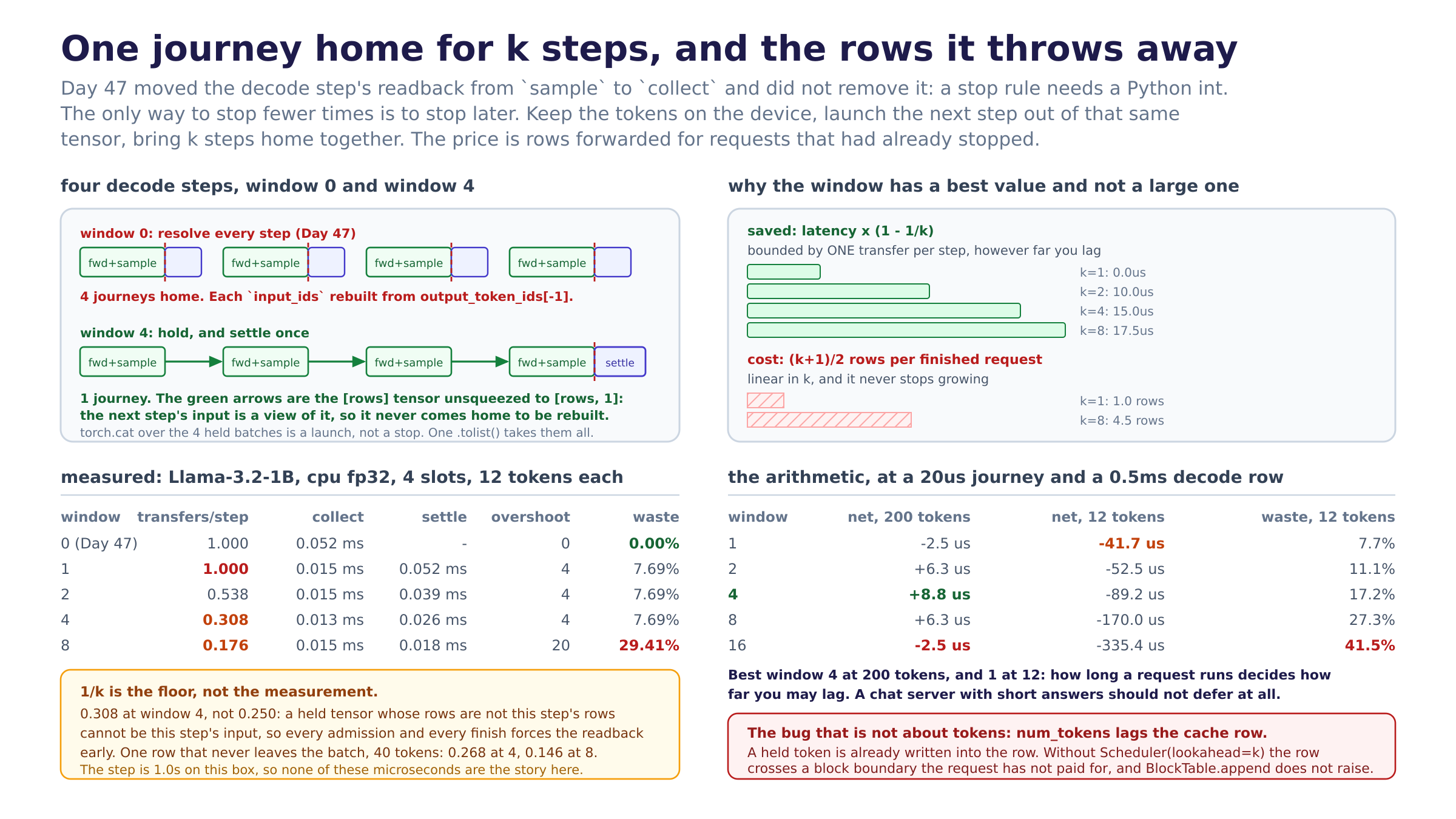
Deferring k steps removes k-1 journeys, and that part holds on any stream. The tokens for k steps are k tiny [rows] tensors; torch.cat glues them on the device, which is a launch the host walks away from, and one .tolist() brings the lot. That is the whole mechanism, and transfers_per_step measured off Engine.output follows it: 0.538, 0.308, 0.176 at windows 2, 4 and 8.
The price is Day 29’s number coming back off zero. A request whose stop token is still on the device is, as far as the scheduler can tell, still running: it stays in the batch and the engine forwards a row for it that nobody will keep. Continuous batching drove waste_fraction from 79% to 0.0 by construction, and this is the first thing in the engine to put any of it back: 7.69% at windows 1 to 4, and 29.41% at window 8 on a 12-token generation. overshoot_waste_fraction(8, 12) predicts 27.3% from (k+1)/2 rows, which is close enough to the measured 29.41% that the model and the run are describing the same thing.
So the window has a best value rather than a large one. The saving is latency x (1 - 1/k) and it saturates: there was only ever one journey per step to remove. The cost is (k+1)/2 rows and it is linear. At a 20us journey against a 0.5ms decode row, best_window is 4 for a 200-token generation and 1 for a 12-token one, and at window 16 the net goes negative even at 200 tokens. A chat server with short answers should not defer at all, and that conclusion is a subtraction rather than a preference.
What I learned
- The saving I set out to get is not the saving
window=1gives, and the one it gives is on the other end of the step. I expected the win to be atcollect.collectdid fall, 0.0515ms to 0.0150ms, and thensettleappeared at 0.0517ms, so atwindow=1the two together are slightly more than the one phase they replaced. What actually changed for free isbuild_inputs: the decode input isheld.tokens.unsqueeze(1), a view of the tensor the sampler left, instead oftorch.tensor([[r.output_token_ids[-1]] for r in requests]). That is one fewer Python list, one fewer allocation and one fewer host to device copy per step. 0.0676ms to 0.0620ms here, which is nothing, and it is the phase Day 46 named as the one a captured graph exists to delete. - 1/k is the floor and not the measurement, and the gap is scheduling. I expected 0.250 at window 4 and measured 0.308. Deferral is only safe while the batch is the batch that was sampled: a held
[rows]tensor whose rows are not this step’s rows is the right length and the wrong rows, and using it hands every row after the change somebody else’s token in fluent, plausible, wrong text. So every admission and every finish forces a full drain at the top of the next step. Four requests that all finish within a couple of steps of each other pay that several times in a short run. The single-row sweep is 0.268 at window 4, which is the same code with nothing churning, and the difference between those two numbers is the honest content of “steady state”. - The hazard of this day is not about tokens at all, it is about blocks. Under deferral
Request.num_tokenslags the cache row’s length by however many tokens are held, because the row is written during the forward and the request is told afterwards.Scheduler.blocks_needed_forsizes the reservation offnum_tokens, so it would top a running request up to blocks it has already outgrown. Nothing raises when that happens:BlockTable.appendreaches the allocator itself, the pool is booked twice for one sequence, and the release frees only the blocks the request knows about, so the pool leaks a block per boundary crossed and every test about tokens still passes.lookaheadis one added term in one expression, and finding out it was needed took longer than writing it. - The two ways a token fails to arrive are not the same and one counter would have hidden the difference. A token for a finished request is overshoot: real waste, caused by the window, and the thing
waste_fractionshould see. A token for a request that was preempted while it was in flight is not waste caused by anything I did today: that token was wanted, and the recompute will sample it again, because the request comes back over prompt-plus-generated and its position is unchanged. Charging it to the window would have made deferral look worse under memory pressure for a cost preemption already had. - The property worth testing was not the speedup, it was that nothing moved. Deferral changes when a token is looked at and not what was drawn, so the test that matters is a greedy run at
defer_window=kproducing byte for byte whatdefer_window=0produced, at every k, through EOS and through preemption. That test caught two real bugs (an empty prefill batch held as a row set that matched nobody, and the flush ordering inside_decode_input_ids) and it is the one assertion in the file that would still be worth keeping if the rest were deleted. The equality claim has a boundary and I want it written down: it holds for greedy because each row’s token depends only on its own context. With the shared generator and a batch that preempts, deferral changes the order draws are consumed in, and the tokens would legitimately differ. - Removing my synchronisation did not make the step free of them. I wrote a test that runs a whole decode step with
tolist,itemand__int__monkeypatched to raise, expecting it to pass. It failed insidepaged_attention_batched_reference, which validates itscontext_lenswithint(context_lens.min())andint(context_lens.max())on every layer of every step. So the reference kernel reads back more times per step than the output path ever did. The test now scopes the claim to_decode_input_ids, which is what I can honestly assert, and the kernel’s own bill is a separate one this day does not pay. - A conservation identity is a better gate than a bound.
check_tokens_conservedsays every deferred token is applied, overshot, abandoned or still held. It is four counters and one equality, it needs no threshold, and it fails on the exact class of bug this design invites: a drain that takes the wrong slice and loses a batch. The symptom without it is a request one token short of its budget that finishes anyway, which no test about output would notice. - Overshoot depends on where the stop lands relative to the drain boundary, which is why the model is an average. The 40-token single-row run at window 8 overshot by exactly 1 row, because 40 is a multiple of 8 and the budget was hit exactly at a drain. The 12-token four-request run at window 8 overshot by 20, five per request. Same window, same code, an eightfold difference in the price, decided by arithmetic between the generation length and the window.
expected_overshootreturns(k+1)/2for that reason and not a bound.
Diagram
deferred-output.png. Left top is four decode steps drawn twice, four red stop lines against one, with the green arrows showing the held tensor becoming the next step’s input. Left bottom is the measured sweep and why the rate does not reach 1/k. Right top is the saving saturating against the cost growing, right middle is best_window at two generation lengths, and right bottom is the lookahead hazard.
Tomorrow
The window is a policy and it is currently a constant a caller passes in. Everything needed to choose it is now measurable in the engine: transfers_per_step is counted, the overshoot is counted, and best_window is the subtraction. Day 49 is torch.compile on the decode step, which Day 47 said would come once there was no readback left in the middle of it to work around, and the deferred path is what finally removes one from between the forward and the next launch. After that, the second stream and the CUDA event that would let window=1 actually hide its journey instead of moving it.
Post angle
Day 48 of building an LLM inference engine from scratch. Yesterday I moved my decode loop’s last synchronisation from sample to collect and said out loud that moving one is not removing one. Today I tried to remove it, the way vLLM does: hold step N’s tokens on the device, launch step N+1 out of that same tensor, and read them home late. First surprise: a one-step lag removes exactly zero journeys. Measured 1.000 transfers per step before and after. Tensor.tolist issues its copy on the current stream and waits for everything queued ahead of it, so a resolve placed after the next forward waits for that forward too. Hiding a sync behind a kernel needs a second stream and an event, and I have one stream. What does work is going less often: k steps of tokens are k tiny tensors, torch.cat glues them on the device (a launch, not a stop), and one .tolist() takes them all. 0.538 transfers per step at window 2, 0.176 at window 8. The price is the interesting part. A request whose stop token is still on the device is still in the batch, so the engine forwards rows nobody keeps, which is exactly the waste continuous batching drove to zero on Day 29. 29% of the forwards at window 8 on a 12-token generation. The saving saturates and the cost is linear, so there is a best window and it is small: 4 at 200 tokens, 1 at 12. And the bug that cost me the most time was not about tokens. A held token is already in the cache row and not yet in the request’s length, so the block allocator was sizing reservations off a number that lags, and nothing raises when a row grows past the blocks it paid for. 1175 green.