Day 61: the capture list loses its width axis, and the price changes currency
Date: 2026-09-17 · Week 14 · Phase 5 Benchmark and optimize
What I added today
DecodeBuckets(streamed=True, block=...), and the three things downstream that had to move with it.
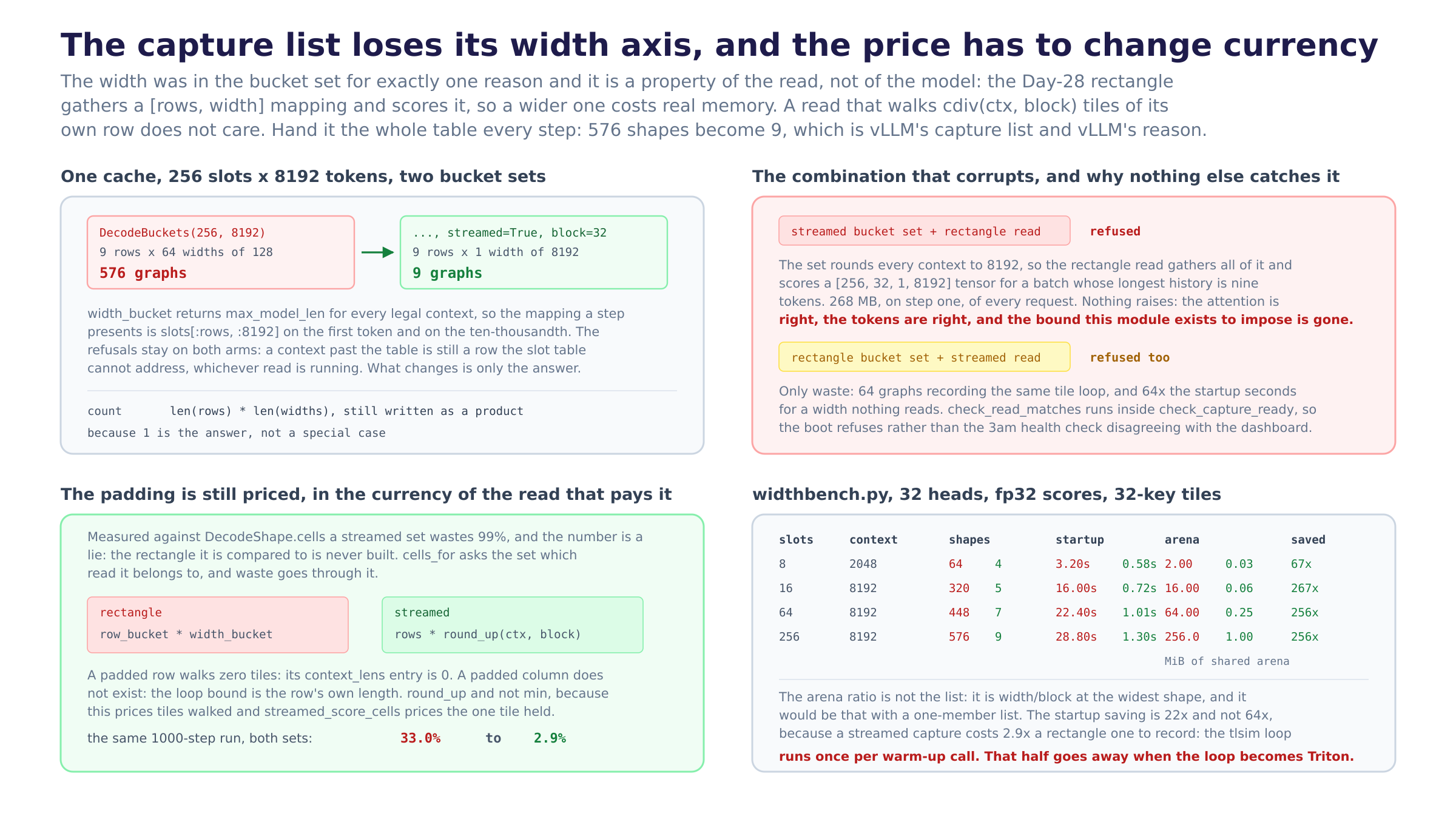
Day 52 bucketed both axes of the decode shape because both of them moved, and the price was a product: len(rows) * len(widths), which at 256 slots and 8192 tokens on a 128-token multiple is 576 graphs. Day 59 wrote a read that never builds the score rectangle and Day 60 wired it to a flag, and today is the day that spends it. The width axis was in the set for exactly one reason and it is a property of the read, not of the model: the Day-28 rectangle gathers a [rows, width] mapping and scores it into a [rows, heads, 1, width] tensor, so a wider mapping costs real memory. A read that walks cdiv(context_lens[row], block) tiles of its own row does not care. So streamed=True collapses the widths to (max_model_len,), count stops being a product, and the same cache’s list is 9 graphs.
cells_for is the second half and it is not optional. waste measured against DecodeShape.cells would read 99% on a streamed set, because the set rounds every context up to max_model_len and that rectangle is never built. So the bucket set answers “what does the read really touch”: row_bucket * width_bucket on the default, rows * round_up(ctx, block) on the streamed one, and padded_cells and waste go through it.
check_read_matches(buckets, read) is the gate, and it runs inside check_capture_ready so a boot refuses rather than a dashboard disagreeing at 3am. shared_pool_bytes, private_pool_bytes and pool_sharing_ratio take a block. CapturePlan carries one, prices its arena in it, and publishes it under read_block in /health. plan_capture grows a fifth width_bound_by, "read", and loses three candidates on that arm.
tests/test_width_axis.py is 54 tests. Suite 1952 green (5 GPU-gated skips), ruff clean.
widthbench.py, host only, no weights (day-61-widthbench.csv):
the capture list for one cache, both reads, 32 heads, fp32 scores, 32-key tiles:
  slots  context         read   rows x widths   shapes   startup      arena   waste
      8     2048    rectangle       4 x 16        64     3.20s      2.00 MiB  33.0%
      8     2048     streamed       4 x 1          4     0.58s      0.03 MiB   2.9%
      8     4096    rectangle       4 x 32       128     6.40s      4.00 MiB  33.0%
      8     4096     streamed       4 x 1          4     0.58s      0.03 MiB   2.9%
     16     8192    rectangle       5 x 64       320    16.00s     16.00 MiB  33.0%
     16     8192     streamed       5 x 1          5     0.72s      0.06 MiB   2.9%
     32     4096    rectangle       6 x 32       192     9.60s     16.00 MiB  33.0%
     32     4096     streamed       6 x 1          6     0.87s      0.12 MiB   2.9%
     64     8192    rectangle       7 x 64       448    22.40s     64.00 MiB  33.0%
     64     8192     streamed       7 x 1          7     1.01s      0.25 MiB   2.9%
    256     8192    rectangle       9 x 64       576    28.80s    256.00 MiB  33.0%
    256     8192     streamed       9 x 1          9     1.30s      1.00 MiB   2.9%

what the axis was costing, per deployment:
  slots  context   shapes   startup    arena
      8     2048      16x        6x      67x
     16     8192      64x       22x     267x
     64     8192      64x       22x     256x
    256     8192      64x       22x     256x
Why it matters
One of those three ratios is the length of the list and the other two are not, and keeping them apart is most of the day. shapes is the list: 576 to 9, and that is arithmetic about a product whose second factor became 1. arena is not about the list at all. It is width / block at the widest shape, which is Day 59’s workspace_saving, and it would be 256x if the list had one member: a shared arena is sized by its largest graph, so shortening the list never touched it and changing what a graph holds is the only thing that ever could. And startup is the one I had to walk back, which is the next section.
The startup saving is 22x, not 64x, and the boot table is what said so. Nine graphs instead of 576 looks like it should divide the warm-up by 64, and the measured boot of the toy model says 6.6 ms a graph on the rectangle arm and 19.2 ms on the streamed one. Every capture runs the read once, and the streamed read is tlsim in Python, so recording a shape costs about 2.9x what it costs on the default. The first version of widthbench.py priced both arms at the same 50 ms and printed a 64x, which is the kind of number that is right in the arithmetic and wrong in the world. The column now carries STREAMED_CAPTURE_PENALTY and the honest reading is that half of this saving is a property of this box and goes away with Triton, and the other half, the memory, does not.
The combination that corrupts is a streamed bucket set under a rectangle read, and nothing else in the repo would have caught it. The set rounds every context to max_model_len, so plan_decode hands the read slots[:rows, :8192] on the first decode step of every request. The rectangle read gathers all of it and scores a [256, 32, 1, 8192] tensor for a batch whose longest history is nine tokens: 268 MB, Day 54’s number, materialised at the start of a run instead of at the end of a long one. Nothing raises. The attention is right, because the padding is masked; the tokens are right; the pool audit is right. The only symptom is that the memory bound this module exists to impose is gone. The two halves are built from one flag in BatchedPagedKVCache so they cannot be wired apart, and check_read_matches is for every caller who assembles them by hand.
Three of plan_capture’s four ceilings stopped being width ceilings, and the graph limit turned into a statement about rows. Day 55 ended on “a budget is not a statement about the length of the capture list, it is a statement about one width”, and Day 56 found the graph limit reduces to the same knob. Both of those are consequences of a workspace that is rows * heads * width. Under a tile it is rows * heads * block, so a budget is not a ceiling on anything, it is a yes or no about one tile, and the refusal has to say so rather than divide. The limit is worse: with a single width the list is the row axis, so width_from_limit’s division has no axis left to truncate and a limit under the row count has to name max_rows as the only knob. A width flag is ignored on that arm, because honouring it would record a list at a width no step will ever present.
And Day 60’s /health saving became a tautology, which I would rather write down than quietly leave in a table. PagedRead charges score_cells off slot_mapping.shape[1], which under a streamed bucket set is max_model_len on every call, and holds min(block, width), which is block on every call. So the quotient is exactly max_model_len / block however long the run was: a server that answered one twelve-token request reports the same saving as one that streamed for an hour. Day 60’s 4.0x to 5.0x came off a cache that still bucketed the width, where the quotient really was integrated over a growing rectangle. It cannot be fixed, and the reason is the same reason the counter was priced in shapes in the first place: the honest numerator is int(context_lens.max()), which is Day 48’s synchronisation once per call per layer to make a log read better.
What I learned
- A bucket set is a claim about a read, and I had been treating it as a claim about a cache.
DecodeBucketshas takenmax_batch_sizeandmax_model_lensince Day 52 and both come off the cache, which made it feel like a property of storage. It is not. The row axis is a property of the scheduler and the width axis is a property of the kernel, and the only reason they were both in one object is that both of them moved. Take away the read that gathers and one of them was never the cache’s business at all. - A price is only comparable inside one currency, and switching arms switches the currency.
wastehas meant “share of computed cells nobody asked for” since Day 29, throughprefill_padding_wasteandpadding_share, and it survived four redefinitions of what a cell is. This is the first time the denominator stopped existing. A 99% waste against a rectangle that is never built is not a pessimistic reading, it is a reading of nothing, andcells_forexists so the number keeps meaning what its name says. round_upandminare two different questions about the same tile and I wrote the wrong one first.streamed_score_cellsusesmin(block, width), which is what a program holds: one tile, and never more than the context.cells_forneedsround_up(width, block), which is what a program walks: whole tiles, the last one masked. My first draft reusedstreamed_score_cellsand reported a four-token row under a 32-key tile as four cells of work, which is not what the loop does.- The graph limit was never a width cap, it was a cap on a product that happened to have a width in it.
width_from_limitis one of the cleverest lines in the repo and it is clever in the way that hides an assumption:limit // row_countis only a width because the list isrows x widths. With one width that division silently asks the wrong question, and the tell was that its refusal message talks about width buckets in a set that has one. - The dangerous half of a flag is not the arm it turns on. Day 60’s whole subject was that a streamed server and a rectangle server are indistinguishable from outside. Today’s is that a streamed bucket set and a rectangle read are also indistinguishable from outside, and that pair is not harmless: it is the one combination in two days of work where the process quietly holds two orders of magnitude more memory than anybody planned. Two switches that are each safe do not make four safe states.
- A measured boot is worth more than a measured kernel when the claim is about startup. I had the shapes, the arena and the arithmetic, and the arithmetic said 64x off the warm-up. One
build_enginethroughplan_captureandwarm_engineon both arms, which is the pathserve.pytakes, said 22x and said why. The tables that have been wrong in this project have almost all been the ones where a multiplication stood in for a second. - Publishing the degeneration is cheaper than removing the number. The obvious move on finding that
savingis now a constant was to stop reporting it under a streamed set. That would makeread_from_healthandcheck_arm_readrefuse on the arm they were written for, which is Day 60’s lesson about a read being not optional, in reverse. The number is still true, it is just no longer about the traffic, and a paragraph on the property is the right size of fix.
Diagram
capture-list-loses-a-width.png. Left top is the collapse: one cache, two sets, 576 graphs against 9, and what width_bucket does instead. Right top is the pair that corrupts and the pair that only wastes, with the reason nothing downstream notices either. Left bottom is the currency change, both charges side by side, and why a padded row and a padded column both cost zero. Right bottom is the measured table with the three ratios kept apart.
Tomorrow
The set is the row axis and the arena is a tile, and both of those are statements this box cannot cash. Everything above is memory and startup, measured on a CPU, and the read underneath is still tlsim in Python at 8x to 67x per call. Day 62 is the Triton version of paged_attention_batched_kernel: the same grid of (row, query head), the same online softmax, the same block as the SRAM tile, graded against Day 59’s reference on the toy pools that already exist and against the rectangle on a real forward. That is the call that turns every ratio in this file into latency instead of a promise, and it is the one thing left before the CUDA run Day 58 pointed at is worth booking hardware for. The honest caveat is unchanged in shape and smaller in scope: nothing here made a single token arrive faster, and the next day is the first one in the whole streak whose whole job is that it should.
Post angle
Day 61 of building an LLM inference engine from scratch. The CUDA graph capture list for a 256-slot, 8192-token server was 576 shapes, and today it is 9. Not because I tuned anything: because the width axis was never a property of the model, it was a property of the read. The old decode read gathers a [rows, width] slot mapping and scores it into a [rows, heads, 1, width] rectangle, so a wider mapping is real memory, so the width has to be bucketed, so the capture list is a product and the product is the bill. The read I wrote on Day 59 walks cdiv(context_lens[row], block) tiles of its own row and holds one tile. Hand it the whole table on every step and it touches exactly the same cells. So the width stops being a thing to round, it becomes a constant, and the list is the row axis, which is what vLLM’s capture list has always been and now I know the actual reason. Two things I got wrong on the way. The first: waste reported 99% on the new set, and waste was right about the arithmetic and measuring a rectangle that is never built. The padding price had to change currency, so a bucket set now says what its own read really touches, which is rows * round_up(ctx, block) and not rows * width, and round_up rather than min because that is tiles walked and not the one tile held. The second: 9 graphs instead of 576 is not 64x off the warm-up. A measured boot says 6.6 ms a graph on the old arm and 19.2 on the new one, because every capture runs the read once and the read is still a Python loop, so the real startup saving is 22x. The memory half is honest either way: the shared arena goes from 256 MiB to 1 MiB, and that ratio is width / block at the widest shape, which would hold if the list had a single member. And the dangerous discovery: a streamed bucket set under the old read hands the rectangle a full-width mapping on the first token of every request. 268 MB of one intermediate, correct tokens, nothing raises. Two switches that are each safe do not make four safe states, so the boot refuses that pair now. 1952 green.