Day 50: the addressing moved out of the forward, and the guard became a shape
Date: 2026-09-04 · Week 13 · Phase 5 Benchmark and optimize
What I added today
nanoserve.plan, the module that decides where a decode step’s tokens go before the forward is called. DecodePlan is a frozen dataclass of four tensors and two host ints: write_slots [rows] (the flat pool slot this step’s K/V goes to), slot_mapping [rows, max_ctx] (the read rectangle), context_lens [rows], and positions [rows, 1] (each new token’s absolute position, read before the tables grow, because it is the count of tokens that preceded it). min_ctx and max_ctx are on it for the host only, and the whole day is about why nothing inside the forward may read them. batch_size, width, cells, real_cells, padding_cells, padding_share, mapping_bytes and render are what it says about itself. plan_decode(cache, rows, device) builds one; BatchedPagedKVCache.plan_decode is where the mutation lives, because growing the tables is the cache’s business.
The wiring is five small changes. BatchedPagedKVCache.write takes a plan and, given one, is a single index_put over the batch instead of a Python loop over rows: no table grows, no slot is computed, and the layer-0 handshake is not consulted, because the handshake existed to tell the other layers where layer 0 put things and the plan tells everybody at once. slot_mapping(plan=...) hands back the plan’s own tensors, identity and not a copy. paged_attention(plan=...) calls the read with validated=True. BatchedCacheRows carries the plan, so layers.py and model.py needed no change at all. Engine._decode builds the plan in build_inputs where it used to build positions off tables[row].num_tokens, and hands the forward plan.positions and cache.view(rows, plan=plan).
paged_attention_batched_reference grows a validated flag, and Day 49’s decode_shape learns to read a plan’s width instead of predicting it. The arithmetic is mapping_cells, mapping_bytes, rebuild_cells, appended_cells and rebuild_ratio; the gates are check_plan_addressing, check_plan_rows, check_plan_current and check_rebuild_bounded. tests/test_plan.py is 56 tests. Suite 1313 green (5 GPU-gated skips), ruff clean.
compilebench.py re-run unchanged, Llama-3.2-1B, cpu fp32, 4 rows, 11 decode steps (day-50-compilebench.csv):
mode      shapes  builds  reuse  fell back    compile        step  speedup
off           11       0   100%         no      0.06s    861.81ms    1.00x
dynamic       11       1    91%         no     44.01s    863.34ms    1.00x
static        11       8    27%        yes          -  16357.90ms    0.05x

Day 49, same script, 9 decode steps:
dynamic        9       8    11%         no          -  28982.62ms    0.02x
Why it matters
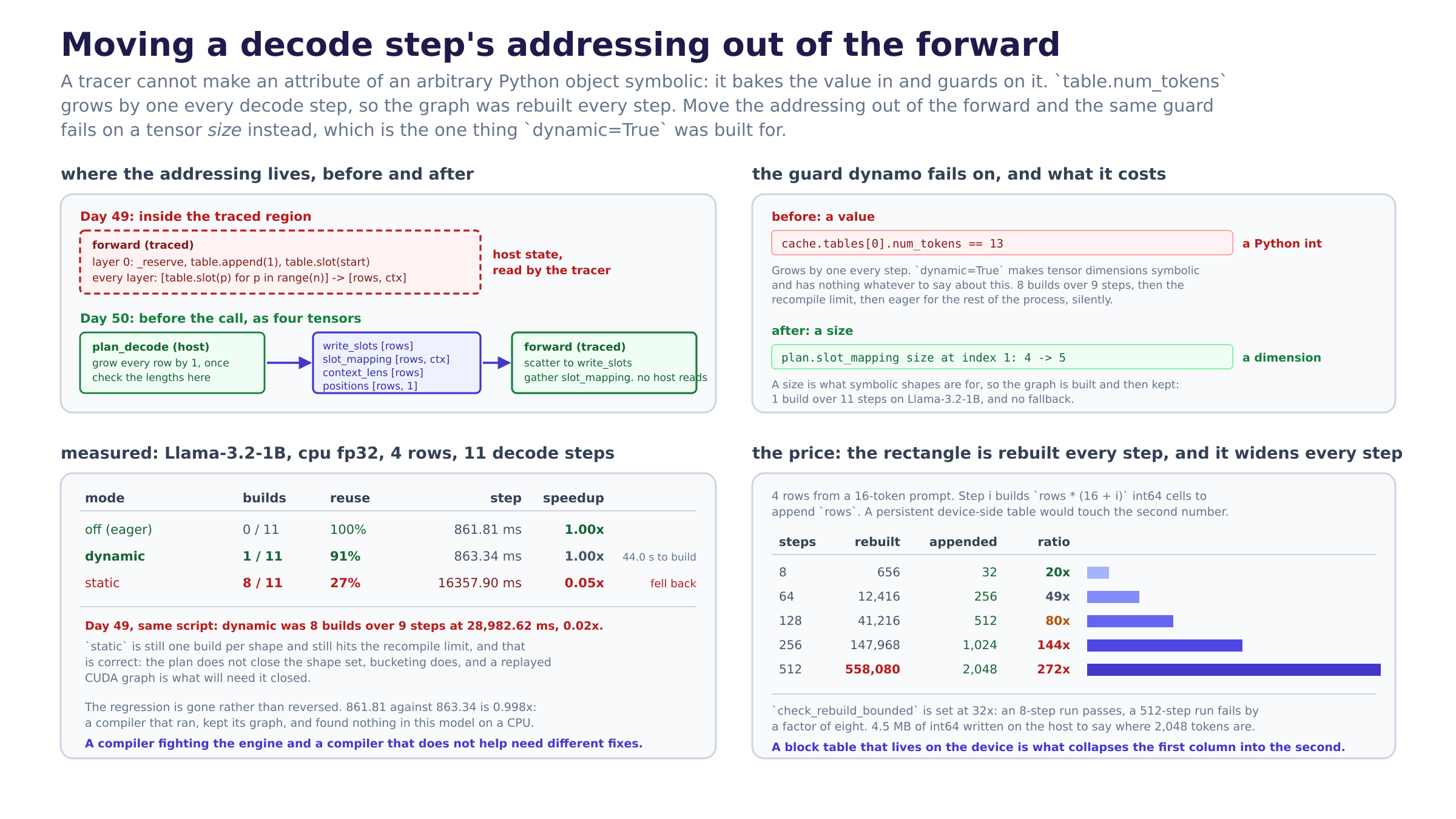
The guard changed category, and that is the entire result. Day 49 ended with one captured graph, zero breaks, and a decode that was forty-six times slower, because what dynamo kept invalidating was not a shape:
kwargs['cache'].cache.tables[0].num_tokens == 13
  # [table.slot(p) for p in range(start, table.num_tokens)], cache.py:729
A tracer cannot make an attribute of an arbitrary Python object symbolic. It bakes the value in and guards on it, and that value grows by one every decode step for the whole run, so dynamic=True had nothing to offer. With the addressing handed in as tensors, the reason dynamo now prints is:
tensor 'kwargs['cache'].plan.slot_mapping' size mismatch at index 1.
  expected 4, actual 5
Same failure, different kind. A size is exactly the thing symbolic shapes exist for, so the build generalises it and the graph is then kept: 1 build over 11 calls on the real Llama-3.2-1B where Day 49 had 8 over 9, and no fallback where Day 49 walked past cache_size_limit in eight steps. check_graph_reused, written on Day 49 as a gate that failed, now passes.
One build over eleven steps, and the regression is gone rather than reversed. 861.81ms a step eager against 863.34ms compiled is 0.998x: inductor’s CPU backend found nothing in this model that it could not already do, and 44 seconds of compile bought none of it back, so breakeven_steps is still infinite and the honest recommendation for this box is still “off”. What changed is the category of the result. Day 49 was a 46x regression caused by the compiler fighting the engine; this is a compiler that ran, kept its graph, and did not help. Those need different next moves, and only one of them is a bug.
On the tiny two-layer model the same run sometimes builds twice, and I could not reduce it to one variable. dynamic=True marks the dimensions of the compiled function’s arguments, and the slot mapping is not an argument: it arrives as kwargs['cache'].plan.slot_mapping, two attribute hops off a non-tensor. Whether it gets a symbol on the first build is therefore left to automatic dynamic, which specialises, sees a second size, and generalises on the rebuild. I measured 1 build on some batches and 2 on others over the same code, chased it through row count, prompt raggedness and a suspected collision with head_dim, and falsified all three. So: sometimes the first build is wasted and the second is the one that lasts, and either way the run no longer goes near the recompile limit. Writing down a mechanism I had disproved would have been the easier paragraph.
Handing the bounds in would have been the same bug in a costume. Day 49’s fix was to stop calling int(context_lens.min()) in the kernel and pass the two numbers down from the cache, where they were already Python ints. The obvious next move was for the plan to pass context_bounds=(plan.min_ctx, plan.max_ctx), and it is exactly wrong: those are two Python ints that change every step, so a guard on their values rebuilds every step whether they were read inside the region or handed into it. That is why the kernel grew validated=True instead. A bool that is True for the whole run is a guard that holds for the whole run, and the plan does the checking on the host when it is built. The generalisation, and I nearly shipped the wrong version of it: this is not about where a number is computed, it is about whether the traced region ever observes it.
The forward became a function again. A forward over a KV cache normally is not one. The paged read writes this step’s K/V into the row before it attends, so calling it twice attends over a history one token longer the second time; Day 49’s first equality test failed by whole units for exactly that reason and I narrowed the test. With the addressing fixed before the call, replaying the same plan writes the same slots and reads the same rectangle, so f(x) == f(x). That is not a side benefit, it is the precondition for everything downstream: comparing compiled against eager, capturing a CUDA graph and replaying it, retrying a step. The test that a replayed plan returns identical logits, and its control showing that an unplanned forward does not, are the two I would keep if I could keep two.
And the price is quadratic. The read rectangle is [rows, max_ctx] int64 rebuilt from scratch on the host every step, and max_ctx grows by one per step, so step i writes rows * (start + i) cells. Four rows from a 16-token prompt:
steps    cells rebuilt   cells appended    ratio    host bytes
    8              656               32     20x         5.2 KB
   64           12,416              256     49x        99.3 KB
  128           41,216              512     80x        329 KB
  512          558,080            2,048    272x        4.5 MB
Half a million int64 written to say where two thousand tokens are. rebuild_cells against appended_cells is that ratio and check_rebuild_bounded is the gate, set at 32x, which an 8-step run passes and a 512-step run fails by a factor of eight. The fix is a block table that lives on the device and takes one write per row per step, which is what vLLM keeps, and it is why vLLM’s slot mapping does not appear in a profile the way this one is about to. Writing the arithmetic on the day the design incurs the cost is the same order Day 49 used for bucketing.
What I learned
- Moving a computation and hiding it from the tracer are different jobs, and only the second one matters. My first framing of this day was that the host now does the addressing “earlier”. It does not: the host did all of it before too, one call frame deeper. The win is that the traced region no longer observes any of the values involved. The test that made this concrete is the one that replaces
BlockTable.num_tokenswith a property that raises: a planned forward completes, an unplanned one does not. A property is a data descriptor and beats the instance attribute, which is what makes that trick work on a plainself.num_tokens = n. - The layer-0 handshake was a symptom, and the planned path has nothing to hand shake about.
writegrows the tables on layer 0 and stashes_step_slotsand_step_rowsso layers 1..15 scatter to the same places, with a check that a later layer cannot name different rows. That is a sixteen-way agreement about state mutated inside the forward, and none of it is needed once the mutation happens before the forward: no stash, no check, no ordering requirement between layers. The prefill still uses all of it, because a ragged prefill really does decide where things go while it runs. What I did not expect is that code written to keep a mutation coherent has nothing to do the moment the mutation moves out, and I found that by writing a test that a planned write needs no layer 0 first and watching it pass with no work. - The per-row Python loop went with it, on that path.
writeloops over rows because a ragged prefill writes different counts to different places. A decode step is one token per row by definition, so with a plan the whole batch isk_pool[plan.write_slots] = k[:, :, 0, :]. That loop had survived four days of optimisation work because it was never the bottleneck, and it went away as a side effect of a change aimed at something else entirely. - My own shape probe went off by one and the tests caught it, not the benchmark. Day 49’s
decode_shapecomputed the width as “longest history plus this step’s token”, because the read built its rectangle after the write. With a plan the tables have already grown when the wrapper sees the call, so the same arithmetic overshoots. The distinct-shape count was still right, so every column incompilebench.pywould have looked correct and every width in it would have been wrong by one. A measurement that is consistently wrong is the hardest kind to notice. - Refusing a decode over an empty row is a check I did not have before and should have.
plan_decoderaises if a row holds no tokens, because a decode over an empty row attends over its own token and no prompt: a fluent, plausible, wrong continuation with nothing in it that looks like an error. The old path allowed it silently. Writing a new entry point is the moment to ask what the old one never refused. - A plan is stale the instant a second one is built, and nothing raises.
plan_decodeis what grows the tables, so planning twice and using the first plan writes step two’s token over step one’s slot. Tables consistent, pool legal, one token quietly gone.check_plan_currentcompares the plan’scontext_lenswith the tables’ current lengths, which is a two-line gate against a bug I would have spent a day on. staticis still eight builds and hits the fallback, and that is correct. Static mode specialises per shape by definition, and the shape set is still one per step becausemax_ctxstill grows. The plan did not close the shape set and was never going to; Day 49’s bucketing arithmetic is what closes it, and a replayed CUDA graph is what will need it closed. Two separate problems that looked like one for a day and a half.- The
compile_scolumn is still an artefact and I left it in. It is estimated as total decode time minus the median step times the step count, which needs most steps not to contain a build.dynamicnow satisfies that and reports a credible 44.01s;staticbuilds in eight of eleven steps and reports 0.00s, which is the same nonsense Day 49 got. An estimator that is right in one row of a table and meaningless in another is worse than one that is wrong everywhere, because the good row lends the bad one credibility. - The honest scoreboard after two days on the compiler: the pathology is gone and the speedup is not there. 1 build over 11 steps at 0.998x, against 8 builds over 9 steps at 0.02x. That is the difference between a compiler fighting the engine and a compiler that ran and found nothing, and it is worth saying in those words rather than picking whichever column reads best.
Diagram
decode-plan.png. Left top is where the addressing lives, before and after: inside the traced region as a table.slot(p) loop per layer, then outside it as four tensors built once. Right top is the guard that fails in each case, an integer against a dimension, with the build counts each produces. Left bottom is the measured sweep. Right bottom is the price, cells rebuilt against cells appended, growing quadratically with the run.
Tomorrow
The plan closed the recompile hole and opened a measurable one: the read rectangle is rebuilt on the host every step and the rebuild is quadratic in the length of the generation. Day 51 makes the block table persistent. Allocate [max_batch_size, max_model_len] of slots on the device once, write one entry per row per step, and hand the forward a view of it rather than a freshly built tensor, so rebuild_cells collapses to appended_cells and check_rebuild_bounded passes at any run length. That also fixes the row count, which is the other half of what a CUDA graph capture needs: a fixed-size buffer at a fixed address. Day 49’s bucketing arithmetic is what tells the capture which sizes to hold, and after Day 51 there is finally something for it to be measured against.
Post angle
Day 50 of building an LLM inference engine from scratch. Yesterday torch.compile made my decode 46x slower and the culprit was one Python integer read inside the traced region: cache.tables[0].num_tokens == 13. Today I moved the whole of a decode step’s addressing out of the forward, and the fix generalises further than I expected. A DecodePlan is four tensors built on the host before the call: the write slot per row, the [rows, ctx] read rectangle, the context lengths, and the new tokens’ positions. With one in hand the forward reads no Python attribute of the cache at all, and the guard dynamo fails on changes category, from tables[0].num_tokens == 13 to plan.slot_mapping size at index 1: expected 4, actual 5. A size is the thing symbolic shapes exist for. On the real Llama-3.2-1B, 8 builds over 9 steps became 1 over 11, and 0.02x became 0.998x. The near-miss is the part worth stealing: my first move was to have the plan pass context_bounds=(min_ctx, max_ctx) down to the kernel, the way Day 49 had. Those are Python ints that change every step, so a guard on their values rebuilds every step whether the region reads them or is handed them. It is not about where a number is computed, it is about whether the traced region ever observes it, so the kernel takes validated=True and the plan checks on the host. Two things fell out that I was not aiming at. The forward is a function again: a cached forward called twice normally returns different logits, because the read writes this step’s K/V before it attends, and with the addressing fixed up front f(x) == f(x). That is the precondition for capturing a CUDA graph, not a nicety. And the per-row Python loop in the write collapsed to one index_put, because a decode step is one token per row. The price is honest and quadratic: the rectangle is rebuilt every step and max_ctx grows every step, so 512 steps over 4 rows rebuild 558,080 int64 cells to append 2,048. That is what a persistent device-side block table fixes, which is what vLLM keeps, and it is tomorrow. 1313 green.