Day 66: the arena got a caller, and the caller had one place to stand
Date: 2026-09-22 · Week 14 · Phase 5 Benchmark and optimize
What I added today
--split-read, wired from the command line down to the cache, plus the boot-path call that turns a planned split into reserved memory. Wiring it turned up a gate that had been refusing every split server with CUDA graphs on.
engine.py. Engine.build(split_read=...) goes to the cache, and the cache’s two refusals (no bucket_decode, or both reads at once) come back unchanged. The constructor’s check_capture_ready call now passes armed=False. The reason is the main finding of the day and is explained below.
captured.py and buckets.py. check_capture_ready(cache, *, armed=True) gains a fourth precondition. If a split read holds no arena, it raises CaptureUnsound naming cache.allocate_split_workspace(device) and arm_split_read. check_read_matches gains the same armed keyword. It excuses exactly one clause, “split read, no workspace”, which is the only one of its seven that is about when something happens rather than what is configured. The chunk-mismatch clause also stops firing on a read with 0 chunks. Otherwise an unarmed read would get reported as “0 against 1” and send someone looking for a disagreement that doesn’t exist.
launch.py. Four pieces:
arm_split_read(engine, capture=None, *, device=None)returnsNonefor the other two reads. For a split read, it allocates the arena through the cache, on the weights’ device, and refuses a second call.check_arena_matches_capture(capture, workspace)holds the plan’s record and the cache’s allocation to each other. Chunks, tile and width must be equal. Rows are only bounded (the plan can’t have more rows than the arena).build_appnow plans the capture withsplit_read=engine.cache.read.split, arms, and only then warms. The arming happens outside the capture branch.boot_infoandboot_linestake the workspace./healthgets a top-levelsplit_workspacesection, and the boot log printsSplitWorkspace.renderdirectly under the capture line.check_boot_inforefuses a payload whose capture priced a split but names no arena, or whose arena disagrees with the plan.
serve.py. --split-read is mutually exclusive with --streamed-read at the argparse level, so passing both is a usage error, not a traceback after the weights have loaded. It implies bucket_decode. That is the one implication in the launcher that comes from a read rather than from --cuda-graphs, and it exists because the split can’t run without a bucketed width, not because it’s convenient.
tests/test_split_boot.py is 26 new tests, and one Day 65 test in tests/test_width_axis.py changed its expected exception (explained below). Suite 2180 green (21 GPU-gated skips), ruff clean.
bootbench_split.py, host only, no weights (day-66-bootbench.csv):
where arm_split_read sits on the boot path:
    position  verdict
       never  CaptureUnsound: this cache runs the split read and holds no arena yet
  after warm  CaptureUnsound: this cache runs the split read and holds no arena yet
       twice  BootUnsound: this read already holds an arena
  after plan  boots

three servers, one flag apart, booted the way serve.py boots them:
  rectangle: 3 boot lines, arena 0 B,    split_workspace in /health: False
  streamed:  3 boot lines, arena 0 B,    split_workspace in /health: False
  split:     4 boot lines, arena 1536 B, split_workspace in /health: True
    CUDA graphs: 3 of 3 shapes, rows <= 4, context <= 1024 (capped by the
      streamed read, which has no width axis), 2-way split, 0.0 MiB of workspace
    split workspace: 4 rows x 8 heads x 2 splits of 512 keys over a
      1024-wide mapping, 0.00 MiB, allocated once
Why it matters
The gate I wrote yesterday refused the server I was building today, and it did it at the earliest possible moment. Day 54’s Engine.__init__ runs check_capture_ready when the graphs are on, so a capture over an open shape set is refused at construction. Day 65 added the “does the split read hold an arena” clause to the gate that function calls. On the boot path, the engine is built before any device memory exists, and the arena comes later. So as of last night, Engine.build(split_read=True, capture_decode=True) raised a BucketsUnsound about 0 chunks against 1, every time, before the only call that could have fixed it. No test caught it because no test had ever built a split engine with graphs on. Day 65’s tests built the cache, allocated the arena by hand, and called the gate afterwards, which is the order a test takes and not the order a server does. It took a wiring day to build one in boot order.
The fix is a distinction, not a relaxation. Of the seven clauses in check_read_matches, six are wrong whenever they are true: a width axis under a tiled read, a split set under an unsplit read, two chunk counts that disagree. Those are configuration errors, and construction is the right time to refuse them. The seventh, “a split read with no arena”, is only wrong too late. It’s legitimate from the constructor until arm_split_read, and fatal after. armed=False excuses that one clause and nothing else, and a test covers exactly that: a mis-assembled set is still refused with armed=False.
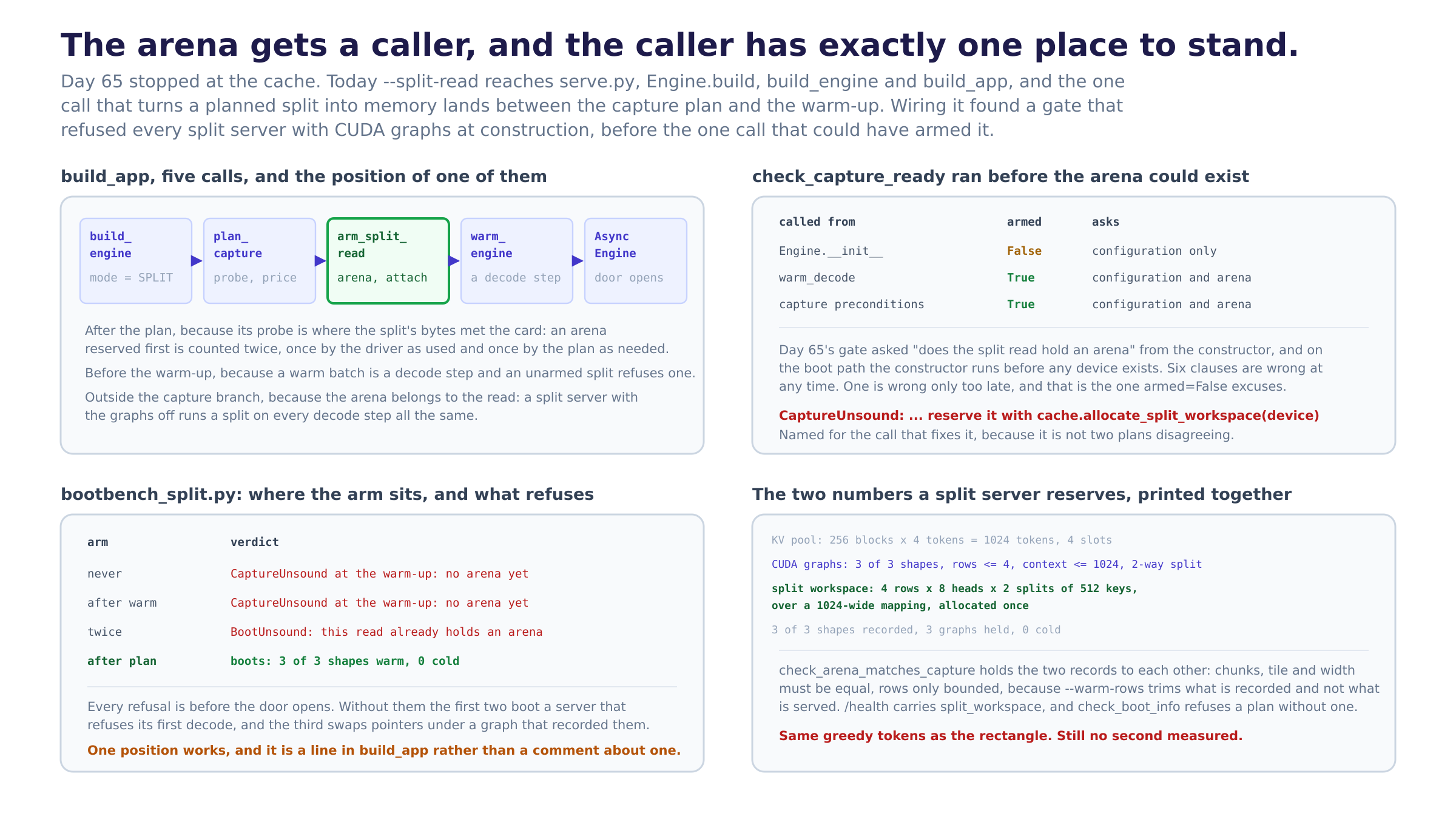
The arena has one correct position on the boot path, and a line of code is what holds it there. After plan_capture, because the plan’s budget probe is where the split’s bytes get checked against the card. An arena reserved before the probe would be counted twice: by the driver as used, and by the plan as needed. Before warm_engine, because a warm batch is a decode step, and an unarmed split read refuses a decode step. And outside the if graphs branch, because the arena belongs to the read, not to the capture. A split server with graphs off still runs a split on every decode step, and if it were only armed inside that branch, its first request would be a refusal. The order table above tries each alternative, and every wrong one is refused before the door opens.
A split server reserves two numbers beyond the pool, and now they print together. The capture’s shared arena is priced by plan_capture against a probe. The partials arena is allocated by the cache from its own limits. Both are held for the life of the process. They’re computed at different moments by different callers, and until today only the first ever appeared on the boot log. Now the second is the very next line, and /health carries it as split_workspace, so someone adding up what the card holds doesn’t have to recompute rows * heads * splits * (head_dim + 2) * 4.
What I learned
allocate_for(capture)still has no caller on the boot path, and that’s the right answer, not a leftover. Day 65’s “Tomorrow” said this day would finally give it one. Once I wrote the call, the problem was obvious: a capture plan describes what is recorded, and--warm-rowscan trim that below the slot count. The arena has to cover what is served, and a shape the list skipped still runs, eagerly, against the same buffers. Sizing the arena off the plan would have given a--warm-rows 4server an arena four rows wide and a scheduler that admits- So the cache sizes it, and
check_arena_matches_capturechecks the plan against the result instead of treating the plan as the source. That is also why the rows clause is an inequality while the other three are equalities.
- So the cache sizes it, and
- The refusal changed class, and it had to. Day 65’s
test_check_capture_ready_runs_the_split_gate_tooexpectedBucketsUnsoundwith “no workspace”. It now getsCaptureUnsoundnamingallocate_split_workspace.check_capture_preconditionshas a standing rule that the exception comes from the module where the fix is. An unarmed read isn’t a bucket set disagreeing with a read, it’s a boot path that stopped one call short, and the fix is in the boot path. The bucket gate’s clause is still there for callers who assemble the pair by hand, and the updated test checks both. - The toy model never split, and I only noticed because I asserted the count. With 8 heads, 4 rows and a 32-token context,
plan_splitsreturns 1 at every width up to 512, because the grid already fillsDEFAULT_PARTITION’s minimum. A 1-way split runs the whole two-pass machinery and proves nothing a split is for. The tests now use a 1024-wide table, which plans 2. The first draft of the token test would have passed on a split read that wasn’t splitting anything. arm_split_readrefuses a second call withBootUnsoundbefore allocating, rather than lettingattachrefuse after.attachalready refuses a second arena, but by the time it runs,allocate_partialshas already reserved the memory. A refused attach would leave a live, unreachable tensor on the card until the garbage collector gets to it. The check has to come before the allocation.- The launcher implied
bucket_decodefrom a read for the first time, and the Day 60 comment arguing against bundling reads still holds. That comment was about not switching on a slower read as a side effect of another flag. This goes the other direction: the read requires the bucket set, the cache refuses without it, and an operator typing--split-readhas no configuration in which they don’t want it. Implying a requirement isn’t bundling a preference.
Diagram
split-read-boot-path.png. Top left: the five calls in build_app, with the arm between the plan and the warm-up and the reason for each side. Top right: the three callers of check_capture_ready and what each one asks. Bottom left: the order table, three refusals and one boot. Bottom right: the split server’s boot lines, with the arena right under the capture.
Tomorrow
The acceptance run gets its third arm. test_the_same_engine_answers_the_same_bytes_on_either_read compares two live servers over a socket. Today’s token test compares three engines through step, which settles the attention and the sampler but not the detokenizer or SSE framing. A third server needs --split-read, which exists as of today. It’s slow on this box because every arm is a Python tlsim loop, so Day 67 is either that run with PLANS cut down enough to stay under a minute, or a decision written down that it waits for the card.
Separately, the capture line still prints 0.0 MiB of workspace for the toy, with the split’s partials folded into pool_bytes from Day 64’s pricing, while the partials now also appear on their own line. At serving size a reader summing the two lines counts the same 76.55 MB twice. Deciding which of the two lines owns the partials is small, and it belongs to the same day.
And the caveat, unchanged: graphbench.py --weights ./weights --device cuda --rates 1,2,4,8 on all three arms is the first run to book hardware for. It has been since Day 58, and today’s --split-read flag is the last piece of wiring that run was waiting on.
Post angle
Day 66 of building an LLM inference engine from scratch. Today the flash-decoding read became a command-line flag, and wiring it found a bug in yesterday’s gate. The split read holds a partials arena it doesn’t allocate, and yesterday I added a check that refuses a split read without one. Reasonable. But the engine’s constructor runs that check when CUDA graphs are on, and on the boot path the engine is built before anything is on a device. So every split server with graphs on was refused at construction, before the one call that could have armed it. No test caught it, because every test built the cache, allocated the arena by hand, and then called the gate, which is the order a test takes and not the order a server does. The fix is a distinction, not a relaxation. Six of the gate’s seven clauses are wrong whenever they’re true: config errors, refused at construction. One, “no arena”, is only wrong too late. It’s legitimate until the arm call and fatal after. So it’s excused at construction and required at warm-up. That leaves the arena exactly one place on the boot path: after the capture plan, because its probe is where the arena’s bytes met the card, and before the warm-up, because a warm batch is a decode step. And outside the graphs branch entirely, because the arena belongs to the read. vLLM and SGLang both size these workspaces at startup, not per step, and wiring it myself showed me the startup ordering is the actual design problem. 2180 green, same greedy tokens as the rectangle through the real boot path, and still not one measured second.