Day 47: the token that stopped coming home one row at a time
Date: 2026-08-30 · Week 13 · Phase 5 Benchmark and optimize
What I added today
BatchedSampler.sample_batch_device, which draws exactly what sample_batch drew and returns it as a [rows] int64 tensor on the device the forward ran on instead of as list[int], with an all-greedy fast path that is one argmax over the whole tensor and no gather, no dict and no per-row loop. sample_batch is now that plus one .tolist(), so the two paths cannot drift. Then nanoserve.output, the collect half: Readback counting journeys home and the elements they carried, TokenBatch holding one step’s tokens plus the request id that owns each row and resolving them at most once however many callers look, OutputProcessor applying them and counting transfers_per_step, the arithmetic (STRATEGIES, syncs_per_step, readback_s, saving_per_step, strategy_speedup, sample_ceiling pointing Day 46’s speedup_if at one phase, measure_transfer_s, render), and four gates (check_single_transfer, check_device_resident, check_in_row_order, check_measurable). Engine._sample returns a TokenBatch and Engine._collect goes through the processor, which moves syncs=True off the sample phase and onto collect. syncbench.py at the root measures both paths over one real [slots, 128256] logits tensor and writes day-47-syncbench.csv. tests/test_output.py is 72 tests and tests/test_batched_sampling.py gained 14, including two that monkeypatch tolist, item and __int__ into raising so that “did not read back” is something a test can fail on rather than a claim in a docstring. Suite 1116 green (5 GPU-gated skips), ruff clean.
Llama-3.2-1B, cpu fp32, the sample phase over one real logits tensor, median of 25:
slots   params      per row    one tensor    faster    syncs before/after
  1     greedy     0.193ms       0.145ms      1.33x           1 / 1
  2     greedy     0.231ms       0.151ms      1.54x           1 / 1
  4     greedy     0.299ms       0.151ms      1.99x           1 / 1
  8     greedy     0.680ms       0.358ms      1.90x           1 / 1
  1     top-p     14.525ms      14.504ms      1.00x           1 / 1
  2     top-p     19.481ms      19.208ms      1.01x           2 / 1
  4     top-p     28.993ms      28.708ms      1.01x           4 / 1
  8     top-p     60.900ms      59.592ms      1.02x           8 / 1
And the loop as the engine runs it, greedy, with the transfer count taken live from Engine.output rather than derived: 1.00 transfers per step at every batch size, collect 0.028ms to 0.070ms, sample 0.230ms to 0.841ms.
Why it matters
A readback is not a copy, it is a stop. CUDA launches are asynchronous: the host queues kernels and runs on, which is what makes per-step Python free when it fits under the arithmetic. Reading a value back ends that, because the number does not exist until the kernels producing it have finished. sample_batch returned list[int], and every one of those ints was its own int(tensor), so a batch of eight sampled rows stopped the host nine times a step. That is the mechanism behind Day 46’s finding that sample held 86% to 89% of the whole loop, and it is why recommended_model returned serial for this engine.
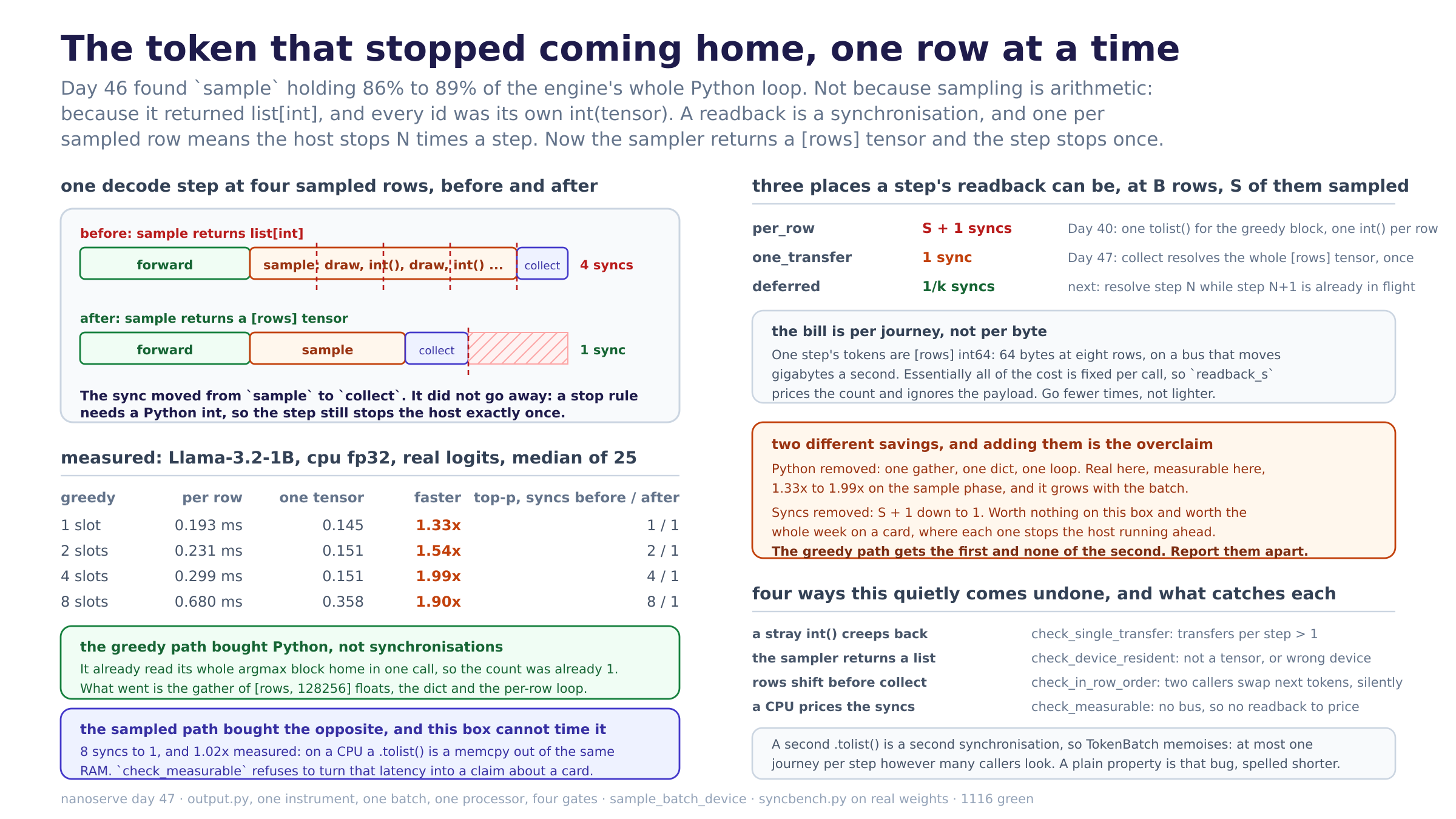
The bill is per journey, not per byte. One step’s tokens are [rows] int64: 64 bytes at eight rows, on a bus that moves gigabytes a second. Essentially all of the cost is the fixed part, so readback_s prices the count and ignores the payload, and the optimisation it points at is going fewer times rather than carrying less.
Two savings landed and they are not the same saving. The Python one is real on this box and measurable on it: 1.33x to 1.99x on the sample phase, growing with the batch, because what went away includes a gather of [rows, 128256] floats. The synchronisation one is 8 down to 1 at eight sampled rows, is worth nothing here and is worth the week on a card. They are reported in separate columns and saving_per_step returns 0.0 for the greedy path on purpose, because adding them together is how a modest day becomes an overclaim.
A sync was moved, not removed, and the profile says so. collect still has to turn the tensor into ints, because append_token applies the stop rules and a stop rule needs a Python int. So syncs=True came off sample and went onto collect, sync_points is still 1, and recommended_model still says serial. The next step is vLLM’s async output processing: resolve step N’s tokens while step N+1 is already in flight, which costs one token of overshoot past a stop condition and removes the last synchronisation. syncs_per_step(..., strategy="deferred", window=k) is the arithmetic for it, and it is arithmetic rather than code because the engine does not do it yet.
What I learned
- The measurement I could not make from the outside was “did it sync”. A synchronisation leaves nothing in a return value. It shows up as the host waiting, and on a box with no accelerator it does not show up at all, so no assertion about tokens can check that the sampler stopped reading back. Two things fixed that.
Readbackturns every deliberate journey home into an integer the gates read. And the tests monkeypatchtolist,itemand__int__ontorch.Tensorinto raising for the duration of a call, which turns “did not sync” into a failure rather than a comment. That is the first test in this project whose subject is an operation that does not happen. - The all-greedy fast path was the whole win on this box, and it is not the win I set out to get. I went after the readback count and the count was already 1 for greedy rows: they were one batched
argmaxand one.tolist()since Day 40. What was actually costing 0.193ms at one row and 0.680ms at eight waslogits[greedy], a fancy-index gather that copies[rows, 128256]floats before an argmax that never looks sideways in the first place.logits.argmax(dim=-1)is the same answer for no copy. Half a millisecond at eight rows, from deleting an indexing expression that looked like it was selecting rows and was actually allocating 4MB. - The saving grows with the batch, which is the opposite of what Day 46 taught me to expect. Day 46’s lesson was that the loop is roughly flat in the batch and therefore cheap per token at high B. This one is not flat: it was a gather whose size is the batch, so removing it gets better with more rows, 1.33x at one and 1.90x at eight. Worth noticing because the flat-loop model is the one I now reach for by default, and this is a per-step cost that was not flat and was hiding inside a phase whose name suggested arithmetic.
- The sampled path shows nothing on a CPU and that is the measurement, not a failed one. top-p at eight rows is 60.9ms before and 59.6ms after: 1.02x, well inside the noise. The filters sort a 128256-wide vocabulary per row and that dominates everything else by two orders of magnitude, while the eight synchronisations I removed cost nothing here because there is no bus to cross.
check_measurablerefuses to price them from this box, the same way Day 46’scheck_device_timedrefuses to price an optimisation from a CPU profile. Reporting “1.02x” as the result of removing seven synchronisations would be true and would be a lie about a different machine. - I nearly ran the before and after on different days, and it would have been worthless. The obvious comparison was Day 46’s profbench numbers against today’s. I re-ran that exact config and the forward came out at 389ms, 775ms and 1135ms against Day 46’s 307ms, 534ms and 982ms: the same code, 27% to 43% slower, because the box is busier today. Every phase in the loop moved with it. A before and after taken two days apart on a shared machine is a measurement of the machine’s mood. The number that survives is a paired one: both implementations, in one process, seconds apart, over the same logits tensor, median of 25. That is why
rowwise_samplelives insidesyncbench.pyas a copy of the Day-40 body rather than as a second path left behind insampling.py, where it would quietly stop matching. - Memoising the resolve is the difference between one sync a step and one per caller.
TokenBatch.resolvecaches, and the first version of it was anidsproperty that recomputed. Nothing about that is visibly wrong: the values are identical every time. It just means the log line somebody adds next month costs a full round trip, and the counter is the only thing that would ever say so. The gate for it,check_single_transfer, reads a rate rather than inspecting code, which is the only form of this check that survives contact with a future commit. - The
[rows]tensor is anonymous and that is a real hazard, so the ids ride with it. Betweensampleandcollectnothing moves, but the thing this is building toward is deferring the resolve across a step boundary, and between one step and the next the scheduler releases finished rows and admits new ones. A row order that shifted in between hands one caller another caller’s next token, both answers stay grammatical, and no shape check fires because the lengths still agree.TokenBatchcarriesrequest_idsandcheck_in_row_ordercompares them, which costs a tuple comparison per step and buys the one bug in this area that would otherwise be found by a user. index_copy_needs an index tensor, and building one is a launch rather than a sync. The mixed path writes greedy results and each filter group into one[rows]buffer by index, and the indices come from Python lists viatorch.tensor(..., device=...). That is a host to device copy, which the host hands to the driver and walks away from; it is the opposite direction from the thing being removed. Easy to talk yourself out of on the grounds that it is “still a transfer per step”, which is true and is not the transfer that costs anything.
Diagram
token-readback.png. Left top is one decode step drawn twice, four red stop lines through the old sample phase and one through the new collect. Left bottom is the measured sweep with the greedy and sampled paths kept apart. Right top is the three strategies and the per-journey cost model, right middle is the two savings and why they do not add, and right bottom is the four gates plus why the resolve is memoised.
Tomorrow
The last synchronisation in a decode step is collect, and removing it means not resolving step N’s tokens until step N+1 has already been launched, which the decode input can support because the next input_ids is the previous step’s device tensor and never has to come home at all. The cost is one token of overshoot past a stop condition, discarded when the resolve catches up. Day 48 is that, priced first with syncs_per_step(..., strategy="deferred") and gated by check_in_row_order, which is exactly the check a one-step lag needs. torch.compile on the decode step is after it, once there is no readback left for it to work around.
Post angle
Day 47 of building an LLM inference engine from scratch. Yesterday’s profile said the sampler was eating 88% of my engine’s Python loop, which made no sense: sampling is an argmax. Today I found out why, and it was the return type. sample_batch returned list[int], and every one of those ints was its own int(tensor). On a GPU that is not a copy, it is a stop. Launches are asynchronous, so the host queues kernels and runs ahead, and Python that fits under the arithmetic is free. Reading a value back ends that, because the number does not exist yet. Eight sampled rows meant nine stops a step. So the sampler now returns a [rows] tensor that stays on the device and the step reads it home once. Three things I did not expect. The first is that on the path my engine actually runs, all greedy, the sync count was already 1, and the real cost was logits[greedy]: a fancy-index gather copying [rows, 128256] floats before an argmax that never looks sideways. Deleting it is 1.33x at one row and 1.90x at eight, and it gets better with the batch, which is the opposite of what a loop cost usually does. The second is that the sampled path shows 1.02x here and drops 8 synchronisations to 1, so the two savings are completely different quantities and my box can only see one of them; there is a gate that refuses to price the other from a CPU. And the third: I did not remove a sync, I moved it. collect still needs a Python int to apply a stop rule, so the step still stops once and the profile still says serial. Resolving it one step late, the way vLLM does, is what removes the last one, and it costs one token of overshoot. 1116 green.