Day 53: the inputs stopped being built, and the witness that shared their storage
Date: 2026-09-07 · Week 13 · Phase 5 Benchmark and optimize
What I added today
nanoserve.inputs, the decode step’s four input tensors allocated once and written in place. An InputBuffer is one [max_rows, *tail] int64 buffer plus a staging mirror on the host, pinned when the buffer is on CUDA; write puts a Python list into the mirror through its numpy view (which allocates nothing at all) and copies it down with one copy_, or copies a tensor that is already on the device straight in. window(rows) is buffer[:rows], basic slicing, so the same storage at the same address. DecodeInputs is the four of them, sized from the cache’s row count: input_ids and positions [rows, 1], write_slots and context_lens [rows].
The arithmetic is input_cells, input_bytes, fresh_cells, fresh_allocations, per_shape_bytes and sharing_ratio. The gates are check_addresses_stable, check_plan_inputs_persistent, check_step_inputs_persistent, check_inputs_fit, check_one_set_covers, and check_snapshots_present, which is the correctness one.
The wiring is five changes. DecodePlan grows context_snapshot and write_snapshot, host-side copies of the two tensors as they were at build time, plus context_list and write_list to read whichever source is the real witness. check_plan_current and check_window_intact go through those two properties instead of through the tensors. SlotTable.read takes a lengths_writer, so the lengths land in the caller’s buffer instead of a fresh [rows] vector. The cache gains persist_inputs, writes positions, write_slots and context_lens into self.decode_inputs, and attaches the snapshots. The engine splits _decode_input_ids into what the token is and what tensor it becomes, so the persistent path can take the sampler’s device tensor or a list of host ints, and the torch.cat that padded a bucketed step becomes a wider window on a buffer.
tests/test_inputs.py is 72 tests. Suite 1503 green (5 GPU-gated skips), ruff clean.
inputbench.py, host only, no weights, 3 rows of an 8-row cache from a 16-token prompt (day-53-inputbench.csv):
steps   allocations       writes    cells    plan ms fresh -> buffered
    8        24 -> 0           24       72        0.560 ->    0.666
   64       192 -> 0          192      576        3.762 ->    4.193
  128       384 -> 0          384    1,152        7.406 ->    8.218
  512     1,536 -> 0        1,536    4,608       29.664 ->   32.778
and the second table, which is the memory question the day set out to answer, at 256 rows and 8192 tokens:
one set of 4 inputs                        8,192 bytes
a set per captured shape (36 shapes)      65,408 bytes       8.0x
the Day-51 slot table                 16,777,216 bytes   2,048.0x
Why it matters
Four days have been about the same sentence, and this is the last clause of it. A replayed CUDA graph takes no arguments. It re-runs the kernels it recorded, reading the buffers those kernels were recorded against, so every input has to be at a fixed address, in a fixed shape, holding whatever this step wants said. Day 49 removed the graph breaks, Day 50 moved the addressing out of the forward so the only guard left is on a tensor shape, Day 51 made the read rectangle a window so its address stopped moving, Day 52 rounded the shape into a closed set. Everything else the forward is handed was still a fresh tensor: 1,536 of them over a 512-step run, none at an address the next step reuses. Today they are four buffers and 0.
The day costs host time and buys an address, which is the opposite trade to every other day this week. 32.8ms against 29.7ms over 512 steps, about 10%. Nothing here makes a step do less work. A fresh [3] int64 is cheap to allocate, and writing one into an existing buffer still has to get the numbers out of a Python list, so the buffered arm pays a staging write plus a copy where the fresh arm paid a constructor. What changes is the second column, and allocations is not a performance number: it is the count that has to reach zero rather than the count that has to get small. One allocation in the middle of a captured run is not a slow run, it is a graph reading storage that belongs to somebody else.
Day 47’s fastest path is the one this day makes slower, on purpose. The token a decode row forwards is the token the previous step sampled, and Day 47 left it on the device so the input was tokens.unsqueeze(1): a view, zero copy, no journey home. A replay cannot use a view on the sampler’s output, because that allocation is new every step. So the buffer turns a zero-copy view into a one-copy device-to-device write. It is a real regression measured against Day 47 and it is the only version of that line a capture can replay.
And the part I did not see coming: making an input shared disarmed two gates. Day 51 kept context_lens a fresh copy on purpose, and wrote down why: Day 50’s check_plan_current compares a plan’s lengths against the cache’s tables, so a length that lives in a buffer the next step writes through always agrees with them. The gate stops being able to fail rather than starting to. Day 51 avoided that by not sharing. Day 53 has to share, because a replay needs the address, so the copy has to become explicit: context_snapshot and write_snapshot are host-side tuples taken from the lists the tensors were written from, free because the host already had the numbers, and check_snapshots_present refuses a shared plan that carries none. The general rule, which cost the most and is worth the most: when a witness becomes shared storage, it stops being a witness.
vLLM has been doing this the whole time and the reason is the same one. Its model runner keeps input_tokens, input_positions and slot_mapping as pinned host tensors written in place and copied to fixed device buffers, and its cudagraph replay writes into those buffers and calls graph.replay() with no arguments at all. The interesting difference is what it does not need: its kernel reads each row’s length out of a tensor, so its capture list is over batch sizes only and its per-shape state is smaller than mine. The input buffers are the part that is the same, and they are the same because the constraint is a property of graph replay rather than of anybody’s attention kernel.
What I learned
- The gate Day 51 wrote down as a reason not to do something was a spec for how to do it. Day 51’s module docstring says the lengths cannot be persistent because
check_plan_currentwould stop working, and it has a test namedtest_a_length_that_tracked_the_cache_would_disarm_the_staleness_gatethat demonstrates the failure with a hand-built tensor. Two days later that hand-built tensor is the design. The note did not stop me, it told me exactly what I owed: one snapshot, one gate, and the older test passes unchanged because it never used persistent inputs. Writing down why you are not doing something is worth as much as writing down what you did. check_window_intactwas disarmed too and I nearly missed it. I fixedcheck_plan_current, felt done, and then read Day 51’s docstring line “the witnesses are the plan’s own copies:write_slotsandcontext_lenswere taken at build time and cannot move.” That sentence was true when it was written and my change made it false. Both gates had the same shape of bug and only one of them was in the module I was editing. The fix was one property,plan.write_list, and the reason I looked was that Day 51 had named its witnesses out loud.- “Written in place” is a claim about the source as well as the destination. My first buffer wrote with
buffer[:n] = torch.tensor(values), which allocates the tensor the class exists to avoid. The device buffer stops moving and the traffic does not. The fix is the staging mirror and its numpy view,self._flat[:k] = values, which writes into storage that already exists, and on CPU the mirror is the buffer so there is nothing to copy at all. This is what vLLM’s pinned input tensors are and I had read that code without understanding what the pinning was for. - The padded row’s token can be garbage and its slot cannot, and the buffer makes that asymmetry a one-word difference.
write(values, window=graph_rows)widens what comes back past what was written, so a bucketed step’s paddedinput_idskeeps whatever the buffer last held. That is safe for exactly Day 51’s reason: nothing but a legal token id is ever written there, and the row’s logits are dropped.write_slotsandcontext_lensmust not usewindow, because a stale slot in a padded row is a made-up token landing in a real sequence’s history. Two inputs to the same forward, one of which may inherit and one of which may not. - The arithmetic answered the question and then answered a better one I had not asked. How many buffer sets does a 36-shape capture list need? One: a graph is per shape, but a buffer is indexed by batch position, so every shape’s window is a prefix of the same storage. Then I priced the alternative and the whole thing collapsed: a set per shape is 65 KB and one set is 8 KB, against a slot table that is 16 MB. The input side of a decode step was never where the memory went. These buffers are worth having for their address and not for their size, and I would not have said that before writing the table.
- Splitting a function by what it returns made the fast path visible.
_decode_input_idsdid two things: decide what the token is (a held device tensor or a readback) and build the[rows, 1]it becomes. The persistent path only wants the first half, because a tensor and a list take different routes into a buffer. Splitting it is four lines and it is the first time the two halves of Day 47’s deferral have been separable. The buffer wants to know which it got; the old signature had thrown that away. - A benchmark whose fast arm is slower is the honest one. I expected the buffered arm to win on host time and it loses by 10% at every length. The number is real and the day still ships, because the column that matters is
allocationsand it went to zero. I nearly went looking for a way to make the timing come out the other way, which would have meant optimising a number that is not what the day is for. 0is a legal slot and it is why so much of this works. A fresh buffer, a padded column of the Day-51 rectangle, a padded row’s position: all of them are 0, and 0 is legal in every one of those places by construction rather than by luck. Zero-filled allocation means an untouched cell of a new buffer is already valid on its very first read, which is the reason none of these classes has an initialisation step.
Diagram
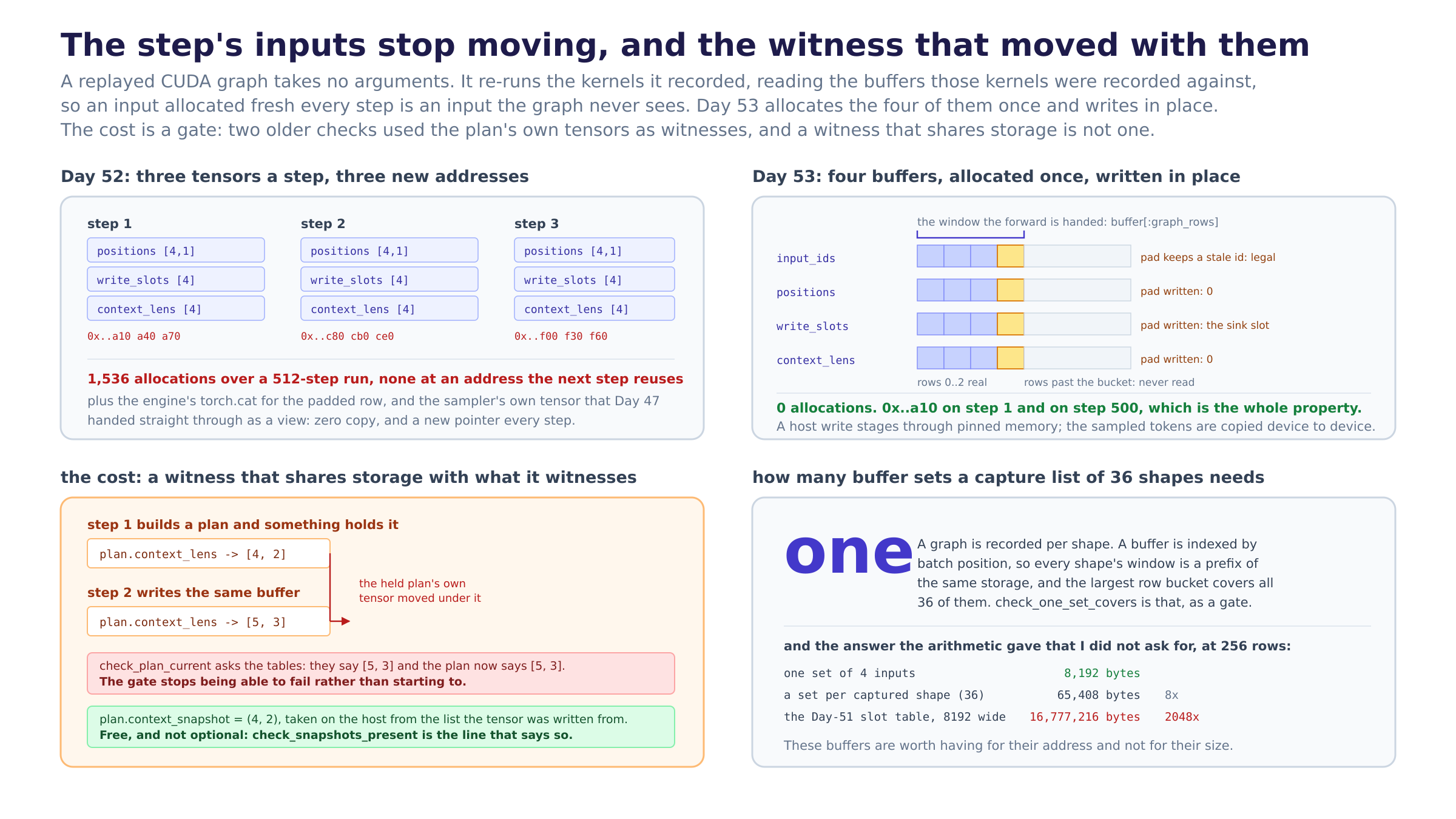
persistent-decode-inputs.png. Left top is the Day-52 input side: three tensors a step at three new addresses. Right top is the same step over four buffers, with the window the forward is handed, the padded row’s three different destinies, and the address that does not change. Left bottom is the disarmed gate: a held plan’s context_lens moving under it, check_plan_current agreeing with everything forever, and the snapshot that re-arms it. Right bottom is how many buffer sets a capture list needs, and the byte table that says it did not matter much.
Tomorrow
Every precondition is now written down and gated: no graph breaks (Day 49), no Python state in the traced region (Day 50), a fixed rectangle address (Day 51), a closed shape set (Day 52), fixed input addresses (Day 53). Day 54 is the capture itself, torch.cuda.graph over one bucketed decode step: record per shape, replay by writing the buffers and calling replay(), and a CapturedDecode that owns the pool the graphs share. The gates written over the last four days become the preconditions it checks before it records anything, which is the point of having written them as functions rather than as comments. The number I expect to be wrong about is memory: check_capture_budget says 36 shapes is a capture list, and 36 recorded graphs each holding a private workspace is a number nobody has measured on this box yet.
Post angle
Day 53 of building an LLM inference engine from scratch. A replayed CUDA graph takes no arguments. It re-runs the kernels it recorded, reading the buffers those kernels were recorded against, so an input allocated fresh every step is an input the graph never sees. My decode step was allocating three tensors a step, 1,536 over a 512-step run, none at an address the next step reuses. Today they are four buffers allocated once and written in place, and the forward gets buffer[:graph_rows], a window. The host got 10% slower and that is fine: nothing here makes a step do less work, and the column that matters went from 1,536 to 0. The part I did not see coming is that sharing storage disarmed two gates. Day 50 checks a plan is not stale by comparing its context_lens against the cache’s tables, and Day 51 wrote down that the lengths could not be a persistent buffer for exactly that reason: a length the next step writes through always agrees with the tables, so the gate stops being able to fail rather than starting to. Day 51’s answer was not to share. Mine has to, so the copy became explicit: the plan carries a host-side snapshot, free because the host already had the numbers. The rule that cost the most: when a witness becomes shared storage, it stops being a witness, and the second gate with the same bug was in a different module. Also, I set out to compute how many buffer sets a 36-shape capture list needs (one: a graph is per shape, a buffer is per batch position, so every window is a prefix of the same storage) and found out it barely mattered. One set is 8 KB, a set per shape is 65 KB, the slot table is 16 MB. These buffers are worth having for their address, not their size. vLLM has kept pinned input buffers all along and now I know what the pinning was for. 1503 green.