Day 17: paging under the sampling path, free-and-reuse closes Week 5
Date: 2026-07-02 · Week 5 · Phase 2 Paged memory
What I added today
The sampling path can now run over the paged pool, and a finished sequence frees its blocks back so the next one reuses them. generate and generate_stream grow three arguments: paged=True (a self-managed pool sized to this one run, the same sizing greedy_generate_paged uses), block_size, and an optional allocator to share one pool across sequences. A small _sampling_cache helper picks the cache: NaiveKVCache by default, PagedKVCache when paging is asked for. The decode loop itself did not change; it already spoke only the append/seq_len interface both caches share, so choosing the cache is the whole edit. The paged cache is freed in a finally, so a run returns every block the moment it ends (normal stop, eos, or a caller that abandons the stream). Five new tests in tests/test_generate.py, including the free-and-reuse stress run: one pool sized for a single sequence serves two back to back, and the second only succeeds because the first freed. I also de-flaked one Day-11 tolerance test (details below). Pure suite 112 green, ruff clean, and the gated real-model tests still match HF token for token.
Why it matters
This closes Week 5. Days 14-16 built the allocator, the block table, and the paged cache, and wired paging into the greedy decode path. But the real decode path is the sampling one (generate), and it was still building a NaiveKVCache directly. Today paging reaches the path the server actually calls. More importantly, free-and-reuse is the first time a finished sequence’s memory provably returns to the pool for another sequence to take. That is the entire economic argument for paging: a pool sized for one sequence can serve a stream of them, one after another, because each hands its blocks back on the way out. The shared pool under many concurrent sequences is Weeks 8-9, but the reuse primitive it stands on is here and tested now.
What I learned
- Free-on-finish belongs in a
finally, not after the loop.generate_streamis a generator with several early returns (eos, the last-token short circuit) and it can also be abandoned mid-drain, which raisesGeneratorExitinside it. Only afinallycovers all of those. Put thefree()after the loop body and a caller who reads three tokens and walks away leaks the whole sequence’s blocks forever. Thefinallyis what makes “a finished sequence never leaks a block” true regardless of how the stream ends. - An
allocatorargument is what makes reuse observable.paged=Truealone builds a fresh pool per call, so two runs never touch the same blocks and reuse is invisible. Passing one sharedBlockAllocatorinto both runs, sized to exactly one sequence, turns the claim into a test: the secondgeneratecan only allocate because the first freed, and if free-on-finish regressed it would raiseKVCacheExhaustedinstead of silently passing. - Choosing the cache, not forking the loop, is the point of Day 16’s interface. The reason wiring paging into sampling was a helper and three keyword arguments, not a second decode loop, is that
NaiveKVCacheandPagedKVCacheexpose the identicalappend/seq_len. The loop never learns which one it holds. Every day I resist duplicating that loop is a day the two decode modes cannot drift. - A tolerance can be flaky without any code being wrong. A Day-11 test compared the incrementally-cached forward against a one-shot full forward at
atol=1e-5on unseeded random weights. Both assemble the same K/V, but they accumulate the attention sum in a different order (incremental concat vs one contiguous matmul), so fp32 rounding alone drifts by ~1e-5 and tripped the bound maybe two runs in five. Loosening it to1e-4, the model’s documented HF-agreement level, fixes the flake without hiding anything: a real cache bug moves logits far more than 1e-4.
Diagram
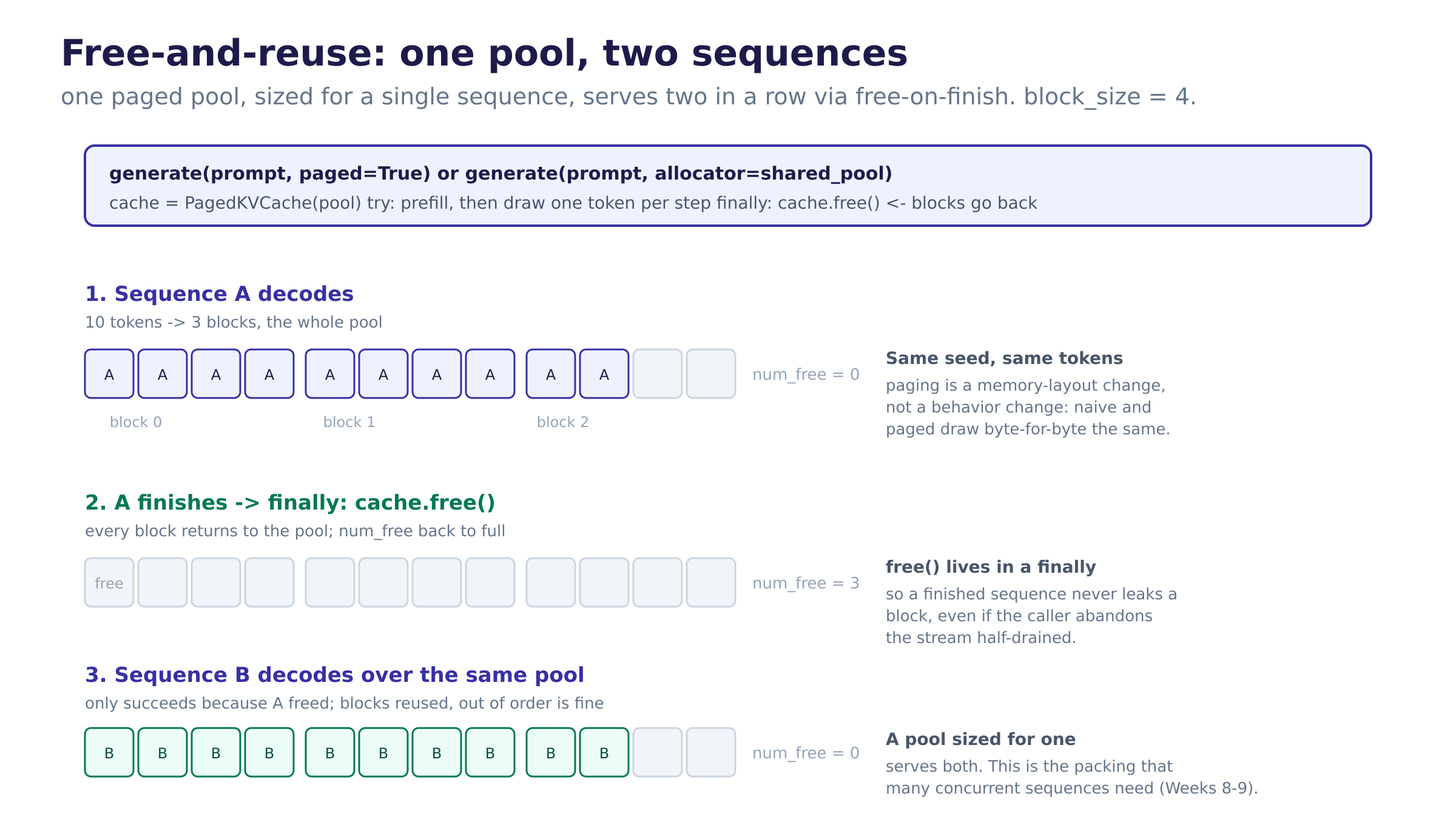
paged-free-reuse.png. One shared pool sized for a single sequence, three snapshots in time. Top: the sampling path builds a PagedKVCache and frees it in a finally. (1) Sequence A decodes and fills all three blocks, num_free = 0. (2) A finishes and free() returns every block, num_free back to 3. (3) Sequence B decodes over the same pool, reusing the blocks A gave back. Same seed draws the same tokens whichever cache is underneath, because paging moves where the K/V live, not what attention computes.
Tomorrow
Week 5 is done: the allocator, block table, paged cache, and now paging under both decode paths with real free-and-reuse. Week 6 replaces the deliberately slow read, the gather-and-reassemble that rebuilds the full contiguous history every step, with a hand-written Triton paged-attention kernel that attends over the scattered blocks directly. The torch reference built across Weeks 4-5 is exactly what that kernel gets verified against: same tokens, same logits, now without materializing the history.
Post angle
Day 17 of building an LLM inference engine from scratch. Days 14-16 built paged memory: a pool of fixed KV blocks, a block table mapping tokens to blocks, and a paged cache that stores real K/V through it, verified byte-for-byte against the naive contiguous cache. But all of that was wired only into greedy decode. Today it reaches the sampling path, the one the server actually calls, and closes the loop with free-and-reuse. The edit was small on purpose: generate and generate_stream gain a paged switch and an optional shared allocator, and a one-line helper picks the cache. The decode loop does not change at all, because the naive and paged caches expose the exact same append/seq_len interface, so the loop never learns which one it holds. Two things earned their keep. The free() lives in a finally, not after the loop, because a streaming generator can stop at eos, at the token cap, or be abandoned half-drained, and only a finally catches every exit; anywhere else and a caller who reads three tokens and walks away leaks the whole sequence’s blocks. And a shared allocator argument is what makes reuse a test instead of a claim: one pool sized for a single sequence serves two in a row, and the second only allocates because the first freed. If free-on-finish regressed, it would raise instead of quietly passing. This is the reuse primitive the concurrent shared pool stands on later. It still matches HF on Llama-3.2-1B token for token. 112 tests green. #AI #LLM #vLLM #BuildInPublic #Claude #OpenAI </content> </invoke>