Day 78: a stand-in for a launch has to be opaque like a launch
Date: 2026-10-07 · Week 14 · Phase 5 Benchmark and optimize
What I added today
Yesterday ended on the one frame Day 77’s gate still caught: the three-arm compiled toy run (--split-read --compile dynamic) failed “every compiled arm stayed compiled” in the split arm, and the stderr said why:
torch._dynamo hit config.recompile_limit (8)
   function: 'torch_dynamo_resume_in_split_kernel_at_877'
   last reason: 14/7: i == 0  # qi = q_rows[i, h]
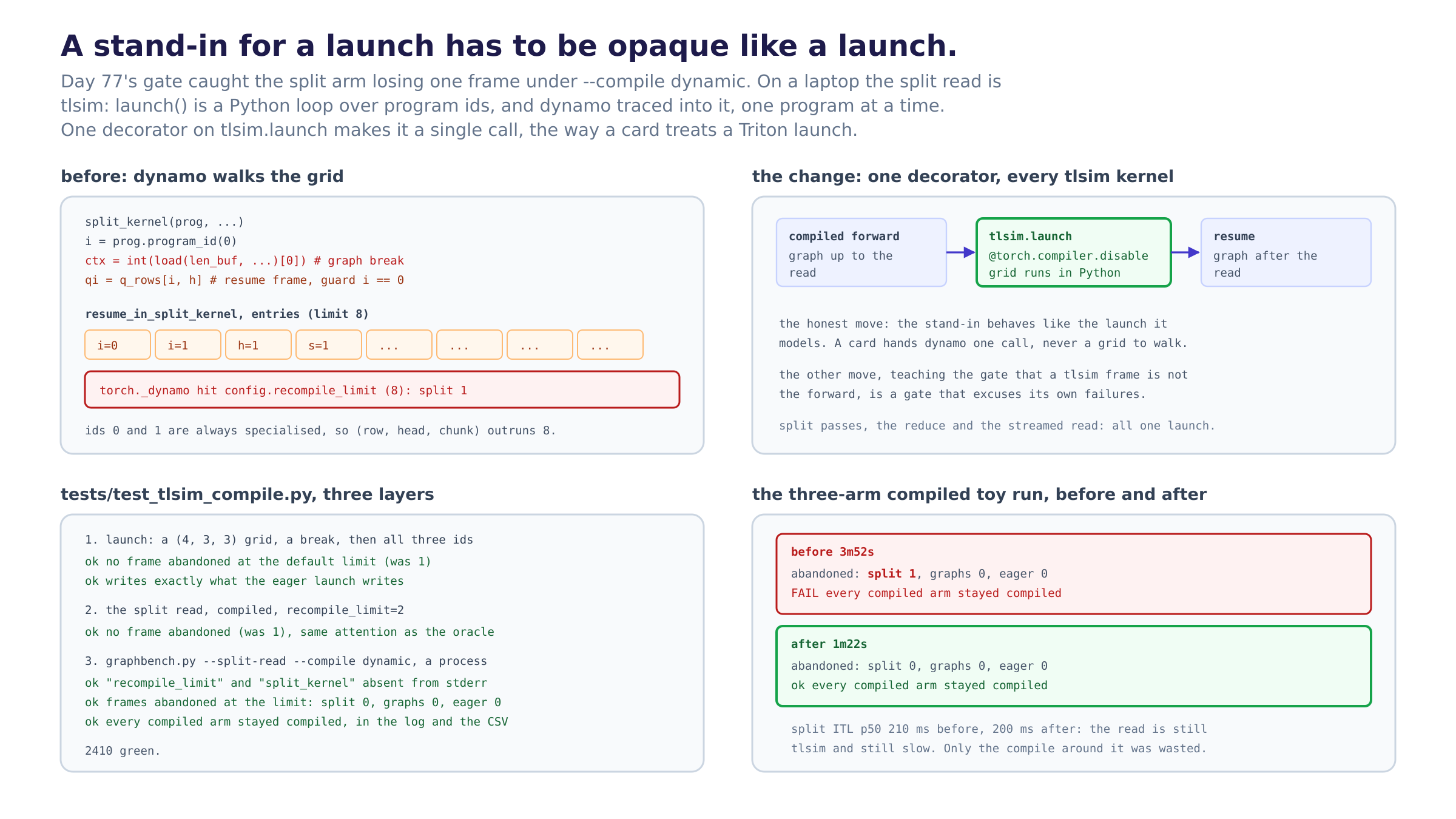
On a laptop the split read is tlsim, and tlsim.launch is a Python loop that calls the kernel body once per program id. Dynamo traced into that loop. The body reads its row’s length as an int (int(load(len_buf, ...)[0])), which is a graph break, so the rest of the body became a resume frame. That frame indexes with i, h and s, ints dynamo guards on, and it always specialises 0 and 1. Three ids over a (row, head, chunk) grid is more than eight entries, and the ninth was given up.
The fix is one decorator. tlsim.launch is wrapped in torch.compiler.disable. A compiled forward that reaches a tlsim read now breaks the graph at the launch, runs the grid in the interpreter, and resumes after it. Every tlsim kernel goes through launch (the split’s pass one, its reduce, the streamed read, Day 21’s gather), so the one wrapper covers all of them, and the Triton path a card takes is untouched.
tests/test_tlsim_compile.py has 8 tests in three layers:
- the launch: a
(4, 3, 3)grid with the split kernel’s shape (read a length as an int, then address the cell with all three ids). Compiled at the default limit it gave up 1 frame before the fix and 0 after, and it writes exactly what the eager launch writes. The wrapper keepslaunch’s name and Day 21’s docstring. - the split read:
paged_attention_split_kernelcompiled withrecompile_limit=2, four rows in three chunks. 1 frame abandoned before, 0 after, and the attention matchespaged_attention_batched_reference. - the process: the three-arm compiled run that failed yesterday. Exit 0, no
recompile_limitand nosplit_kernelin stderr,split 0, graphs 0, eager 0, and the compile claim out ofclaims_failedin the CSV.
Suite 2410 green (34 GPU-gated skips), ruff clean.
Why it matters
The stand-in should fail where the real thing fails, and nowhere else. A card hands dynamo one call for a Triton launch. It never walks a grid. A failure that only exists because the CPU model of a kernel is traceable Python is a failure of the model, and the fix belongs in the model.
The other option was worse. Teaching the gate that a frame named split_kernel does not count would have been a gate that knows where its failures come from and excuses them. The next frame to hit the limit inside a tlsim kernel would have been excused too, and so would a real one with an unlucky name.
It was also most of the run. The three-arm compiled toy run went from 3m52s to 1m22s. The split arm’s ITL p50 barely moved (210 ms to 200 ms), because the read is still tlsim and still slow. What went away was dynamo compiling a resume frame for every program id it had not seen.
What I learned
- Dynamo specialises 0 and 1 even when an int goes dynamic. My first test was a 1-D grid of six programs under a limit of two, and it passed before the fix: after one recompile
iwent symbolic and every later id shared an entry. The split’s grid has three ids, each with its own 0 and 1, and that product is what outruns eight. The test grid is(4, 3, 3)for that reason. - A graph break inside an inlined function turns the rest of it into a frame of its own.
split_kernelis a closure called from a loop, and the break on the row length is what made its tail a cached frame with guards, once per program. torch.compiler.disableis a boundary, not an off switch. The forward around the read still compiles; the graph stops at the launch and picks up after it. That is the same shape a compiled forward has around a custom op on a card.
Diagram
tlsim-launch-opaque.png. Top left: the split kernel’s body, its graph break, and the resume frame’s entries filling up. Top right: the decorator, and why it is the honest move. Bottom left: the three layers of test. Bottom right: the three-arm compiled run before and after.
Tomorrow
The three-arm compiled run is green except for “the arms are comparable”, which wants 20 frame gaps and the toy run has 11. That is a sample-size gate doing its job on a six-request smoke, not a bug, but it means no toy run can pass every claim. Next: a --requests and --max-tokens pair for the smoke that clears the floor in the same wall time budget, or an explicit note in the smoke tests that this one FAIL is expected, so a new FAIL next to it is not lost.
The card run still comes first when hardware is booked, and now every arm of a compiled three-arm run reports a compile it kept.
Post angle
Day 78 of building an LLM inference engine from scratch. My CPU model of a Triton kernel is a Python loop over program ids, and torch.compile traced into it: one recompile per program until dynamo gave the frame up. A card hands dynamo one call per launch. So the model now does too: one torch.compiler.disable on launch. 3m52s to 1m22s, every arm compiled. 2410 green.