Day 07: one full transformer block, end to end vs HuggingFace
Date: 2026-06-22 · Week 1 · Phase 0 Foundations
What I added today
src/nanoserve/layers.py: transformer_block, the pre-norm Llama decoder block that wires the four pieces from Days 4-6 into one (attn_norm, attention, residual, mlp_norm, SwiGLU, residual). Three new tests in tests/test_layers.py: two pure-math (a residual-wiring trap and a per-sublayer-norm trap) and one gated against the real Llama-3.2-1B model.layers[0] hook to 1e-5. Full suite is 44 green.
Why it matters
This is the Week 1 done line. The whole model is this block stacked sixteen times between an embedding and a final norm, so a block verified end to end against HF means the forward pass in Week 2 is mostly a for loop. It is also the first time all four computed pieces run together on the real weights, which is the moment a wiring mistake (rather than a per-piece math mistake) would show up.
What I learned
There is no new math in a transformer block. Every formula was already built and checked to 1e-5 on its own. The entire risk today was dataflow, and a block has exactly two structural decisions: where the norm sits, and what the residual skips.
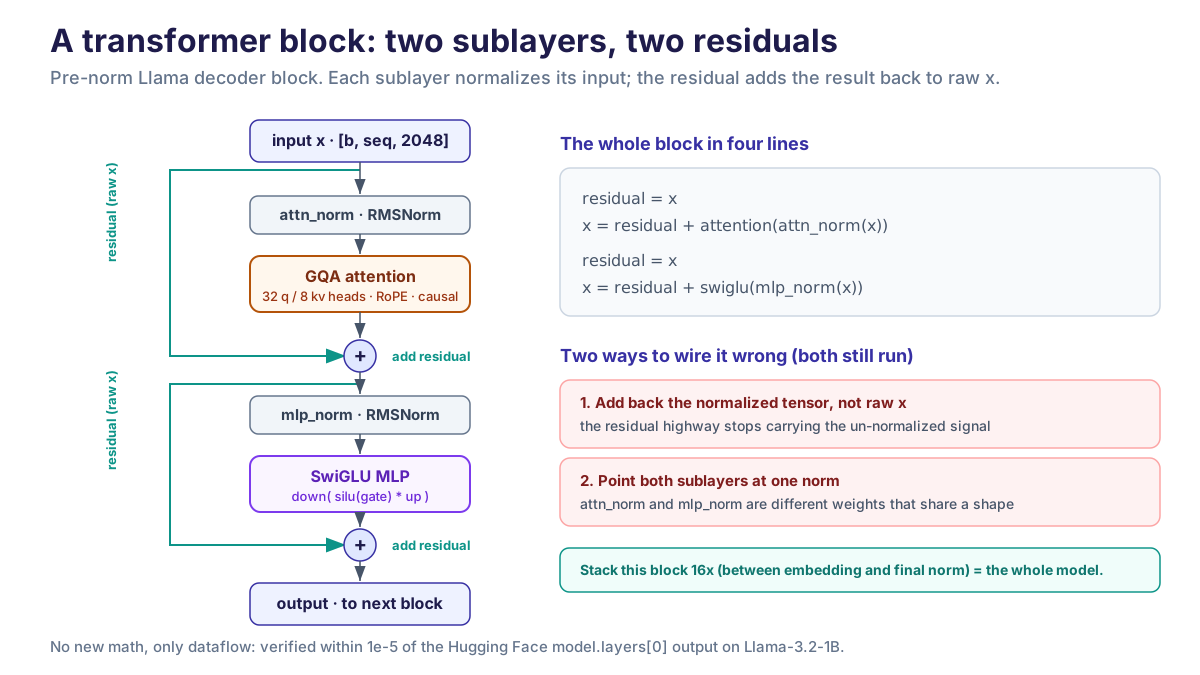
Llama is pre-norm. The norm lives inside each sublayer’s branch, and the residual adds the sublayer output back to the input the sublayer saw before the norm:
x = x + attention( attn_norm(x) )
x = x + swiglu(    mlp_norm(x)  )
The trap is that the normalized tensor is right there in your hand when you go to write the residual add, and adding that back instead of the raw x typechecks, runs, and produces plausible-looking activations. The highway just quietly stops carrying the un-normalized signal. The other easy slip is reusing one norm for both sublayers: attn_norm and mlp_norm are different learned weights, but they are the same shape, so a copy-paste that points the MLP at attn_norm also just runs.
Both bugs are invisible to a smoke test and invisible to the eye, so I wrote a trap for each instead of trusting the HF compare alone:
- Residual wiring: zero out
o_projanddown_proj(the last matmul of each sublayer), which forces both sublayer contributions to exactly 0. A correctly wired block then returns its input untouched (x + 0 + 0). If a residual added back the normalized input, or skipped, the output drifts offxand the test fails. This pins the skip connections without needing the real weights. - Per-sublayer norm: pin the attention residual to
x(zeroo_projagain), then perturb onlymlp_norm.weight. The output must move, which proves the MLP branch actually readsmlp_normand not some shared norm.
Then the real one: feed layer 0 its true input (the token embeddings, captured off the embed_tokens hook), run transformer_block with the loader’s full layer-0 weight set and our own RoPE table, and compare to what HF’s model.layers[0] hook emits. 1e-5 on the first run. The Weights.layer(0) helper from the Day 3 loader returns exactly the in-block-named dict the function wants, so the call site is one line, which is the payoff for getting the names right back on Day 3.
That closes Week 1: the map, the weights, the four pieces, and now the block they form, all checked against the real model. Week 2 stacks sixteen of these and chases HF token for token.
Diagram
transformer-block.svg — the block dataflow (input, attn_norm, attention, residual, mlp_norm, SwiGLU, residual, output) with the residual highway drawn as the skip around each sublayer, the whole block in four lines, and the two wiring traps (adding back the normalized tensor instead of raw x; pointing both sublayers at one norm).
Tomorrow
Week 2, Day 8: start the full forward pass in model.py, the embedding lookup and the loop that stacks the block sixteen times into a final hidden state, on the way to greedy decode matching HuggingFace token for token.
Post angle: Day 7 of building an inference engine from scratch, and the end of week one. Today I assembled a full transformer block from the four pieces I built this week, and it matches Hugging Face to 1e-5 on the first run. The lesson of the day is that a block has no new math in it at all. Every formula was already proven. The only thing that can go wrong is the plumbing: a transformer is pre-norm, so each sublayer normalizes its own input and then the residual adds the result back to the input as it was before that norm, not after. The normalized tensor is sitting right there when you write the add, and grabbing it by mistake compiles, runs, and produces activations that look completely reasonable while quietly breaking the residual highway. The other trap is that the two norms in a block are different learned weights that happen to be the same shape, so pointing both sublayers at one of them also just runs. Neither shows up in a smoke test, so I wrote two trap tests: one zeros the last matmul of each sublayer so a correct block becomes the identity (proving the skips are wired), and one perturbs only the second norm and demands the output move (proving each sublayer reads its own). That is week one done: the weights load, the four pieces are each verified against the real Llama-3.2-1B, and now the block they form is too. Week two stacks sixteen of these and goes for matching the reference token for token.