Day 37: an async server over a synchronous GPU loop
Date: 2026-08-17 · Week 10 · Phase 4 Serving layer
What I added today
server.py has been a docstring and three TODOs since Week 1. Two of them are closed. src/nanoserve/serving.py is the bridge: one background task that steps the engine forever, an inbox that HTTP handlers push arrivals onto, and one future per request resolved when that request finishes. src/nanoserve/server.py is the FastAPI app over it: POST /v1/completions in the OpenAI shape, GET /health, and a set of refusals. tests/test_serving.py (20 tests) and tests/test_server.py (16) run the whole thing in-process over the tiny random model, so nothing here needs ./weights or a socket. Suite 565 green (5 GPU-gated skips), ruff clean.
Every day until now had exactly one caller. Engine.generate takes a list of prompts, drives step() in a while loop, and owns the process until it drains. That is right for a benchmark and useless for a server, where requests arrive from sockets that already exist, at moments nobody chose, and the entire point of Week 8 is that a request admitted now joins a batch already in flight.
Why it matters
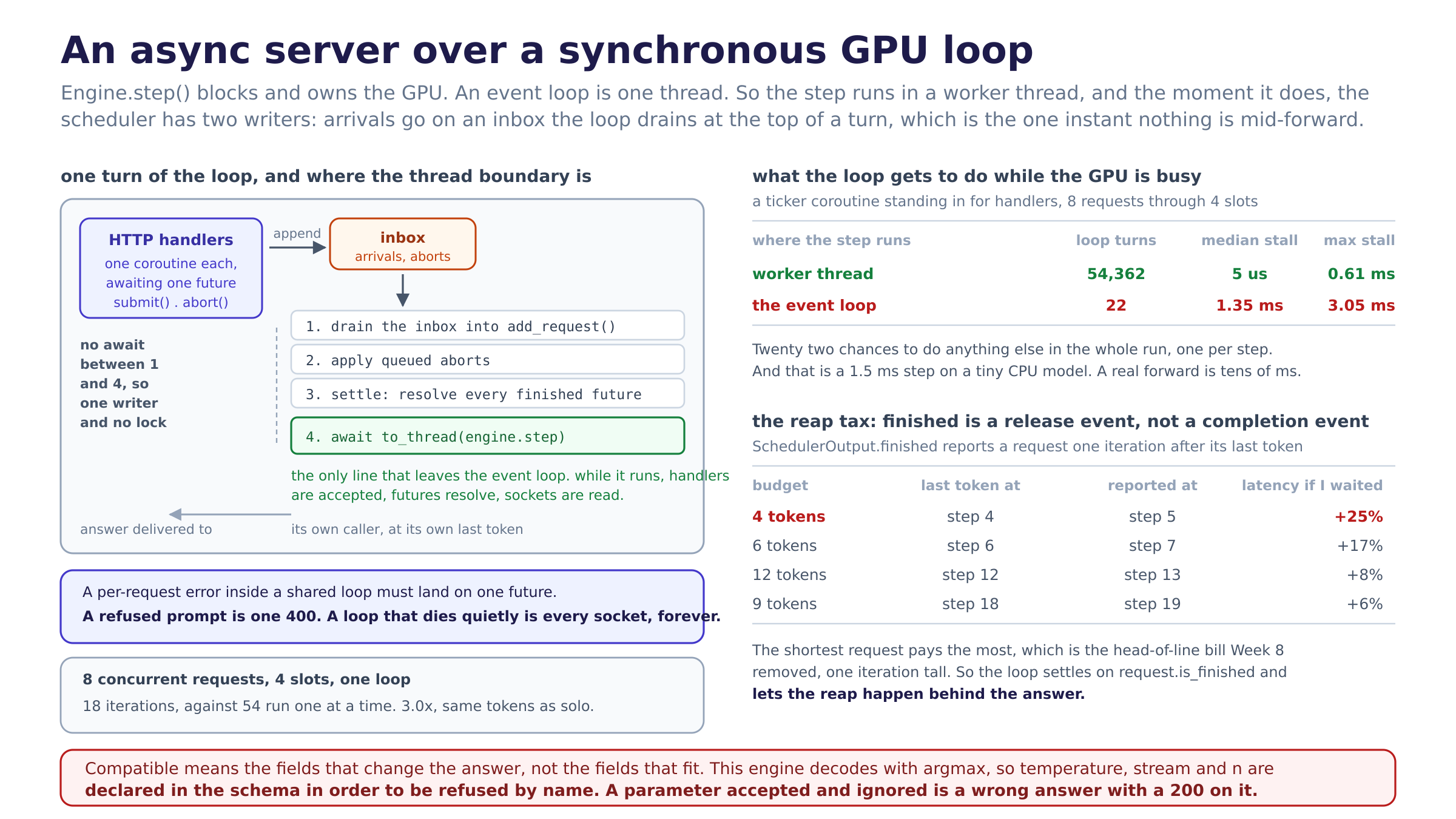
Engine.step() blocks and owns the GPU, and an event loop is one thread. Call the step from a coroutine and the loop stops for its whole duration: no socket is read, no arrival accepted, no finished answer written back. The server is still correct, and every request in the batch still gets the right tokens, which is exactly what makes this a bad bug to have. So the step runs in a worker thread and the loop is free while it does. Measured, on 8 requests through 4 slots, with a ticker coroutine standing in for handlers:
| where the step runs | turns the loop got | median stall | max stall |
|---|---|---|---|
| worker thread | 54,362 | 5 us | 0.61 ms |
| the event loop | 22 | 1.35 ms | 3.05 ms |
Twenty two chances to do anything else in the whole run, one per step, against fifty four thousand. And that is a 1.5 ms step on a tiny CPU model; a real forward is tens of milliseconds, and the stall column is what a /health probe, a new connection, and every already-finished answer wait behind.
A thread means two writers, so arrivals need a queue. The moment the step leaves the loop, the scheduler has two threads reaching for it: the worker inside schedule(), and the loop inside a handler that wants to add a request. There is no lock in Scheduler, on purpose, because everything it does is meant to happen at one point in the iteration. So a handler never touches the engine. It appends to an inbox, and the loop drains the inbox at the top of a turn, which is the one instant when nothing is mid-forward. Aborts take the same road. The order inside the loop is the whole invariant:
drain the inbox        \
apply queued aborts     >  no await between these: one writer, no lock
settle finished futures /
await to_thread(step)      the only line that leaves this thread
Deliver on finish, not on the reap. SchedulerOutput.finished reports a request one iteration after its last token, because releasing its slot and blocks is the next schedule’s first job. It is a release event and I had been reading it as a completion event. Waiting for it charges every caller an extra iteration for something the engine already knew, and the bill is regressive:
| budget | last token emitted | reported finished | latency if I waited |
|---|---|---|---|
| 4 | step 4 | step 5 | +25% |
| 6 | step 6 | step 7 | +17% |
| 12 | step 12 | step 13 | +8% |
| 9 | step 18 | step 19 | +6% |
The shortest request pays the most, which is the same shape as the head-of-line bill Week 8 removed, one iteration tall. So the loop settles on request.is_finished and lets the reap happen behind the answer. The test that pins it holds the reap step shut inside a worker thread: an answer that arrives anyway is an answer that did not wait for it.
Compatible means the fields that change the answer. The engine samples with argmax. Accepting temperature=0.7 and returning greedy tokens with a 200 on them is a wrong answer nothing downstream can detect, so temperature, stream and n are declared in the schema in order to be refused by name, with a 400 that says when they land. Status codes are claims about whose fault it is: a token id outside the vocab is a 400 here and an IndexError in the embedding lookup (a 500) without the check, which I verified rather than assumed. A budget too large for the pool is a 400 whose refusal is made by Scheduler.add_request inside a loop shared with every other request, comes back on one future, and becomes one caller’s status code while the others keep generating.
Eight concurrent requests through one loop: 18 iterations against 54 run one at a time, 3.0x, with each answer identical to its solo run.
What I learned
- A shared loop turns every per-request error into a broadcast unless you route it. Offline,
Engine.generatehas one caller and may simply raise at it. Here a rejected prompt is refused inside the drain, on behalf of somebody who is not on the stack, and letting that propagate kills the loop and hangs every other open connection. Three of the four error paths in the bridge exist only because the loop is shared: the rejected arrival goes to its own future, a step that raises goes to all of them, a schedule that stops progressing goes to all of them too. A loop that dies quietly is a server where nothing ever answers again, and that is strictly worse than a server that returns 500s. - The offline hang guard and the serving one are not the same guard.
run_to_completionraises after N iterations, which is a fine way to learn about a deadlock from a terminal and an unacceptable way to learn about one from a request that never returns. Day 36’s watermark deadlock was exactly this shape. Same detection, different obligation: a server has to fail sockets. - The first version of the inline comparison deadlocked, which was the honest result. My inline loop had no
awaitin the busy path, so once it had work it spun forever and never yielded: the second request was never even submitted and the first request’s waiter never ran. I addedawait asyncio.sleep(0)after the step to make the comparison fair. The unfair version is what an inline server actually looks like when somebody writes it in a hurry, and it does not degrade, it stops. - A disconnect has to reach the scheduler. A cancelled handler that leaves its request running is a slot and a block reservation held for an answer nobody will read, on a pool that Day 33 deliberately stopped over-reserving. So
generatecatchesCancelledErroron its way out and aborts, and the settle pass aborts on a cancelled future too, for callers who usedsubmitdirectly. The abort still has to wait for an iteration boundary like everything else. - Ids are the bridge’s map key, so a duplicate is a correctness bug, not a nuisance. Two in-flight requests with one id means one caller gets the other’s tokens. It is refused synchronously in
submit, along with an empty prompt and a budget below one, because a check that needs nothing from the engine belongs in the handler where it can be a 400 before the loop has spent an iteration on it.
Diagram
serving-bridge.png. Left is the loop’s turn drawn as four bands with the thread boundary marked: drain, aborts, settle, then the one await that leaves the event loop, with the note that nothing between the drain and the step yields, which is why one writer is enough and no lock is needed. Right is the two measurements: the stall table for step-on-loop against step-in-thread, and the reap tax with the short request paying 25% and the long one 6%. The banner is the rule the refusals follow: a parameter that would change the answer is honoured or refused, never accepted and ignored.
Tomorrow
Day 38 points this at the real model. serving.py and server.py both take their engine and their tokenizer by injection and have never met Llama-3.2-1B, so what is missing is the launcher: load the weights, size the block pool against actual VRAM instead of a test constant, build the HF tokenizer, hand the three of them to create_app, and run it under uvicorn so the thing can genuinely be curled. The interesting part is the pool sizing, which is the first time this project has had to turn a number of gigabytes into a number of blocks. Streaming is Week 11 and the bridge is already the right shape for it: one future becomes one queue.
Post angle
Day 37 of building an LLM inference engine from scratch. Today the engine got an HTTP server, and the whole problem is one sentence: Engine.step() is a blocking call that owns the GPU, and an asyncio event loop is one thread. Call the step from a request handler and the loop stops for its entire duration. Nothing else runs: no new connection is accepted, no arrival is queued, no already-finished answer is written back to the socket it belongs to. The server is still correct, every request still gets the right tokens, which is what makes it a nasty bug. I measured it with a ticker coroutine standing in for handlers, 8 requests through 4 slots: with the step on the event loop the loop got 22 turns in the whole run, one per step, and stalled 1.35 ms at a time. With the step in a worker thread it got 54,362 turns and stalled 5 us. That is a 1.5 ms step on a tiny CPU model. A real forward is tens of milliseconds. But the moment the step goes to a thread, the scheduler has two writers: the worker inside schedule() and the loop inside a handler calling add_request. There is no lock in the scheduler and there should not be, because everything it does is meant to happen at one point in the iteration. So handlers never touch the engine. They append to an inbox, and the loop drains it at the top of a turn, with no await between the drain and the step. One writer, no lock, one answer to “when is it safe to add a request”. The thing I got wrong first: I was delivering answers off SchedulerOutput.finished, which reports a request one iteration after its last token, because releasing its slot and blocks is the next schedule’s job. That is a release event, not a completion event, and waiting for it taxes every caller an iteration for a fact the engine already had. It is regressive too: +25% latency on a 4 token completion, +6% on an 18 step one. Delivering on request.is_finished instead makes it free. Also, my first attempt at the inline comparison deadlocked, because a loop with no await in its busy path never yields, so the second request was never even submitted. That is not a straw man, that is what an inline server does. vLLM’s AsyncLLMEngine is this same shape. 565 green.