Day 05: SwiGLU, the gated MLP every modern model uses
Date: 2026-06-20 · Week 1 · Phase 0 Foundations
What I added today
src/nanoserve/layers.py: swiglu, the block’s feed-forward sublayer (down(silu(gate(x)) * up(x))), three bias-free matmuls. Plus three tests in tests/test_layers.py: two pure-math (the definition, and a guard that the gate and up branches are not interchangeable) and one gated against the real Llama-3.2-1B mlp hook to 1e-5. Full suite is 36 green.
Why it matters
A transformer block is two sublayers: attention, which mixes information across tokens, and the MLP, which transforms each token on its own. The MLP is where most of a model’s parameters and most of its raw compute live. Day 4 did the normalizer; this is the second computed piece. After tomorrow’s attention, all four ingredients of a block exist.
What I learned
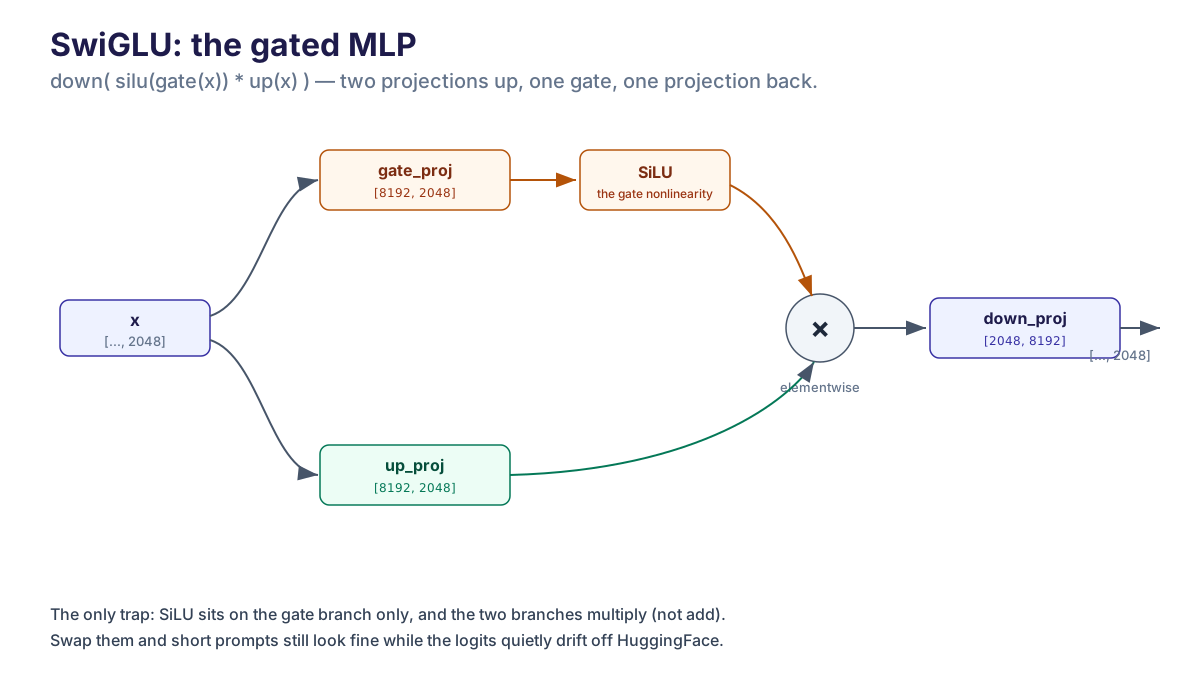
A plain MLP is down(act(up(x))): project up to a wide hidden dim, apply a nonlinearity, project back. SwiGLU splits the up-projection into two parallel matrices. One, the gate, goes through SiLU; the other, up, does not. They are multiplied elementwise, then projected down:
down( silu(gate(x)) * up(x) )
The intuition that made it click: the gate is a learned, input-dependent valve. For each of the 8192 intermediate channels, silu(gate(x)) produces a soft 0-to-1 multiplier on the matching up(x) channel, so the network can open and close parts of the feed-forward per token, instead of pushing everything through one fixed nonlinearity. That is the “gated linear unit” idea; SiLU is just the smooth gate function.
It costs a third matrix, so Llama sizes the intermediate dim at about 2.7x hidden (8192 for this 2048-hidden model), not the classic 4x. Same parameter budget, spent on a gate instead of a wider single projection.
The one thing to get exactly right is which branch the nonlinearity sits on. SiLU goes on the gate only, and the branches multiply, not add. Swap them, or move the SiLU, and because SiLU is nonlinear the output genuinely changes, but short prompts still look plausible while the logits drift off HF. So one test does the real comparison (1e-5 against the HF mlp hook on the layer’s true input), and a second is a pure trap test: run swiglu with gate and up exchanged and assert the result disagrees, so a future refactor that flips them fails loudly.
Easiest 1e-5 of the week. No conventions to argue about like RoPE had, just three matmuls in the right order. The HF LlamaMLP.forward is the same three lines, so mirroring it is trivial and the match is immediate.
Diagram
swiglu-gated-mlp.svg — x fans out to the gate and up projections, SiLU on the gate branch, elementwise multiply, then down. The shapes (2048 to 8192 and back) and the one trap (SiLU on the gate only) called out.
Tomorrow
Day 6: GQA attention in layers.py. Q/K/V projections, RoPE on q/k (Day 4 plugs in here), repeat the 8 KV heads to match 32 query heads, causal mask, softmax, output projection. No KV cache yet, just the plain prefill math, verified within 1e-5 of the HF self_attn hook. The usual mismatch suspects: the mask, the head reshape, and the GQA repeat.
Post angle: Day 5 of building an inference engine from scratch. Today: SwiGLU, the feed-forward block almost every modern model uses. A normal MLP widens each token vector, bends it through one nonlinearity, and narrows it back. SwiGLU adds a second parallel projection and uses it as a gate: one branch goes through SiLU to make a soft per-channel valve, the other branch passes straight through, and they get multiplied. So the network can open and shut parts of the feed-forward per token instead of forcing everything through one fixed curve. It pays for that with a third matrix, which is why Llama makes the inner dimension about 2.7x the hidden size instead of the textbook 4x. The whole thing is three matmuls in the right order, and it matches Hugging Face to 1e-5 on the first try. The only way to get it wrong is to put the SiLU on the wrong branch, so I wrote a test that swaps the two branches and demands the answer change, to catch exactly that.