Day 15: the block table, address translation for a scattered sequence
Date: 2026-06-30 · Week 4 · Phase 2 Paged memory
What I added today
BlockTable in src/nanoserve/cache.py: the per-sequence map from a logical token position to the physical block that holds it. It sits on top of yesterday’s allocator and adds append(num_new_tokens), which grows the sequence and pulls a fresh block from the pool only when growth crosses a block boundary; position(p), which translates a logical position to (block_id, offset); slot(p), the flat index block_id * block_size + offset that Week 5’s paged read/write will address; and free(), which hands every block back and resets. Ten new tests in tests/test_cache.py pin it: address translation (the Day-14 example, position 17 lands at offset 1 of the second block), lazy allocation across a boundary, atomic growth under exhaustion, and the headline equivalence. Pure suite 100 green, ruff clean.
Why it matters
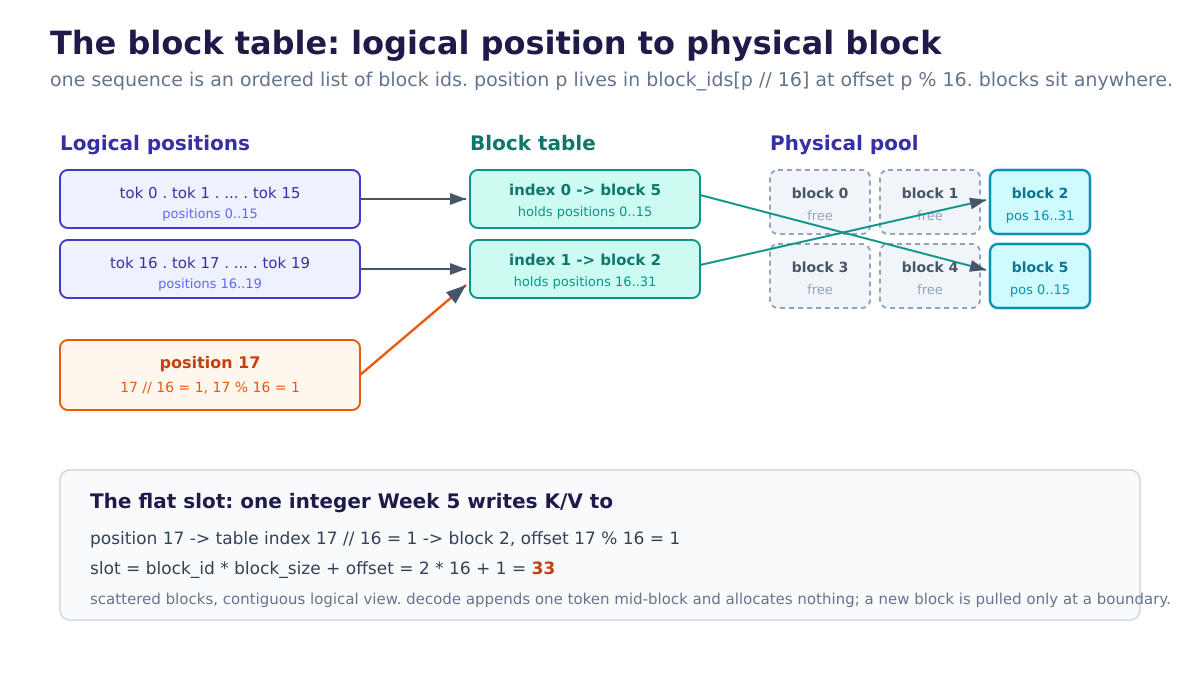
The allocator owns physical blocks but is blind to meaning: it hands out ids and takes them back, nothing more. Nothing yet says which block holds which token. The block table is that missing layer, and it is the exact counterpart of an OS page table: a sequence is an ordered list of block ids, and logical position p lives in block_ids[p // block_size] at offset p % block_size. That one line is the whole paging trick. It buys the freedom the Week-3 contiguous cache never had: the physical blocks can sit anywhere in the pool, scattered, and the model still sees one clean contiguous sequence, because translation does not care whether the blocks are next to each other.
What I learned
- Lazy allocation is what makes paging cheap on the hot path. A new block is pulled at exactly one moment: when a token’s position equals the current capacity, so it has no block yet. The common decode step appends one token in the middle of the last block and allocates nothing. Memory is grabbed one block at a time, only at the instant it is first written, never reserved up front. So
append(1)on a half-full block is pure arithmetic, no pool touch. - The equivalence test is the real contract, and it is the same shape as the cache’s. The KV cache had to prove an optimization changes nothing; the block table has to prove that growing a token at a time (decode) lands a sequence on the exact same blocks and slots as one bulk allocation (prefill). If those diverged, prefill and decode would write the same token’s K/V to different physical addresses and attention would read garbage. So the test grows one table by
append(1)ten times, another by a singleappend(10), and asserts identicalblock_idsand identicalslot(p)for every position. - Growth has to be atomic, inherited from the allocator. If
append(n)needs two new blocks and only one is free, it must take none and raise, leavingnum_tokensandblock_idsexactly as they were. A half-grown table is the same disease as a half-filled allocation: blocks stranded, andnum_tokensout of sync with the blocks actually held.appendleans onallocate_for, which is already all-or-nothing, so the table inherits the guarantee for free. -
Concrete trace, block_size 4, after one sequence freed (so reuse scatters):
seq A (8 tok) -> blocks [0, 1], then free()    # pool LIFO now tops with 1, 0
seq B append(12):
  index 0 -> block 1   holds positions 0..3
  index 1 -> block 0   holds positions 4..7
  index 2 -> block 2   holds positions 8..11
position 5  -> block_ids[5 // 4] = block_ids[1] = 0, offset 5 % 4 = 1
slot(5)     -> 0 * 4 + 1 = 1
B’s blocks are
[1, 0, 2], not a contiguous run, because reuse is last-in first-out and B is running on the memory A just vacated. The logical view is still0..11in order; the physical placement is scattered; translation resolves each one correctly anyway. That gap between the two views is paging.
Diagram
block-table.png. Left: the logical positions of a 20-token sequence. Middle: the block table mapping index 0 to block 5 and index 1 to block 2. Right: those two blocks scattered in the physical pool among free ones. Bottom: position 17 translated all the way to flat slot 33.
Tomorrow
The table computes where every token’s K/V goes but stores no K/V yet. Next is the physical side of Week 5: a real [num_blocks, block_size, num_kv_heads, head_dim] pool tensor, writing each token’s K/V to the slot this table returns, and gathering a sequence’s K/V back out of scattered blocks for attention. Once that read-gather matches the naive contiguous cache token for token, paged attention works in plain torch, before any kernel.
Post angle: Day 15 of building an LLM inference engine from scratch. Yesterday I built the allocator that owns a pool of fixed KV blocks. Today is the block table, the piece that remembers which block holds which token, and it is just an operating system page table aimed at the KV cache. A sequence is an ordered list of block ids, and logical position p lives in block_ids[p // block_size] at offset p modulo block_size. That single line is the whole trick, because it lets a sequence’s blocks sit scattered anywhere in the pool while the model still sees one clean contiguous run. Two things earned their tests. First, allocation is lazy: a new block is pulled only when a token crosses a block boundary, so a normal decode step appends one token mid-block and allocates nothing, which is what keeps paging cheap on the hot path. Second, and this is the real contract, growing a sequence one token at a time (decode) has to land it on the exact same blocks and slots as one bulk allocation (prefill); if those ever disagreed, the two paths would write the same token’s K/V to different physical addresses and attention would read garbage. So the test grows one table by single appends, another in one shot, and asserts the block ids and every flat slot match. The flat slot is the punchline: block_id times block_size plus offset is the one integer next week’s paged read and write will address, scattered blocks underneath, contiguous view on top. 100 tests green. #AI #LLM #vLLM #BuildInPublic #PagedAttention #Claude #OpenAI #MachineLearning