Day 40: one logits tensor, four callers who disagree
Date: 2026-08-21 · Week 11 · Phase 4 Serving layer
What I added today
SamplingParams and BatchedSampler in sampling.py, a sampling field on Request, Engine.sampler in place of the two .argmax(dim=-1) calls, and temperature / top_k / top_p / seed on POST /v1/completions. Day 37 made temperature a 400 that named itself and said it would stay one until the sampler existed. The sampler exists. tests/test_batched_sampling.py is the new file (21 tests) and the rest went where the thing they test lives: 7 in test_engine.py, 3 in test_serving.py, 7 in test_server.py, and Day 39’s test_temperature_is_still_refused_when_streaming became test_a_bad_sampling_parameter_is_still_a_400_when_streaming. Suite 693 green (5 GPU-gated skips), ruff clean.
The real 1B, on CPU, fp32, at temperature=0.8, top_p=0.9:
prompt   "The capital of France is"
greedy   " Paris. It is the most populous city in France and the"
seed 0   " Paris. It is a very beautiful city. It is the"
seed 1   " one of the most beautiful cities in the world. Paris is"
seed 2   " Paris and the official language of France is French. French is"
Three seeds, three different continuations, all of them fluent. The interesting line is the fourth one, which is not in that table.
Why it matters
The tensor is homogeneous and the parameters are not. Since Day 31 the rows of one forward have belonged to different callers, and until today that did not matter to the sampler, because there was no sampler: logits[:, -1].argmax(dim=-1) is one call and it means the same thing for every row. Now row 0 wants greedy, rows 1 and 2 want top_p=0.9 at two different temperatures, row 3 wants top_k=40, and they are slices of one [rows, vocab] tensor. The batch is heterogeneous in what it asked for and cannot be split up, because splitting it up is undoing the whole of Week 8.
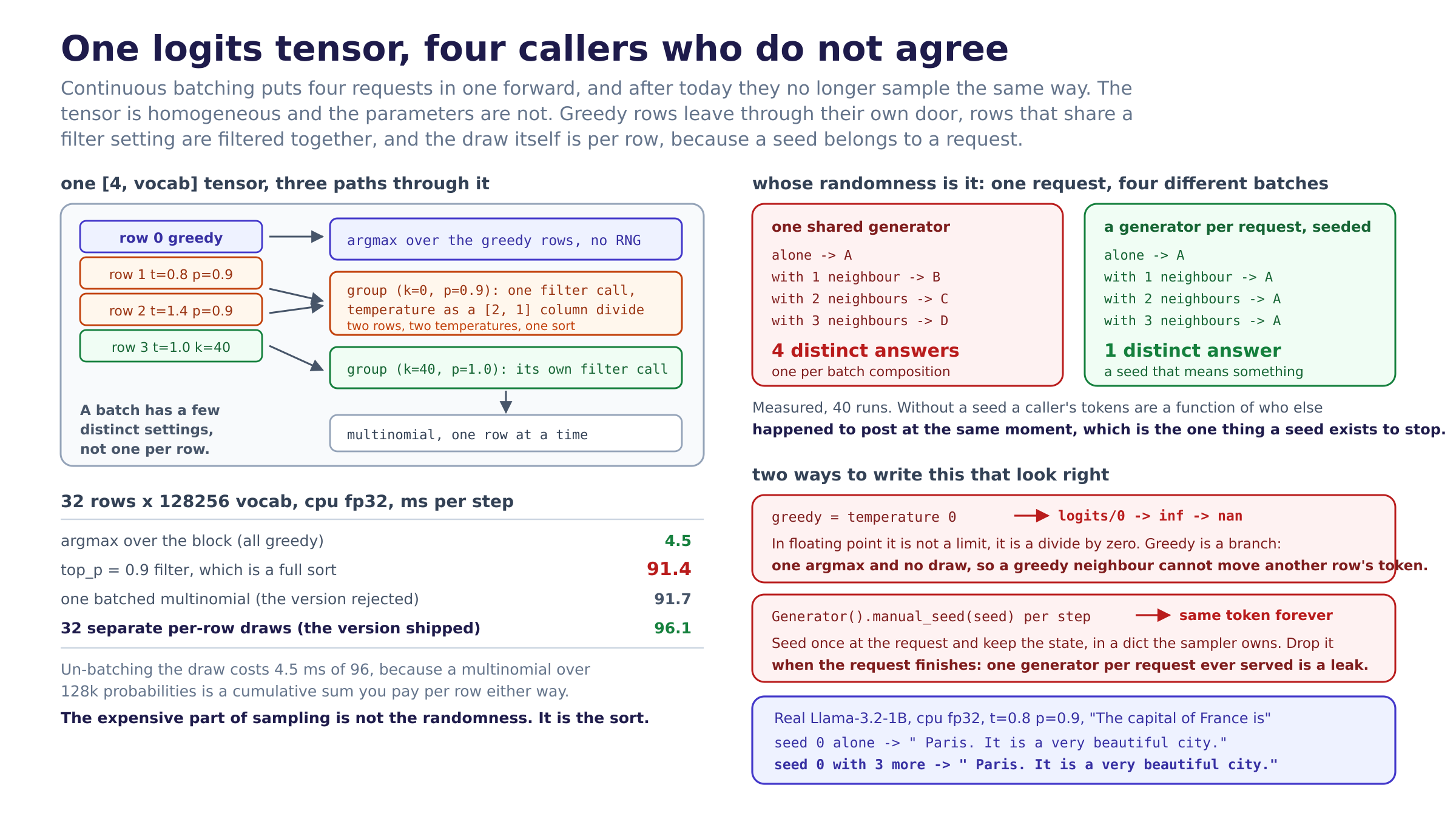
So the sampler splits it three ways instead. Greedy rows leave first, through one argmax over their sub-block. Sampled rows are grouped by filter_key, which is (top_k, top_p) and deliberately not temperature: temperature is a divide and vectorises against a [m, 1] column whatever the values are, while top-k and top-p compute a threshold inside the filter from a scalar, so rows that disagree about k or p have to be different calls. A real batch has a handful of distinct filter settings, not one per request, so that is a few kernel launches per step rather than one per row. vLLM vectorises the whole thing with per-row k and p tensors; this is the same idea with less machinery and the same answers.
The draw itself is per row, and that is the one place batching had to be given up. One torch.multinomial over [m, vocab] advances one generator once for the whole block, which makes every row’s token a function of who else was in the block. That is exactly the coupling a seed exists to remove. I expected to pay for un-batching it, and measured what it costs, 32 rows over Llama-3’s 128256-entry vocabulary, CPU, fp32:
| per step | ms |
|---|---|
argmax over the block (all greedy) | 4.5 |
top_p=0.9 filter, which is a full sort | 91.4 |
| one batched multinomial (the version rejected) | 91.7 |
| 32 separate per-row draws (the version shipped) | 96.1 |
Un-batching the draw costs 4.5 ms out of 96, about 5%, because a multinomial over 128k probabilities is a cumulative sum over the vocabulary that you pay per row either way; batching it saves the loop overhead and nothing else. The line above it is the one worth staring at. The expensive part of sampling is not the randomness, it is the sort: top_p is a full torch.sort of every row’s whole vocabulary, and it costs twenty times what a greedy step costs. That is the number that makes vLLM’s fused sampling kernels look less like premature optimisation than they did yesterday.
A request’s tokens must not depend on who it shared a step with. This is the claim Day 31 made for greedy and it is much harder to keep once there is an RNG in the loop. Measured: one request run 40 times, batched with zero to three other sampled requests, everything else fixed.
one shared generator     ->  4 distinct answers, one per batch composition
a generator per request  ->  1 distinct answer
Four, not because the sampler is flaky, but because it is deterministic in the wrong variable: with one generator the answer is a function of how many rows drew before this one in the same step, which is a function of who else happened to post at that moment. On the real 1B the same test reads:
seed 0, alone               " Paris. It is a very beautiful city. It is the"
seed 0, sharing with 3 more " Paris. It is a very beautiful city. It is the"
byte for byte, which is what a seed is supposed to mean and what a shared generator cannot deliver at any batch size above one.
Greedy is not temperature=0, in floating point. It is tempting to make greedy the limit of the sampled path and delete the branch, and logits / 0 is inf, whose softmax is nan, and a draw over nan either raises or lies. Even a small positive temperature is not it: at 0.01 two logits a thousandth apart are still a coin flip. So greedy is its own path, and the second property of that path matters as much as the first: it consumes no randomness, so adding a greedy row to a batch cannot move anybody else’s token. If greedy went through the softmax it would eat a draw and shift every seeded request that shared the step with it.
The RNG state does not belong to the request. SamplingParams is four numbers and it lives on Request; the torch.Generator lives in BatchedSampler, keyed by request id. Two reasons. scheduler.py is the one module here that owns no tensors and can be tested over plain integers, and hanging a generator off Request would end that. And a generator needs a lifetime: it must survive from one step to the next, and it must be dropped when the request finishes, which is a thing the sampler can do at the point it learns a request is gone (out.finished, which covers aborts too) and a dataclass cannot do at all. Preempted requests are deliberately not in that list: they come back, and their generator has to be where they left it.
What I learned
- Preemption already replays the RNG correctly, and it is not obvious why. A preempted request loses its K/V and re-prefills over prompt-plus-generated, which emits exactly one token, the same as the decode step it replaced. Same number of draws, same order, same generator state, so the sampled text survives a memory decision the caller never sees. It works because Day 33 chose to keep the tokens and throw away the K/V. Had recompute been a re-run from the prompt, every preemption would have silently rewritten the answer, and the test that catches that (
test_preemption_does_not_change_a_sampled_requests_tokens, a 64-block pool against a 3-block pool on identical requests) would have been the only thing standing between me and a bug that appears only under memory pressure. - Re-seeding per step is the version of this bug that looks correct.
Generator().manual_seed(params.seed)inside the sampling call is one line shorter, reproducible in every test that samples once, and emits the same token forever on the second token onward, because every draw comes from the same state. The test that sees it is not a correctness assertion, it islen(set(draws)) > 1over 20 steps of a flat distribution. Worth writing that kind of assertion any time state is supposed to advance. SamplingParams(temperature=0, seed=8)must not allocate a generator. It is a perfectly ordinary request body (a client that always sendsseedand sometimes sendstemperature=0), and creating the generator at admission instead of at the first draw would have leaked one per greedy request. Creating it in_generator_for, at the point a draw is actually about to happen, makes that case free without a special case.- Serving a parameter and policing its value are the same day’s work.
top_p=1.5is not a nucleus andtemperature=-1is a distribution turned inside out. BuildingSamplingParamsin the handler is what turns those into a 400 that names the field, before the engine has spent an iteration; constructed on the loop thread instead, theValueErrorwould surface as somebody’s 500. It is the same argument Day 37 made aboutKVCacheExhausted, run the other way: check in the handler what the handler can check. top_k=1is a free end-to-end test of the whole path. With one candidate unmasked the multinomial has exactly one outcome, whatever the temperature and whatever the seed, sotop_k=1attemperature=1.7must return the greedy text over HTTP. If it does not, the filters are being applied to the wrong rows, and that is the failure mode the row-major/group-major indexing insample_batchinvites.
Diagram
heterogeneous-sampling.png. Left top is the split: four rows with four parameter sets, the greedy door, the two filter groups, the per-row draw underneath. Left bottom is the cost table with the sort called out. Right top is the coupling measurement, 4 distinct answers against 1. Right bottom is the two versions that look right and are not, the temperature-zero divide and the per-step re-seed. The banner is the real 1B, same seed, alone and in a crowd.
Tomorrow
Day 41 is the Week 11 acceptance test, which is the last thing Phase 4 owes: a real uvicorn process on a socket, a crowd of concurrent clients mixing streaming and unary, greedy and seeded sampling, short prompts and long ones, some of them hanging up halfway. The claims to hold down are the ones every day of this phase asserted separately and none of them asserted together: no request ever receives another request’s tokens, every seeded request matches its solo run, the pool comes back to completely free when the crowd leaves, and the process survives clients that disappear. It is also the first day the thing is exercised through curl rather than through an ASGI transport, which has already been shown (Day 39, learning 2) to hide an entire class of disconnect bug.
Post angle
Day 40 of building an LLM inference engine from scratch. temperature, top_k, top_p and seed are served now, which sounds like plumbing and is not, because under continuous batching the rows of one forward belong to different callers and they no longer agree on how to sample. One row wants greedy, two want top_p=0.9 at different temperatures, one wants top_k=40, and they are slices of the same [rows, vocab] tensor. Greedy rows go out through one argmax. Rows that share a (top_k, top_p) go through one filter call, with temperature as a per-row column divide, because a batch has a handful of distinct settings and not one per request. And then the part I thought would be the compromise: the draw itself has to be per row. One batched multinomial advances one generator once for the whole block, so every row’s token becomes a function of who else was in the block, which is exactly what a seed exists to prevent. I measured what un-batching it costs at 32 rows over Llama-3’s 128k vocab: 96.1 ms against 91.7 ms, about 5%, because a multinomial over 128k probabilities is a cumulative sum you pay per row either way. The line above it in the same table is top_p, at 91.4 ms, which is a full sort of every row’s whole vocabulary and twenty times what a greedy step costs. The expensive part of sampling is not the randomness, it is the sort, and that is why vLLM has fused kernels for this. Two things that look right and are not. Greedy is not temperature=0: in floating point that is a divide by zero, inf, then nan, and it also has to consume no randomness, or adding one greedy row to a batch shifts every seeded request sharing the step. And a generator re-seeded per step emits the same token forever, so the seed goes in once at the request and the state lives in the sampler, keyed by request id, dropped when the request finishes. Measured on the real Llama-3.2-1B: same prompt, same seed, alone and sharing a batch with three other sampled requests, byte-identical output. 693 green.