Day 03: the loader, and the name-mapping rabbit hole
Date: 2026-06-18 · Week 1 · Phase 0 Foundations
What I added today
src/nanoserve/loader.py: reads the Llama-3.2-1B safetensors and files every tensor under nanoserve’s own names, shape-checked against ModelConfig at load time. The deliverable is a Weights container the Week 1-2 layers will pull from. Plus tests/test_loader.py (24 tests, the heavy ones gated on ./weights) and a pythonpath = ["src"] pytest setting so the src-layout package imports without an editable install.
Why it matters
Nothing downstream should ever touch a HuggingFace key string. The loader is the one place that knows model.layers.0.self_attn.q_proj.weight is what nanoserve calls layers.0.attn.q_proj.weight. Get the mapping right once, here, and every layer I write next gets its weights by asking for a clean canonical name.
What I learned
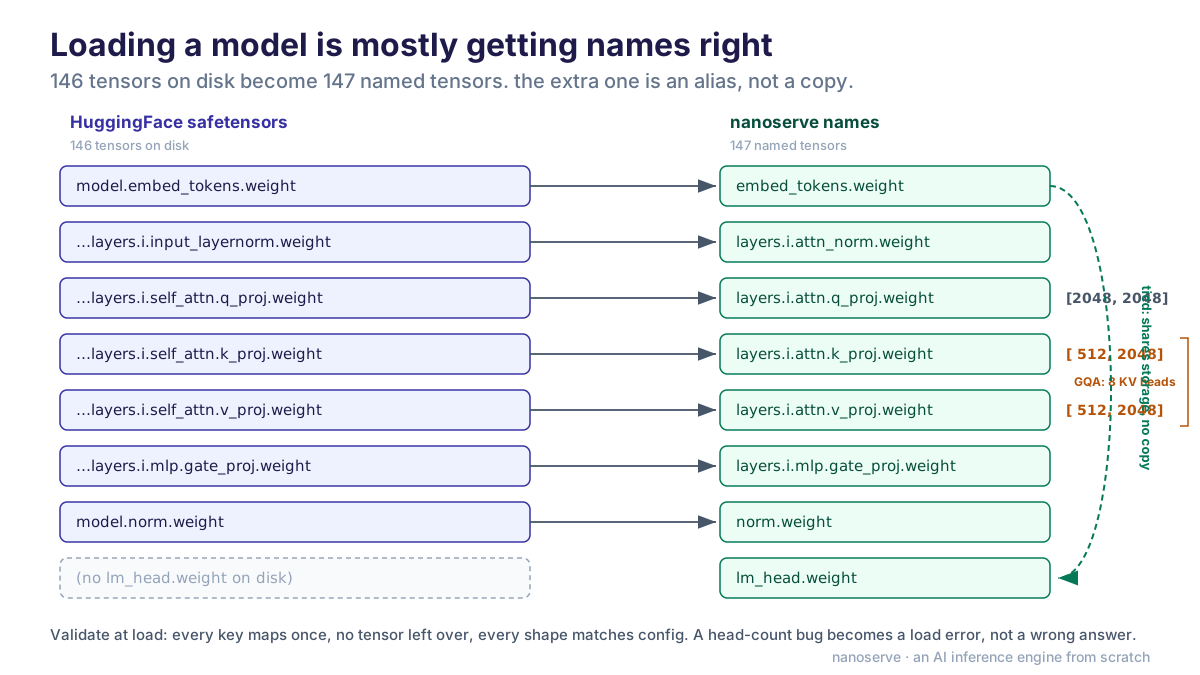
Half of “loading a model” is just getting the names right, and the file fights you in three small ways. (1) The on-disk Llama-3.2-1B has 146 tensors but a correct nanoserve model has 147: there is no lm_head.weight on disk at all. The output projection is tied to the input embedding, so I synthesize lm_head as an alias of embed_tokens (shared storage, asserted by equal data_ptr()), not a second 128256x2048 matrix. (2) The shapes encode GQA before any attention math runs: q_proj is [2048, 2048] but k_proj/v_proj are [512, 2048], because 8 KV heads x 64 = 512. Checking that at load time turns a head-count bug into a load error instead of a silent wrong answer three days later. (3) HF keeps q/k/v as three separate matrices; some engines fuse them into one. I kept them split for Week 1 because it mirrors HF exactly and makes the upcoming 1e-5 verification trivial to reason about. Fusing is a deliberate later optimization, not a loading detail.
The strongest test is not “did the names line up” but “did the right bytes land under the right name”: I read a handful of tensors straight from the file and assert the loaded q/k/gate/norm match. That is what actually catches a swapped q<->k mapping, which shapes alone would not.
Diagram
weight-name-mapping.svg — the HF key on the left, the nanoserve name on the right, the GQA shape asymmetry (q to 2048, k/v to 512), and the tie: lm_head has no tensor on disk and aliases embed_tokens.
Tomorrow
Day 4: RMSNorm + RoPE in layers.py, verified to 1e-5 against the HF hook. RoPE is the one people get wrong (inv_freq, the cos/sin table, and the llama3 frequency rescaling already captured in config).
Post angle: Day 3 of building an inference engine from scratch. Today was the unglamorous half of “load a model”: getting the names right. Llama-3.2-1B ships 146 tensors on disk, but a correct model has 147. The missing one is lm_head: the output projection is tied to the input embedding, so it is an alias, not a copy, and storing it twice would waste 250MB for nothing. The shapes also quietly encode GQA before you write a line of attention: query projects to 2048, but key and value only to 512, because 8 KV heads are shared across 32 query heads. I check all of that at load time, so a head-count mistake becomes a clear load error instead of a silently wrong answer days later. And the test that matters is not “do the names match” but “did the right bytes land under the right name”, which is the only thing that catches a swapped q and k.