Day 10: sampling, pinned bit-for-bit to the HuggingFace warpers
Date: 2026-06-25 · Week 3 · Phase 0 Foundations
What I added today
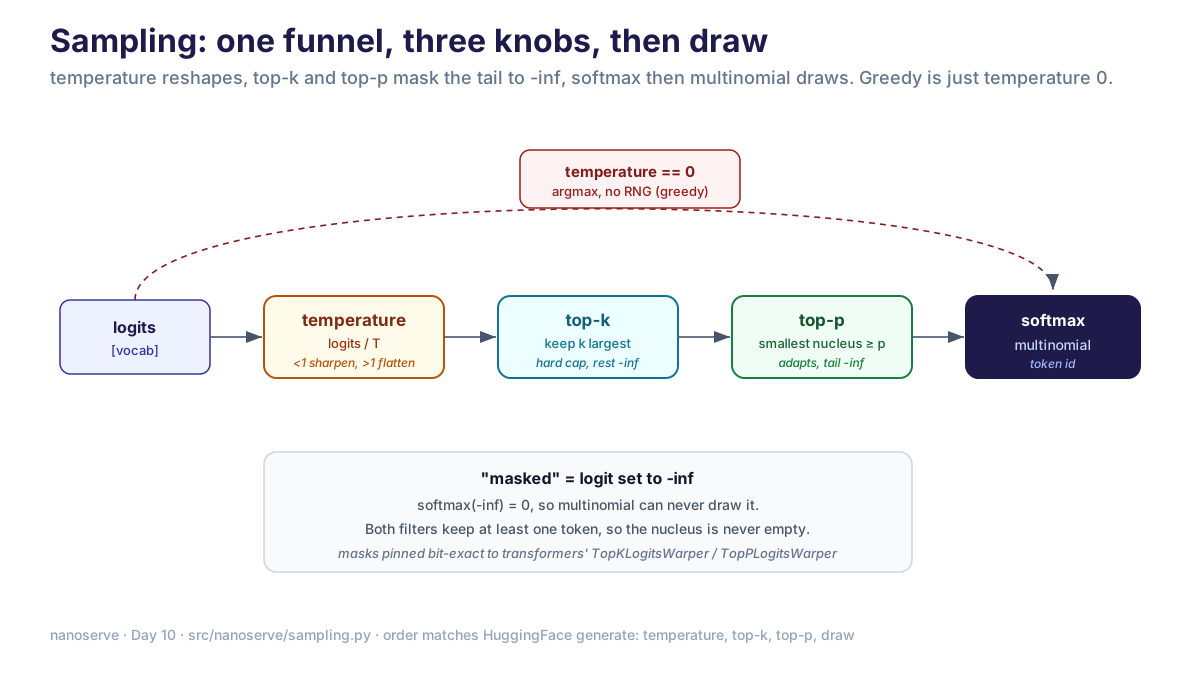
src/nanoserve/sampling.py: the four pure transforms behind sampling. apply_temperature (a plain logit divide), top_k_filter (keep the k largest, mask the rest to -inf), top_p_filter (keep the smallest nucleus whose mass reaches p), and sample, which composes them in HuggingFace’s order (temperature, top-k, top-p, softmax, one multinomial draw) and short-circuits to the argmax at temperature == 0, so greedy is just the zero-temperature corner of the same function. Eighteen new tests in tests/test_sampling.py: fourteen pure (the math on hand-checkable logits, plus the composition edges) and four that pin each mask and the full pipeline bit-for-bit to transformers’ own TemperatureLogitsWarper / TopKLogitsWarper / TopPLogitsWarper. Full suite 72 green.
Why it matters
Greedy decode only ever needs the single largest logit, so Week 2 could be sloppy about exact logit values and still match the reference. Sampling cannot: the next token is drawn from the distribution, so the shape of that distribution has to be right, not just its argmax. This is the first knob a real serving request sets (temperature, top_k, top_p in an OpenAI-style body), so it has to match what people already expect from those numbers.
What I learned
The reason to pin the masks to transformers rather than “implement nucleus sampling” is that every detail of these filters is a convention with an off-by-one waiting in it, and the reference already made every choice:
- top-p sorts ascending, not descending. HF’s
TopPLogitsWarpersorts the logits low-to-high, takes the cumulative softmax, and removes everything whose cumulative mass is<= 1 - p. So for probs[0.5, 0.3, 0.15, 0.05]andp = 0.8, the ascending cumsum is[0.05, 0.20, 0.50, 1.00]and the cut is at1 - 0.8 = 0.2. The0.20 <= 0.20boundary token is removed, leaving the{0.5, 0.3}nucleus. Reason about it from the wrong end and the nucleus is off by a token, which never throws, it just samples from a subtly wrong set. - the nucleus is never empty.
min_tokens_to_keepforces the most likely token to survive even whenpis tiny, so a confident step that would otherwise mask everything still has something to draw. Without it a peaked distribution plus a smallpis an all--infsoftmax, which isnan. - masking is just
-inf. There is no separate “candidate set” data structure: a filtered logit becomes-inf, its softmax probability is exactly0, andmultinomialcan never select it. The three filters compose by stacking-infs, which is why their order only matters for top-p (it measures a nucleus over whatever top-k already kept).
The satisfying test is the last one: temperature then top-k then top-p, composed by hand, equals the three warpers stacked in that order, torch.equal, no tolerance. Same trick as Day-4 RoPE, where I pinned my rotation to HF’s apply_rotary_pos_emb instead of trusting my own sign convention. Match the reference, do not reinvent it.
One thing greedy let me skip that sampling forces: determinism now has to be explicit. sample threads a torch.Generator through multinomial, so a seed reproduces a run exactly; the tests lean on that to assert a peaked distribution lands on its mode the large majority of 300 draws without being flaky.
Diagram
sampling-funnel.svg — logits in, the three knobs in order (temperature reshapes, top-k and top-p mask the tail to -inf), softmax then multinomial out, the dashed greedy bypass at temperature == 0, and the note that the masks are pinned to the transformers warpers.
Tomorrow
Wire sample into a generate path alongside greedy_generate (a do_sample switch that calls sample per step instead of the argmax), or start Week 3’s real subject, the naive contiguous KV cache, now that the sampling math it will feed is settled. Lean toward the cache: the sampler is done and tested, and the O(n^2) decode is the thing actually worth fixing.
Post angle: Day 10 of building an LLM inference engine from scratch. Greedy decode was the easy case: you only ever need the single largest logit, so a tiny float error is invisible. Today is sampling, where the actual probabilities matter because the token is drawn from them, and every detail is a convention with an off-by-one waiting in it. So I did not “implement nucleus sampling”, I pinned my top-k and top-p masks bit-for-bit to the exact functions HuggingFace uses, the same way I pinned my RoPE rotation to theirs on Day 4. The one that bites: top-p sorts logits ascending and cuts at 1 minus p, so for probs 0.5, 0.3, 0.15, 0.05 and p = 0.8 the nucleus is exactly the first two tokens, and getting the direction wrong never throws, it just quietly samples from the wrong set. Masking is just setting a logit to negative infinity so its softmax probability is zero, and the filters always keep at least one token so the distribution is never empty. Greedy is now just the temperature equals zero corner of the same function. 72 tests green, four of them checking my masks equal the reference with no tolerance at all. #AI #LLM #vLLM #BuildInPublic #Claude #OpenAI