Day 09: greedy decode, the whole continuation matches HuggingFace
Date: 2026-06-24 · Week 2 · Phase 0 Foundations
What I added today
src/nanoserve/model.py: greedy_generate, the decode loop. It is the Day-8 single step (greedy_token, an argmax over a full forward) wrapped in a loop: take the argmax, append it to the sequence, recompute, repeat until max_new_tokens or an optional eos_id. One sequence only (it rejects a batch dim greater than 1; ragged multi-sequence batching is Phase 3). Five new tests in tests/test_model.py: four pure (exact output length, determinism plus equivalence to a hand-rolled step-by-step loop, eos stops-and-keeps-the-token, and the batch guard) and one gated against the real Llama-3.2-1B (the full greedy continuation matches HF generate(do_sample=False) token for token). Also committed chat.py, the interactive REPL that drives this loop. Pure suite is 41 green; the gated multi-token match verified directly (see below).
Why it matters
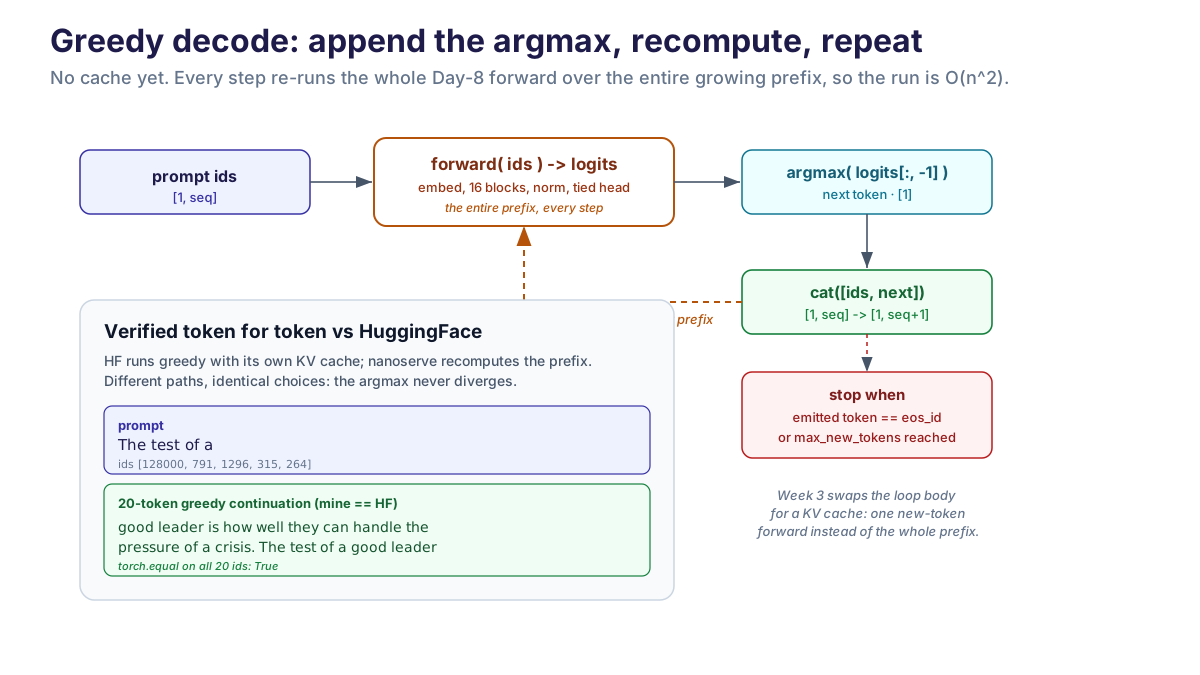
Day 8 proved one decode step agreed with the reference. This is the loop around it, and the loop is the actual product of Week 2: not “the first token matches” but “the whole continuation matches”. On the prompt “The test of a”, twenty greedy tokens come out bit-identical to HuggingFace, ids and all:
The test of a good leader is how well they can handle the pressure of a
crisis. The test of a good leader
torch.equal on all twenty ids is True. That is the Week 2 north star reached in miniature, before any cache exists to make it fast.
What I learned
The quietly reassuring part is how the two agree. HF runs greedy decode through its own KV cache; nanoserve has no cache yet and recomputes the entire prefix on every step. Two completely different execution paths, and yet the argmax never diverges across twenty steps. That is the whole reason the Day-8 logit tolerance (~1e-4) is good enough: a greedy decode only cares about which logit is largest, not its exact value, so as long as the gap to the runner-up never closes, small float drift is invisible to the token stream. Greedy is the forgiving case; sampling in Week 3 will be less so.
Three smaller things the loop made concrete:
- The cost is in the shape of the loop, not the math. With no cache, step
kre-runs a forward over a length-kprefix, so generatingntokens is O(n^2) work. You can feel it: each token is slower than the last. This is exactly the waste Week 3’s contiguous cache removes by turning the loop body into a single new-token forward, and Week 5’s paged cache makes affordable at scale. The slow version first, on purpose, so the speedup later is measurable. position_idsneeds no special handling here.forwarddefaults them to0..len-1, and because the whole grown prefix is passed every step, that stays correct as the sequence lengthens. The scattered-position case only matters once a cache means you feed just the new token, which is a Week 3 problem.- Stop-on-eos keeps the eos token. HF’s
generatereturns the eos in the output rather than trimming it, so the test pins that: pass the first token the model would emit aseos_idand the sequence grows by exactly one, ending on that token. A decode loop that silently dropped the stop token would pass a length check and still disagree with the reference.
Honesty note, same constraint as Day 8: the gated test loads two fp32 copies of the 1B model and my 14GB box OOM-kills that. So the pure suite (41 tests) is the green run, and I verified the multi-token match with the save-free-reload dance: generate the HF continuation, save its ids, free HF, then load nanoserve and compare, which only ever holds one model in memory. The gated test test_greedy_generate_matches_hf_multi_token is the spec; it passes on a box with the RAM to hold both, and on a rented GPU.
Diagram
greedy-decode-loop.svg — the loop (prompt, forward over the whole prefix, argmax of the last position, append, back to forward), the two stop conditions, and the verified 20-token continuation with torch.equal == True.
Tomorrow
Week 2 is essentially done a few days early (full forward Day 8, greedy loop Day 9). Buffer day: either start Week 3 early by writing the temperature/top-k sampling functions so a bad day still has something to push, or add a short generation-throughput note showing the O(n^2) slowdown per token as the motivation graph for the KV cache. Lean toward starting sampling.
Post angle: Day 9 of building an LLM inference engine from scratch. Yesterday one decode step matched HuggingFace; today the whole loop does. greedy_generate is the simplest thing that could work: take the argmax, stick it on the end, run the model again, repeat. On the prompt “The test of a” my engine generates twenty tokens that are bit-for-bit identical to what HuggingFace generates, ids and all: “good leader is how well they can handle the pressure of a crisis.” The part I like is that HuggingFace does this with a KV cache and mine recomputes the entire prefix every single step, two totally different execution paths, and the chosen tokens never diverge once across twenty steps. That is why a tiny logit difference at the fifth decimal does not matter for greedy decode: you only need the largest logit to stay the largest, not to be exactly equal. It also means my loop is O(n squared), each token slower than the last, which is the whole motivation for the KV cache I build next week. Slow and correct first, fast second.