Day 51: the read rectangle stopped being built, and the length that could not be shared
Date: 2026-09-05 · Week 13 · Phase 5 Benchmark and optimize
What I added today
nanoserve.slots, the persistent addressing the decode step reads through. SlotTable is one [max_batch_size, max_model_len] int64 buffer allocated at construction and never reallocated. append(rows, slots) writes one cell per row at that row’s own next column; resync(table, row) copies a whole row in from its BlockTable; sync(tables, rows) does that for any row whose length disagrees; reset(row) sets a length to zero and clears nothing. read(rows, width) hands back the rectangle and the lengths, and the rectangle is slots[:n, :width] when rows is a prefix of the table’s, which is basic slicing and therefore a view: the buffer’s storage, the buffer’s address, the buffer’s row stride. Otherwise it is slots[:, :width].index_select(0, rows), narrowed before the gather so the copy is the rectangle and not the whole buffer. is_window, window_share, appended_cells, resynced_cells, resyncs, windows, gathers and render are what it says about itself.
rebuild_mapping(tables, rows) is Day 50’s construction, extracted rather than deleted: it is the resync path, the oracle the table is graded against in the tests, and the arm the benchmark times.
The wiring is five changes. BatchedPagedKVCache.__init__ takes max_model_len, clamps it to the pool (a row can never hold more tokens than the pool has slots) and builds the table. plan_decode syncs the mirror before the block tables grow, appends the step’s write slots, and reads the plan’s slot_mapping and context_lens out of the table instead of building a grid. adopt_row, reset_row and free keep the mirror honest. Engine.build takes max_model_len and build_engine passes plan.max_model_len, because [max_batch_size, num_blocks * block_size] int64 on a real card is hundreds of megabytes of pure addressing.
The arithmetic is table_cells, table_bytes, block_table_cells, block_table_bytes, incremental_cells and resident_share; the gates are check_slots_agree, check_mapping_is_window, check_window_intact, check_appends_incremental, check_resyncs_bounded and check_table_fits. tests/test_slots.py is 62 tests. Suite 1375 green (5 GPU-gated skips), ruff clean.
slotbench.py, host only, no weights, 4 rows from a 16-token prompt, CPU (day-51-slotbench.csv):
steps      rebuild      window      gather   speedup       cells written
    8      0.461ms     0.485ms     0.621ms     0.95x         656 ->    96
   64      5.697ms     2.488ms     3.158ms     2.29x      12,416 ->   320
  128     17.354ms     5.308ms     6.422ms     3.27x      41,216 ->   576
  512    224.343ms    19.617ms    25.046ms    11.44x     558,080 -> 2,112
Why it matters
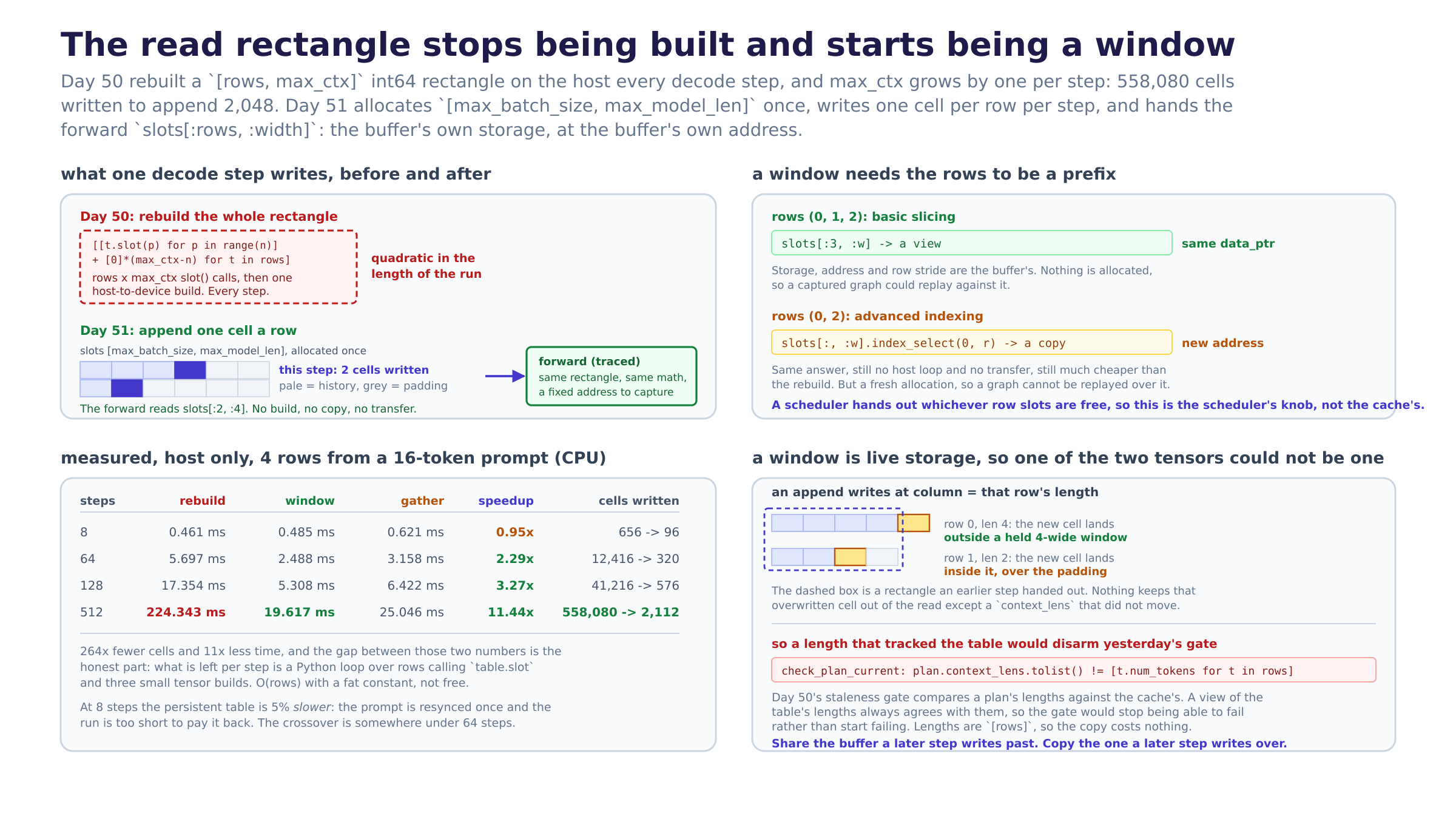
The rectangle stopped being an allocation. Day 50’s addressing was correct and did O(n^2) host work to append n tokens: rows * max_ctx Python-level slot() calls plus one host-to-device build, every step, with max_ctx growing by one each time. The persistent table writes rows cells a step whatever the histories are worth, so check_rebuild_bounded’s 272x at 512 steps becomes 264x fewer cells, and the forward’s rectangle is not built at all, it is pointed at.
264x fewer cells is 11x less time, and the gap is the honest part. What is left per step is a Python loop over rows calling table.slot, plus three small torch.tensor builds in append and one in read. That is O(rows) with a fat constant, not O(rows) and free, and at 8 steps the persistent table is 5% slower than the rebuild because the prompt is resynced once and the run is too short to pay it back. The crossover is somewhere under 64 steps. A day that reports the cell ratio and not the clock would be claiming 264x for an 11x change.
A window only exists when the rows are a prefix. slots[:3, :w] is basic slicing and gives a view. slots[[0, 2], :w] is advanced indexing and gives a copy, and a scheduler hands out whichever row slots are free, so a real batch is often not a prefix. The gather arm is 25.0ms against the window’s 19.6ms at 512 steps: still far cheaper than the rebuild, still no host loop and no transfer, and still a fresh allocation. That matters for exactly one thing, which is why this day happened at all: a CUDA graph replays kernels bound to the addresses they were recorded with. So check_mapping_is_window is a capture gate and not a correctness gate, and its message names the row set, because the fix is on the scheduler’s side.
A window is live storage, and that is why only one of the two tensors could be one. An append writes at column length. For the longest row in a batch that is past the right edge of every rectangle handed out before it, so a held window keeps saying what it said. For a short row it is inside one: a row of length 2 in a 4-wide rectangle has its next token written over column 2 of a rectangle somebody may still be holding. Nothing keeps that cell out of the read except a context_lens that did not move. So slot_mapping is a view and context_lens is a copy, and the copy is not a concession: it is [rows], so it costs rows int64, and it is what keeps Day 50’s staleness gate armed.
The price moved from time to bytes. The rebuild allocated nothing and was quadratic in the run length; the table is constant in the run length and reserves max_batch_size * max_model_len * 8 bytes for the process. 256 rows at 131,072 tokens is 268 MB of addressing before a single token lands, which is why Engine.build and build_engine learned to pass the length the pool was planned around. vLLM does not keep this table: it keeps block ids, [max_seqs, max_blocks], and computes block_id * block_size + offset in the kernel, which is the same information 16x smaller. block_table_bytes is that arithmetic and check_table_fits prints it in the failure. nanoserve stores slots because its reference read gathers per token and has nowhere to do the multiply, which makes the 16x a property of the kernel and not of the table.
What I learned
- A gate that can never fail looks exactly like a gate that always passes, and I wrote one today. My first
check_window_intactcompared the plan’s rectangle against the block tables it addresses. The test for it, a row reset and handed to a new request under a plan that still held its window, refused to fail. Of course it did: the window is a view of the table, so when the resync rewrote the row both sides of the comparison moved together. The gate that works compares the window against the plan’s own copies,write_slotsandcontext_lens, because those are the only things in the room that cannot move. Checking live state against live state is not a check. - Sharing storage turns construction checks into liveness checks, and they are the same two lines. Day 50’s
check_plan_addressingasserts “the write slot is the row’s last real entry in the rectangle”, a statement about how a rectangle had been built out of a list. Over a window, the identical comparison is a statement about whether anything has rewritten it since. Same code, different question, and the second question only exists because the storage is shared. I would not have found the second one by reading the first. - The mirror’s staleness test is length alone, and that is only enough because of an invariant somewhere else. A row’s slots change by being appended to (which the table does itself) or by the row changing tenant, and tenant changes go through
reset_row, which drops the length to zero. So a length comparison catches everything. That is a real dependency onBlockTable.adoptrefusing a non-empty table, written for an unrelated reason on Day 31, and if it ever relaxes this sync goes silently wrong.check_slots_agreecompares every slot and not just the lengths for exactly that reason. - Padding stopped being zero and nothing cared, which says the original promise was never the real one. Day 50 has a test that a plan’s padding is slot 0. It still passes, because the buffer starts zeroed, but it is no longer a promise: a row that is reset and re-tenanted shorter has its old tenant’s slots sitting past its length. That was always fine. The requirement was only ever “a legal index”, because the reference gathers before it masks, and every value ever written into this buffer is a real slot. Writing the test that documents the new behaviour was the moment I noticed the old test was pinning an implementation detail.
- Nothing is cleared on reset, and refusing to clear is the right answer twice over. Zeroing a row would be
max_model_lendevice writes to hide values thatcontext_lensalready masks, on the path that runs when a request finishes and the next one is admitted. It is the same reasoning as not compacting the pool: the cost of tidiness is paid every time and the benefit is never collected. index_selectafter narrowing, not before.slots[rows]copies[len(rows), max_model_len], which at a realmax_model_lenis the entire buffer for the sake of a 40-column rectangle.slots[:, :width].index_select(0, rows)copies[len(rows), width). Advanced indexing does not know what you were going to slice off next, and the difference here is three orders of magnitude.- Sizing a persistent buffer is a serving decision, and it had never been passed down.
max_model_lenexisted inlaunch.pyand reached the scheduler and the pool plan, but the cache had no use for it and was constructed without it. The moment something in the cache isO(max_model_len)the number has to arrive, and the default I fell back to (the whole pool) is a bound that is always true and never sensible. A default that cannot be wrong is not the same as a default that is right. - The benchmark needed a third arm to say anything true. With only “rebuild” and “window” the CSV reads as a clean win and hides that half of real batches will not get a window at all. Adding the scattered-rows arm cost fifteen lines and is the column I would keep, because it is the one that says what the scheduler owes the capture.
Diagram
persistent-slot-table.png. Left top is what one decode step writes, before and after, with the buffer drawn and this step’s two cells picked out. Right top is the prefix condition, the same read as a view and as a copy. Left bottom is the measured sweep. Right bottom is the hazard: an append at column length lands outside a long row’s held window and inside a short row’s, and the gate that a live context_lens would have disarmed.
Tomorrow
The address is fixed and the shape is not. The rectangle is still [rows, max_ctx] with both axes moving: max_ctx grows by one per step and the row count is whatever the scheduler admitted, so the shape set is still one per step and static mode still builds until it hits the recompile limit. Day 52 closes it with Day 49’s bucketing arithmetic on the axis it was written for: pad the batch up to a bucketed row count and read at a bucketed width, so the forward sees one of a small set of shapes at one address. context_lens is what makes the padding free, since a padded row with length 0 attends over nothing and a padded column is masked already. Then compilebench.py is finally measuring a compiler that gets the same graph twice on purpose, and write_slots and positions, still built out of Python lists every step, are the last two allocations between here and a capture.
Post angle
Day 51 of building an LLM inference engine from scratch. Yesterday’s decode plan rebuilt a [rows, ctx] int64 rectangle on the host every step to say where each token’s K/V lives, and ctx grows by one per step, so 512 steps over 4 rows wrote 558,080 cells to append 2,048. Today it is one [max_batch_size, max_model_len] buffer allocated once, one cell written per row per step, and the forward gets slots[:rows, :width]: a view, the buffer’s own storage at the buffer’s own address. 2,112 cells instead of 558,080, and 19.6ms instead of 224.3ms. The gap between 264x fewer cells and 11x less time is the honest bit: what is left is a Python loop over rows and a few small tensor builds, so it is O(rows) with a fat constant, and at 8 steps the persistent table is actually 5% slower because the prompt gets resynced once and the run is too short to pay it back. Two things I did not expect. A window only exists when the batch’s rows are a prefix of the table’s: slots[:3, :w] is basic slicing and gives a view, slots[[0,2], :w] is advanced indexing and gives a copy, and a scheduler hands out whichever row slots are free. That is a scheduler knob, not a cache one, and it decides whether a CUDA graph can be captured over the step at all. And a window is live storage, which broke a gate I wrote yesterday. An append writes at column length: past the right edge of a long row’s held rectangle, but inside a short row’s, over its padding. So the rectangle can be shared and the lengths cannot: a context_lens that read live out of the table would always agree with the cache, and yesterday’s staleness gate would stop being able to fail rather than start failing. Share the buffer a later step writes past, copy the one it writes over. vLLM keeps block ids rather than slots, which is the same table 16x smaller with the multiply moved into the kernel, and that is the version this one is standing in for. 1375 green.