Day 52: the shape stopped moving, and the closed set that is too big to capture
Date: 2026-09-06 · Week 13 · Phase 5 Benchmark and optimize
What I added today
nanoserve.buckets, the policy that decides which shapes a decode step is allowed to present. DecodeBuckets(max_batch_size, max_model_len) is built from the cache’s own two limits, because a row bucket the cache has no row for and a width wider than the slot table are both a crash rather than a rounding decision. rows is the power of two ladder filtered to what fits, plus max_batch_size itself (a server picks 6 and without that a full batch would have no bucket at all); widths is the multiples of width_multiple up to max_model_len, with the last one being max_model_len even when that is not a multiple. row_bucket, width_bucket and shape_for do the rounding, shapes is the whole capture list and count is its size.
bucket_run, padded_cells and waste are what a run costs through them. The gates are check_shape_in_set, check_run_closed, check_capture_budget and check_waste_bounded, plus check_pad_inert, which is the correctness one.
The wiring is four changes. SlotTable.read takes pad_rows and widens the rectangle to len(rows) + pad_rows, which over a prefix is the same basic slice one row taller and therefore still a window; the padded rows’ lengths are 0. DecodePlan grows pad_rows and sink_slot, and with them graph_rows, graph_width, is_bucketed, graph_cells, pad_cells and pad_share; batch_size still means cache rows and graph_rows means what the forward runs, and the whole point of the day is that the two are allowed to disagree. plan_decode takes buckets, pads the write slots with the sink and the positions with 0. BatchedPagedKVCache gains bucket_decode, decode_buckets and sink_slot, and Engine.build passes it through: the engine pads input_ids and drops the padded rows off logits after the forward.
decode_shape now reports plan.graph_rows and plan.graph_width, so CompiledDecode.distinct is the number of graphs the run really asks for. tests/test_buckets.py is 56 tests. Suite 1431 green (5 GPU-gated skips), ruff clean.
bucketbench.py, host only, no weights, no compiler, 3 rows of an 8-row cache from a 16-token prompt, width multiple 128 (day-52-bucketbench.csv):
steps   shapes open   bucketed    waste       cells open -> bucketed    plan ms
    8             8          1    35.9%          492 ->        768   0.59 -> 0.61
   64            64          1    54.5%        9,312 ->     20,480   4.02 -> 4.13
  128           128          2    53.6%       30,912 ->     66,560   8.13 -> 8.75
  512           512          5    38.5%      418,560 ->    680,960  32.56 -> 34.91
and the second table, which is the one that decides whether any of this is a capture list, at 256 rows and 8192 tokens:
width multiple    128:  9 rows x 64 widths =  576 shapes
width multiple    512:  9 rows x 16 widths =  144 shapes
width multiple   2048:  9 rows x  4 widths =   36 shapes
width multiple   8192:  9 rows x  1 width  =    9 shapes
Why it matters
Three days of work were pointing at a dimension that still moved. Day 49 removed the graph breaks and found the guard that mattered was on table.num_tokens. Day 50 moved the addressing out of the forward so the only thing left to guard on is a tensor shape. Day 51 made that tensor a window on a persistent buffer, so the address stopped moving. The shape was the last one, and it moves on both axes: rows is whatever the scheduler admitted and max_ctx grows by one every step for the whole run. 512 steps, 512 shapes, and dynamo abandons the frame after eight. Rounding both axes up turns 512 into 5, and the 5 is not the run length, it is the number of width buckets the run crossed. A 512-step run that starts and finishes inside one bucket presents one.
The padding has to be inert in two directions and only one of them is obvious. Reading is easy: a padded row’s context_lens entry is 0, the mask covers its whole row, and it softmaxes over finfo.min everywhere, which is finite. Writing is the half that corrupts. A planned decode write is one index_put over the whole batch, so a padded row writes K/V whether anybody wants it to or not, and “somewhere” must not be a slot a sequence owns. So the cache keeps a sink slot, one row past the end of the pool the allocator hands out: a legal index into k_pool that no block maps to and no BlockTable can name.
Slicing the write instead would have been the same bug three days running. The obvious alternative is k[:real_rows], and it is k[:3] where 3 is a Python integer that changes when the scheduler admits or reaps. Inside the traced region that is a guard on a value, which is exactly what Day 49 measured a forty-six-fold regression on and exactly what Day 50 existed to remove. The whole point of padding is to stop the traced region from knowing how many rows are real, so the one thing it must not do is tell it.
Closed is not the same as small, and the arithmetic is a product. count is len(rows) * len(widths), and the width axis is unbounded in a way the row axis is not. 256 rows gives 9 row buckets, which is fine. 8192 tokens at a 128-token multiple gives 64 widths, so the closed set is 576 shapes, and every member is a real compile or a real capture with its own memory. That is worse than the open set, not better. The width multiple buys it back in padding: 2048-token widths over the same model is 4 widths and 36 shapes. check_capture_budget is the line where “closed” and “capturable” stop being the same word, and it is the gate I expected to write last and ended up leaning on most.
vLLM does not pay this, and the reason is a property of its kernel. Its cudagraph capture list is over batch sizes only: the kernel walks a block table and reads each row’s length out of a tensor, so the context axis never reaches a shape guard at all. nanoserve buckets both axes because its reference read gathers a [rows, width] rectangle of K/V before it masks, which makes the width a real tensor dimension. The second column of that table is the price of the reference read, stated as compiles rather than as microseconds.
And the padding is real work. 38.5% of the cells the 512-step run computes are there to hold the shape still: 680,960 against 418,560. That is the fourth time this engine has bought a fixed rectangle and paid for the corners, after Day 29’s waste_fraction, Day 34’s prefill_padding_waste and Day 50’s padding_share. The trade is only worth taking if something downstream actually reuses the graph, which is why this day ends with a flag that defaults to off.
What I learned
- A property named
batch_sizehad two meanings and I had not noticed until one of them had to change.DecodePlan.batch_sizewas “rows in this step”, and that was the row count the scheduler picked and the first dimension of every tensor, because they were the same number. Padding splits them, and every call site had quietly picked one meaning._planned_writewanted the tensor dimension,check_plan_currentwanted the cache rows, and the two lines looked identical. I addedgraph_rowsfor the tensor side and leftbatch_sizemeaning cache rows, and the useful part was not the new property, it was being forced to say which one each existing line had meant all along. - The sink cannot come out of the allocator, and the audit is what says so. My first version called
allocator.allocate()once and kept the block. Day 35’saudit_blocksfails that immediately and correctly: a block that is allocated and held by no request is stranded, which is the exact shape of a leak. The sink is not a block. It is one row past the end of the pool tensor, so it is an address that exists physically and cannot exist in the ledger, and the pool is allocated one row taller unconditionally so there is one pool shape rather than two. - Day 27’s
finfo.minpaid off in a place it was not written for. A padded row hascontext_lens = 0, so every column of its score row is masked and the softmax runs over a row of identical values. With-infthat is 0/0 and a NaN; withfinfo.minit is a uniform distribution over garbage that the caller throws away. The choice was made on Day 27 for padded prefill columns and it is what makes a zero-length row legal here at all. I did not plan that and would not have found it before it broke. - The gate I wrote for completeness is the one with the finding in it.
check_capture_budgetwas going to be a two-line sanity check. Then I put real serving numbers through it and the default configuration produces 576 shapes, which is not a capture list, it is a compile bill. The whole day reads as a win until you multiply the two axes, and the arithmetic that says so is four lines long. Writing the price next to the feature is the only reason I found out on the day I built it rather than in a profile next week. - The row bucket ladder needs
max_batch_sizein it and powers of two do not supply it.(1, 2, 4, 8, ...)filtered to a cache of 6 rows gives(1, 2, 4), and then a full batch of 6 has no bucket andbucket_forraises. A full batch is the case a serving system is most likely to hit. Adding the cache’s own row count to the set is one line and it is the difference between the feature working and the feature working until the machine is busy. - A width bucket has a ceiling that a row bucket does not, and it is the slot table.
round_up(8100, 128)is 8192, which is fine ifmax_model_lenis 8192 and aValueErrorout ofSlotTable.readif it is 8000. Sowidth_bucketclamps tomax_model_lenand the top bucket ismax_model_lenwhether or not it is a multiple. The rounding is bounded above by a real allocation, and the moment a bucket set is constructed from anything other than the cache it is describing, that invariant is gone. - The padding cost the host almost nothing and I checked because I expected it to. A padded read is
slots[:n + pad, :width]instead ofslots[:n, :width], which is the same basic slice, and the extra write slots are a list append. The measurement is 34.9ms against 32.6ms over 512 steps, about 7%, and all of it is the widerwrite_slotsandpositionstensors. The cost of this day is device work (38.5% more cells) and not host work, which is the opposite of every other day this week. - A benchmark whose two knobs are the same number hides half the feature. The first version of
bucketbench.pyusedrowsas both the batch and the cache’s row count, sorow_bucket(3)was 3,pad_rowswas always 0, and the sweep only ever exercised the width axis. Splitting them into--rows 3 --max-batch 8is what made the row padding appear, and it moved the reported waste from 18% to 38.5%. The number the benchmark was reporting before was true and was measuring a configuration that does not happen.
Diagram
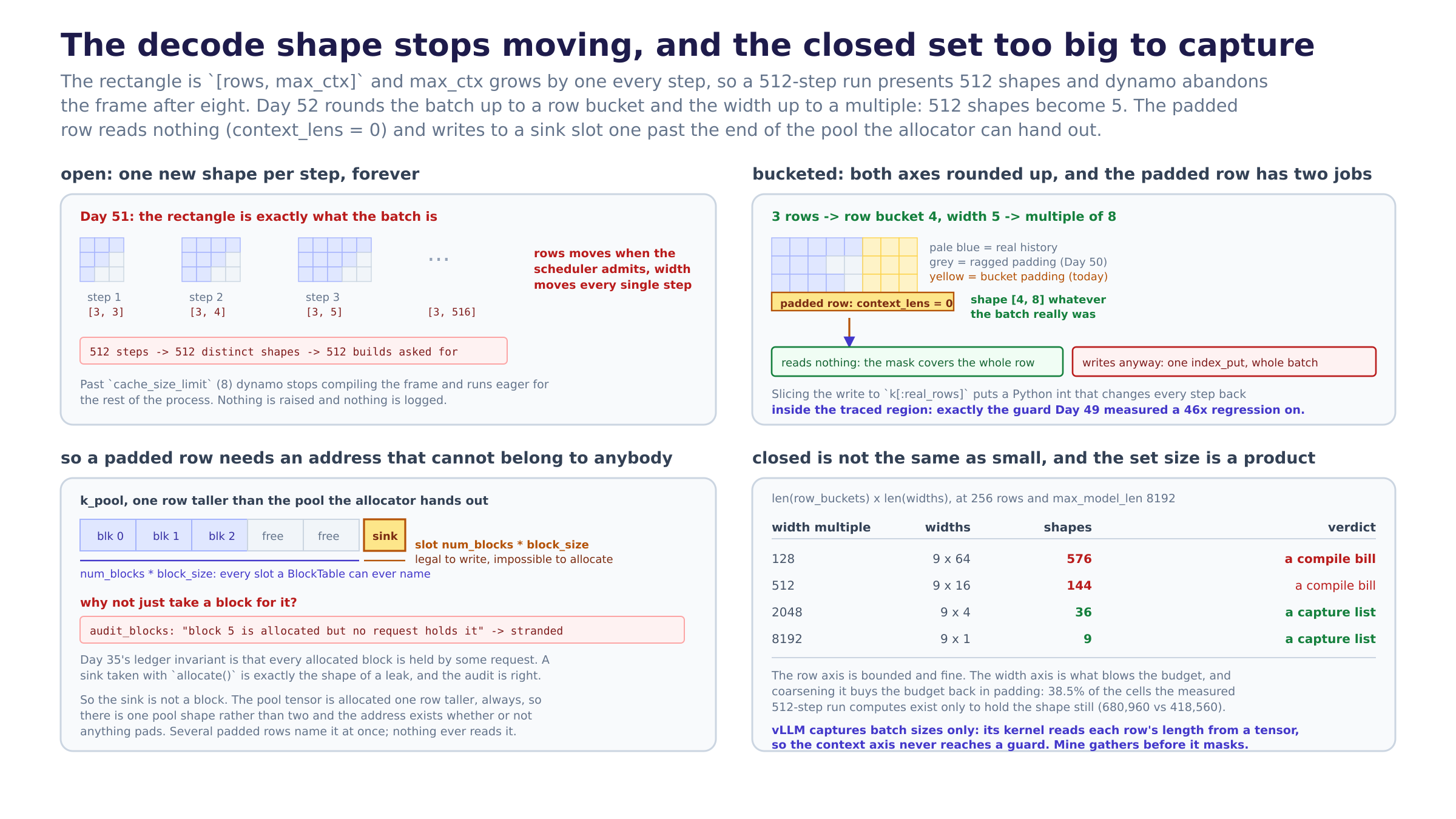
bucketed-decode-shape.png. Left top is the open shape set: one rectangle per step, growing. Right top is the same run bucketed, with the padded row and the padded columns drawn in and the row’s two destinations marked (reads nothing, writes to the sink). Left bottom is the sink slot’s place in the pool, one past the last block the allocator can hand out. Right bottom is the product: rows times widths at four width multiples, and the line where a capture list becomes a compile bill.
Tomorrow
The shape is closed, the address is fixed, and the plan is replayable, which is the whole precondition list for a capture. What is left between here and torch.cuda.graph is on the input side: write_slots and positions are still built out of Python lists into fresh tensors every step, and the engine’s padded input_ids is a torch.cat every step. A replay does not accept a fresh tensor; it reads the buffer it was recorded against, so Day 53 is the persistent input buffers, written in place, and the arithmetic for how many of them a bucket set needs. Then check_capture_budget stops being a projection and starts being a memory number, because a capture list of 36 is 36 recorded graphs each holding its own workspace.
Post angle
Day 52 of building an LLM inference engine from scratch. A decode step’s rectangle is [rows, max_ctx], and max_ctx grows by one every step, so a 512-step run presents 512 distinct shapes to the compiler and dynamo gives up after eight. Today both axes get rounded up: the batch is padded to a power-of-two row bucket and the rectangle is read at a multiple of 128, so 512 shapes become 5, and the 5 is not the run length, it is how many width buckets the run crossed. The interesting part is the padded row. It has to be inert in two directions and only one of them is obvious. Reading is easy: context_lens = 0 masks the whole row, and it softmaxes over finfo.min, which is finite, which is a choice I made on Day 27 for a completely different reason and did not expect to collect on. Writing is the half that corrupts. A planned decode write is one index_put over the whole batch, so a padded row writes K/V whether you want it to or not, and it must not land in a slot some sequence owns. So the cache keeps a sink slot: one row past the end of the pool the allocator hands out, a legal address that no block maps to. The obvious alternative, slicing the write to k[:real_rows], is a Python integer that changes every step sitting inside the traced region, which is precisely the guard Day 49 measured a 46x regression on. And the thing I did not expect: closed is not the same as small. The set size is len(row_buckets) * len(widths), a product, and at 256 rows and 8192 tokens with a 128-token multiple that is 576 shapes, each one a real compile. Worse than leaving it open. Coarsen the width multiple to 2048 and it is 36, paid for in padding. vLLM never pays this because its capture list is over batch sizes only: its kernel reads each row’s length from a tensor, so the context axis never reaches a guard. Mine gathers the rectangle before it masks, so the width is a real dimension. 38.5% of the cells the bucketed run computes are padding. 1431 green.