Day 64: the allocation was legal, it was just unpriced
Date: 2026-09-20 · Week 14 · Phase 5 Benchmark and optimize
What I added today
src/nanoserve/partials.py: the split read’s workspace, allocated once by the plan and handed to the kernel as a window, the way Day 51’s slot table already hands it a mapping.
Day 63 ended on a caveat I wrote too confidently. It said a captured region cannot allocate, so the partials have to become a planned buffer. The first half of that is wrong. A torch.empty made while a CUDA graph is recording is served from the graph’s memory pool, its address is baked into the replay exactly like every other intermediate’s, and the launch is perfectly legal. What is wrong with it is quieter, and it is the real reason for the day: nothing priced it. CapturePlan.pool_bytes was shared_pool_bytes over the score term alone, so a process running the split read reserved an arena it had under-reported by the whole workspace, once per graph, at the largest shape in the list. At serving size that is 1.05 MB reported against 84.93 MB spent, and the allocator was the only thing in the process that knew.
SplitWorkspace is the three buffers, [max_rows, n_q, splits] twice and [max_rows, n_q, splits, head_dim] once, in fp32. allocate_partials reserves them keyword-only, and allocate_for builds one off a CapturePlan by duck typing so the dependency runs down the boot path and not up it. SplitWorkspace.rows is the window, is_window and addresses are the witnesses, and check_workspace_covers is the plan-shaped gate: a mapping of a width the partition was not computed from, a model with the wrong head count, a batch wider than the row ceiling.
plan_splits in kernels/flash_decoding.py is one split count for a whole capture list, and check_partials is the buffer-shaped gate inside both kernels. paged_attention_split_kernel, paged_attention_split_triton and paged_attention_split all take partials=, and when nobody names a splits the handed-in arena answers the question.
captured.py grows partial_cells, split_score_cells, split_workspace_bytes and PARTIAL_ITEMSIZE, and read_workspace_bytes becomes a three-way dispatch. launch.py grows CapturePlan.splits and CapturePlan.head_dim, and plan_capture(split_read=True) calls plan_splits once, at plan time, on the width the bucket set fixed.
tests/test_partials.py is 26 tests; tests/test_flash_decoding.py, tests/test_captured.py and tests/test_width_axis.py grow the rest. Suite 2115 green (21 GPU-gated skips), ruff clean.
arenabench.py, host only, no weights (day-64-arenabench.csv):
a planned arena against the oracle (7-wide mapping, 2-key tiles):
  1 splits of 8 keys, 0.0024 MiB: worst |planned - oracle| 3.58e-07 over 64 reads, addresses moved: False
  2 splits of 4 keys, 0.0049 MiB: worst |planned - oracle| 2.38e-07 over 64 reads, addresses moved: False
  4 splits of 2 keys, 0.0098 MiB: worst |planned - oracle| 3.58e-07 over 64 reads, addresses moved: False

the shared capture arena at 256 rows, 32 heads, 8192 tokens, 32-key tiles:
              read  shapes          arena  vs rectangle
         rectangle      36      268.44 MB          1.0x
          streamed       9        1.05 MB        256.0x
    split (16-way)       9       84.93 MB          3.2x

one arena over a 9-bucket list, 16 splits of 512 keys:
 rows  wants  programs   this shape    charged
    1     16       512      0.33 MB    0.33 MB
    2     16      1024      0.66 MB    0.66 MB
    4     16      2048      1.33 MB    1.33 MB
    8      8      2048      1.33 MB    2.65 MB
   16      4      2048      1.33 MB    5.31 MB
   32      2      2048      1.33 MB   10.62 MB
   64      1      2048      1.33 MB   21.23 MB
  128      1      4096      2.65 MB   42.47 MB
  256      1      8192      5.31 MB   84.93 MB

allocator calls for the partials, 16 layers, 1000 decode steps:
             owner  per step    per run
          the read        48      48000
          the plan         3          3
Why it matters
The bug was not in the allocation, it was in the accounting, and those fail differently. An allocation that is illegal under capture fails loudly on the first recording, in front of whoever is warming the server, with a traceback naming the graph. An allocation that is legal and unpriced does not fail at all until the arena is 81 times the size the plan printed at boot, and then it fails as an out-of-memory error somewhere else, on a shape the plan never mentioned. Day 54 built pool_bytes so a server that cannot start can explain itself in one line, and a read that spends memory outside that line makes the line into a lie rather than an underestimate. The fix is not the buffer. The fix is split_workspace_bytes existing, and the buffer is what makes it checkable.
Only the row axis narrows, and the alternative does not raise. Both passes address the workspace flat, (row * n_q + head) * splits + split, because that is the form tl.store takes. The arena is allocated at the list’s widest split count, so the obvious way to hand a smaller launch its slice is buffer[:, :, :splits], which is a tensor of exactly the right shape, the right dtype and the right device whose stride is the allocated count. The flat arithmetic does not know that. Every program past the first would read and write another (row, head)’s slot, the reduction would fold whatever it found, and the read would return a finite, plausible vector that is not the attention over that row. A window on the outermost axis of a contiguous buffer is still contiguous and still starts at the base address, which is the one narrowing that survives, and it is exactly why check_partials refuses on contiguity rather than on shape.
The split count has to be one number for the list, and the max is the only direction that keeps the split. choose_splits answers per launch. A capture list is not one launch: it is a graph per shape, all replaying against one arena, so the per-bucket answers collapse. Rounding a bucket up costs it chunks it does not fill, and Day 63 made that free, because an empty chunk walks nothing, stores -inf, 0, 0 and drops out of the reduction with no branch. Rounding down takes the splits off the one-row batch, which is the only batch a split was ever for. So plan_splits is a max, and the whole design of the empty chunk is what pays for it.
And the two maxima are at opposite ends of the same list. The split axis peaks at the narrowest bucket, because a small grid is what needs filling: choose_splits(1) is 16 and choose_splits(256) is 1. The arena is rows * heads * splits * (head_dim + 2) and peaks at the widest, because a ceiling division of a program target makes rows * splits(rows) climb to that target and then flatten rather than fall. So one rectangular arena is the product of both maxima, 84.93 MB, while the largest single shape in the list needs 5.31 MB. 16x, and it is not a bug. The alternative is a split count per row bucket, which is a different tl.constexpr per bucket, which is a compiled kernel per bucket: the specialisation Day 61 spent a whole day collapsing, bought back on a different axis. One compiled body against a fatter arena is a trade, and the only thing I can do about it today is measure it and say which way I went.
What I learned
- I wrote a caveat yesterday that was true in its conclusion and wrong in its reason, and the wrong reason would have sent somebody to the wrong fix. “A captured region replays the addresses it was captured with, so it cannot allocate” is a sentence I believed hard enough to put in a module docstring. It is not how graph capture works: allocations under capture go to the graph’s pool and replay at the same address, which is the entire purpose of a pool handle. Had the reason been the real one, the fix would have been “make the read not allocate” and it would have stopped there. The real reason is “nothing prices it”, and that fix is a pricing function, a plan field and a budget check, which is most of today.
- A gate on contiguity is a gate on arithmetic, and it took writing the wrong slice to see it. I reached for
buffer[:, :, :splits]first, because that is the shape the launch wants and PyTorch hands it over without a word. The refusal is not about memory layout as a tidiness matter: the kernel does not take a tensor, it takes a pointer and an integer it multiplies, and a slice is a promise about strides the pointer never sees. Every gate in this repo that reads a.data_ptr()is the same shape of thing, and this is the first one that reads.is_contiguous(). - Day 63’s empty chunk turned out to be load-bearing twice, and the second time was a day later in a different file. It was built so pass two could read a slot unconditionally. It is also what makes a reused buffer safe, because a program that always stores means no step can see the step before it, and it is what makes
plan_splits’s max cheap, because a bucket given surplus chunks pays nothing for them. I took the-inffill out of the tlsim path expecting to have to justify it and found there was nothing to justify: the fill had never been read. torch.emptyand notzerosis a claim about the kernel, not a saving. The saving is nothing; the arena is written before it is read either way. What the choice says is “no slot’s prior contents matter”, and azerosthere would be a quiet assertion of the opposite that nobody would ever test. Writing the honest one is what made the garbage-filled-workspace test worth having.- The head_dim is the first axis in this engine that a workspace has and a score rectangle never did. Every memory number from Day 54 to Day 61 is
rows * heads * query * something, because scoring sums the channels away before the intermediate exists. A partial accumulator has not been divided yet, so it is a head wide, andread_workspace_bytesrefuses to price a split without one rather than inferring it. Small, and it is the clearest statement I have of what the two reads actually hold. - Two itemsizes in one workspace, and it is the only one in the file. The score tiles follow the pool and halve on a bf16 card. The partials do not, because a different program rescales them by
exp(m - M)after a round trip through memory, and that trip is the one place in this read where the range is load-bearing. Pricing the arena at one itemsize would be wrong in whichever direction the deployment chose, sosplit_workspace_bytesadds two terms in two currencies andPARTIAL_ITEMSIZEis read off the dtype the kernel really allocates. - 48 allocator calls a step is the number that made the eager case concrete. The capture argument is the interesting one and it is also the one that only matters on a card that is running graphs. Outside a graph the read allocates three tensors per layer per step, which on a 16-layer model over a thousand steps is 48,000 calls to hold bytes that never change size. That is not the headline and it did not need to be; it is the version of the claim that is true on this box.
Diagram
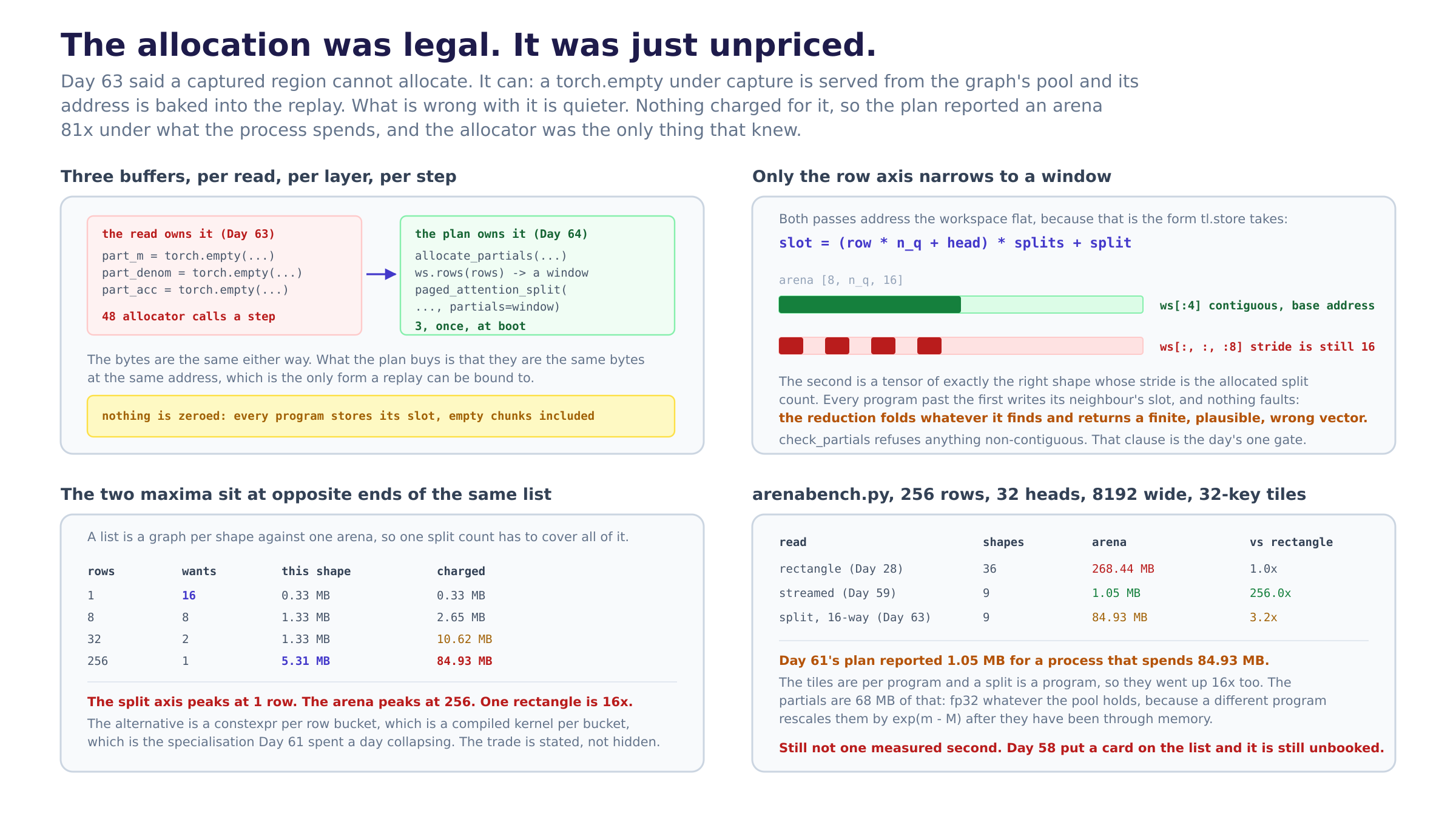
arena-becomes-planned.png. Left top is who owns the three buffers, 48 allocator calls a step against 3 at boot, with the note that nothing is zeroed. Right top is the flat addressing and the two slices, the row window in green and the split slice in red with its unchanged stride. Left bottom is the bucket table with wants against charged and the 16x. Right bottom is the arena in all three reads’ currencies and the 81x under-report.
Tomorrow
The split is now wireable. Day 65 is PagedRead growing a third mode: SPLIT alongside RECTANGLE and STREAMED, holding a SplitWorkspace the cache hands it, charging split_score_cells into the same counters Day 60 built, and reporting the split count next to Day 62’s backend in the health payload. The gate is check_read_matches’s: a split bucket set under a streamed read is a plan whose arena nobody addresses, and a streamed set under a split read is a launch nobody sized.
The 16x arena is the thing I would fix next if the wiring did not come first. There is a design that gets it back: allocate the arena flat rather than as a rectangle, size it by max(rows * heads * splits(rows)) over the list instead of by the product of the two maxima, and hand each shape a contiguous prefix reshaped to its own grid. That costs a compiled body per row bucket, so it is a real trade and not an oversight, and it wants a measurement on a card to settle rather than an opinion here.
The caveat has not moved and I will not dress it up. Six kernels’ worth of arithmetic is tested, the arena is priced to the byte, the addresses hold across 64 reads, and not one of those is a second. graphbench.py --weights ./weights --device cuda --rates 1,2,4,8 on both arms is still the first run to book hardware for, and it has been the first thing on that list since Day 58.
Post angle
Day 64 of building an LLM inference engine from scratch. Yesterday I wrote a caveat I was sure about: a CUDA graph replays kernels bound to the addresses they were recorded with, so the flash-decoding workspace cannot be a torch.empty inside the read. That is wrong, and being wrong about it is the most useful thing that happened this week. An allocation made while a graph is capturing is served from the graph’s own memory pool and replayed at that address, like every other intermediate. It is legal. What is actually wrong with it is much quieter: nothing prices it. My capture plan printed the arena at boot from the score term alone, so a process running the split read reserved 1.05 MB on paper and spent 84.93 MB in fact, once per graph, at the largest shape in the list. An illegal allocation fails in front of you during warm-up. An unpriced one fails as an out-of-memory error later, somewhere else, on a shape your boot line never mentioned. So today the partials become a buffer the plan owns and hands to the kernel as a window, which is the same move I made on the slot mapping on Day 51, and the point of it is the pricing function rather than the buffer. Two things I did not expect. First, only the row axis of that arena can narrow. Both passes address it flat as (row * n_q + head) * splits + split, because that is the form tl.store takes, so slicing the split axis gives you a tensor of exactly the right shape whose stride is still the allocated count: every program past the first writes its neighbour’s slot, nothing faults, and the read returns a finite plausible vector that is not the answer. The gate is on contiguity, not on shape. Second, the split count and the arena size peak at opposite ends of the same capture list. A one-row batch asks for 16 splits because a small grid is what a split is for; a 256-row batch asks for 1 because the card is already a queue. But the arena is rows times splits, so it peaks at 256 rows. One rectangular arena over the list is 84.93 MB while the largest single shape in it needs 5.31 MB. 16x, and it is not a bug: the alternative is a constexpr per row bucket, which is a compiled kernel per bucket, which is exactly the specialisation Day 61 spent a day collapsing. vLLM and SGLang both ship a fixed partition for the same reason. 2115 green, the arena priced to the byte, the addresses unmoved across 64 reads, and still not one measured second.