Day 83: one row shape, so the table reprints from the file
Date: 2026-10-12 · Week 14 · Phase 5 Benchmark and optimize
What I added today
Day 82 finished typing read_sweep, and print_table still read the other shape of the same row: the raw dict main built, with claims_failed the joined string it split on FAILED_SEP by hand. So a row read back from a CSV could not be printed, and an old sweep could not be looked at again without running it again.
One shape, the one the file reads back as:
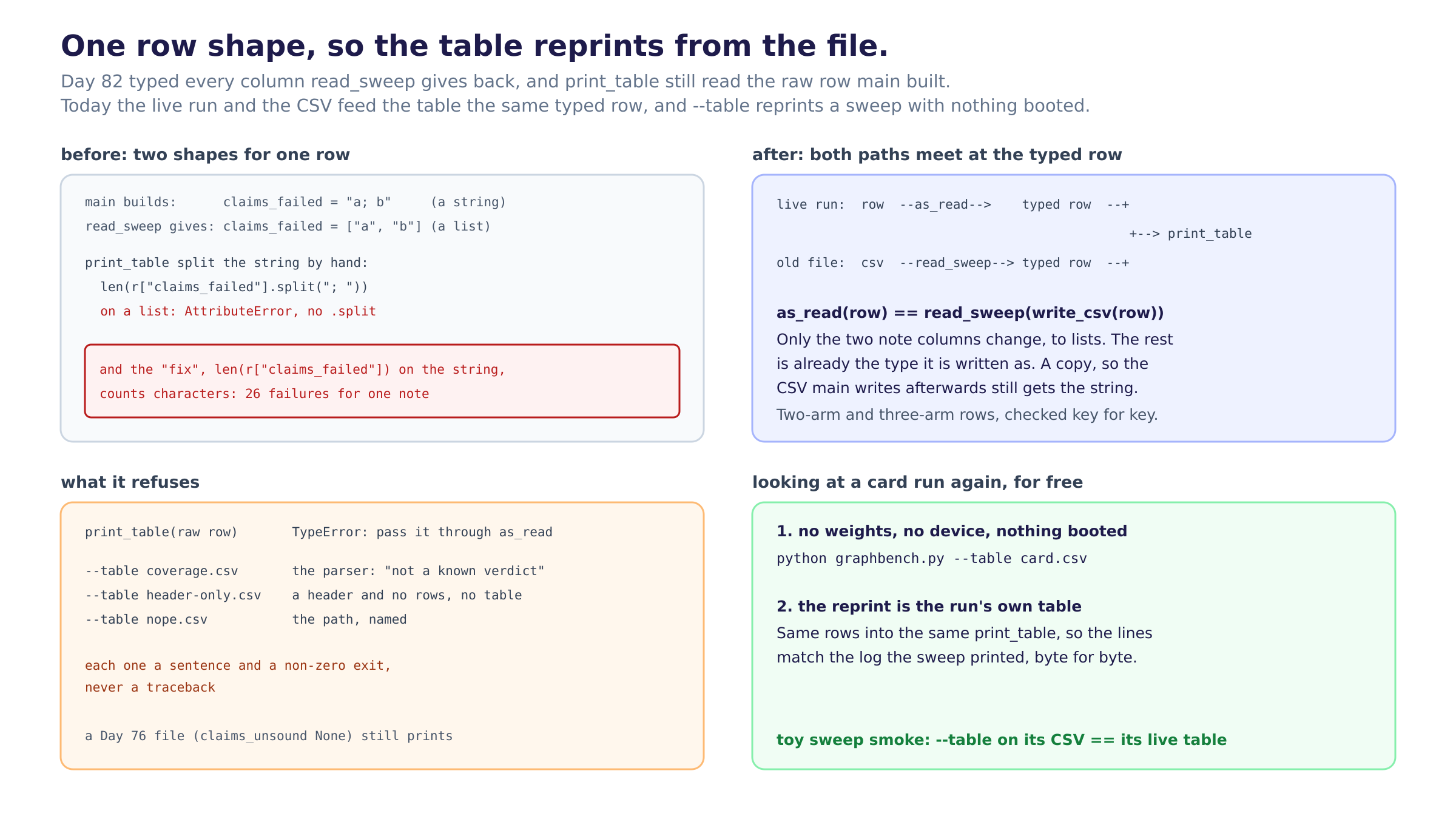
as_read(row)turns a rowmainjust built into whatread_sweepwould return from the CSV. Only the two note columns change, to lists. Everything else already has the type it is written with. It returns a copy, becausemainwrites the CSV from the row it built after the table prints.print_tabletakes that shape and only that shape. The claims cell isclaims_ok + len(claims_failed). A string inclaims_failedraises aTypeErrorthat says to pass the row throughas_readfirst, becauselenon a string counts characters and would print a wrong total with no error.graphbench.py --table <csv>reprints a finished sweep’s table from its file throughread_sweep, with no weights, no device, and nothing booted. Every refusal is a sentence and a non-zero exit, not a traceback: a missing file, a file the parser refuses (a--coveragetable, a pre-Day-76 sweep), and a file with a header and no rows.reprint(path)is the function behind it.
tests/test_sweep_table.py has 13 pure tests: as_read equals read_sweep of the written row for two-arm and three-arm rows, it changes only the note columns and does not modify the row it was given, the table counts a typed row and refuses a raw one, a Day 76 row with claims_unsound as None still prints, the table printed from the file matches the table printed from the run, and --table run as a process reprints the same lines, needs no weights, and refuses all three bad files with no traceback. Three older table tests now send their rows through as_read, which is how main sends them.
The toy sweep smoke gets one more test: --table on its real three-arm CSV prints the same lines the sweep printed.
Suite 2480 green (34 GPU-gated skips), ruff clean.
Why it matters
A card run costs hardware time, and its table should not. The run prints the table once, in a log that scrolls away. With --table, the CSV is enough to print it again, on any machine, without a GPU.
Two shapes for one row means two tables that can disagree. If the live run and the file each had their own path into the table, a column could print one way during the run and another way when read back, and no test would see it. With as_read there is one shape, and a test pins the shape: what as_read returns equals what read_sweep returns.
The quiet failure was the dangerous one. The obvious change, len(claims_failed), works on a list and on a string, and on a string it is wrong. "the tail did not get worse" is one failed claim and 26 characters. The table now refuses a string rather than count it.
What I learned
- When two producers feed one consumer, pick one shape and convert the other. The file cannot hold a list, so the live row is the one that converts, and the conversion is pinned by a round-trip test instead of by hand.
- Duck typing can hide a bug.
lentakes a string and a list, so the type was the only thing that could tell a correct count from a character count. Checking it at the top of the loop costs one line. - A reprint test that compares lines catches more than one that checks fields. The toy smoke compares
--table’s stdout to the live table line by line, so a change in a float’s format, a column, or the claims count shows up as a diff.
Diagram
sweep-table.png. Top left: the two shapes and the character count. Top right: the live run and the old file meeting at the typed row. Bottom left: what it refuses. Bottom right: --table on a card CSV.
Tomorrow
The table counts claims and does not separate the unsound ones, and Day 80 said a row with an unsound note is not a result. Next: mark those rows in the table, so a reprinted card sweep shows which rows can be compared and which could not be measured, and which claims to look at first.
The card run still comes first when hardware is booked.
Post angle
Day 83 of building an LLM inference engine from scratch. My benchmark table read claims_failed as a string, and the CSV reader gives it back as a list. The obvious fix, len(claims_failed), works on both, and on the string it counts characters: one failed claim showed up as 26. Now there is one row shape, the table refuses the other one, and --table run.csv reprints a GPU sweep with nothing booted. 2480 green.