Day 18: the torch reference for paged attention, Week 6 opens
Date: 2026-07-02 · Week 6 · Phase 2 Paged memory
What I added today
paged_attention_reference in src/nanoserve/kernels/paged_attention.py: a plain torch function that computes one sequence’s attention by reading K/V through the block table instead of over a pre-assembled contiguous history. It takes the rotated query [1, n_q, seq_q, d], the layer’s flat physical pools [num_slots, n_kv, d] (exactly what PagedKVCache.k_pool[layer] holds), and the per-position slot_mapping the table produces, then gathers each past token through its slot, repeats the KV heads, applies the same rectangular causal mask and fp32 softmax as gqa_attention, and returns the attention output before o_proj. Seven new tests in tests/test_paged_attention.py, pure suite 119 green, ruff clean. Nothing is wired into the model yet: this is the component, built and pinned on its own, the way Days 14 and 15 built the allocator and the table before anything used them.
Why it matters
Week 6 is the headline of Phase 2: replace the deliberately slow paged read (Day 16 gathers the whole history back into a contiguous tensor every step, then runs a normal SDPA) with a hand-written Triton kernel that attends over the scattered blocks directly and never materializes that history. A kernel is only trustworthy against a reference, and this is that reference. It fixes the exact contract the kernel must meet: same inputs (query, the flat pools, the slot mapping), same output to about 1e-3. Writing it in plain torch first means the day the kernel lands there is already a test that says whether it is right, on any box, with no GPU in the loop. The reference is honest about what it is: it still gathers with a torch index rather than streaming blocks, so it is not the fast path. What it nails down is the interface and the math, so the kernel has a fixed target instead of a moving one.
What I learned
- A reference is a frozen target, not a fast path. The temptation on the first day of a kernel week is to start writing the kernel. But a kernel verified against nothing is a kernel you cannot trust, and a reference that keeps changing while you optimize is no reference at all. So the reference gets built and pinned first, deliberately slow (a torch gather), and it does not move again. Every later kernel test compares against this one function’s output. This is the same discipline as Day 16’s “prove paged output equals naive output before trusting a kernel”, pushed one layer down to the attention itself.
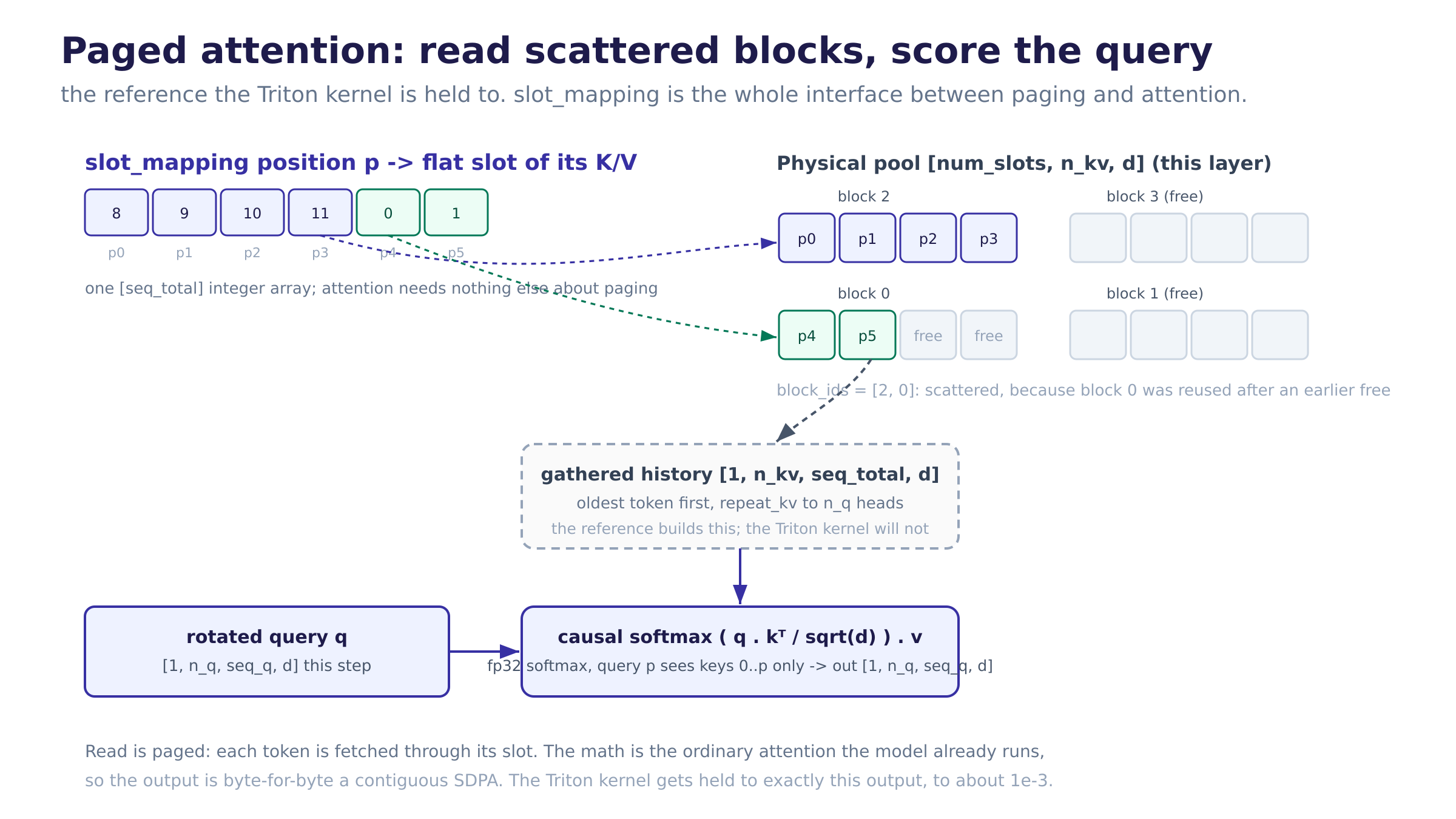
- The slot mapping is the whole interface between paging and attention. All the block table, allocator, and scattered-pool machinery collapses, at the attention boundary, into a single
[seq_total]integer array: position p’s K/V lives at flat slotslot_mapping[p]. Attention needs nothing else about paging. Making that the argument (rather than passing the cache or the table object) is what lets the future Triton kernel take the identical signature, and it is exactly theslot_mappingreal paged-attention kernels are handed. - Reusing
gqa_attention’s exact mask and fp32 softmax is what makes equality testable. The reference is not “an” attention, it is the attention the model already runs, expressed over a paged read. Sametriu(diagonal=past+1)band, samesoftmax(..., dtype=float32).to(q.dtype). Because the gather is an exact index copy and the math is identical op for op, the tests asserttorch.equal, not justallclose: byte-for-byte, even when the physical blocks are scattered. A looser bound would have hidden a real slot bug behind rounding. - A causal test needs a perturbation, not just a shape check. The strongest test corrupts the last position’s stored K/V and asserts every earlier query’s output is unchanged while the last query’s output moves. A future token that leaks into an earlier query’s softmax is exactly the bug an off-by-one in the mask band causes, and only a perturbation catches it; a shape or a single all-visible decode row would pass right over it.
Diagram
paged-attention-read.png. The query on the left; the scattered physical pool on the right with a sequence’s tokens on out-of-order blocks. The slot_mapping in the middle is the one array attention needs: it gathers each logical position’s K/V through its slot, and the reference scores the query against that history under the causal mask. The dashed box marks the contiguous history the reference gathers but the Triton kernel will not: same output, without ever assembling it.
Tomorrow
Two ways forward for Week 6. Either the first cut of the Triton triton.jit kernel, held to this reference (needs a GPU, so it may run gated like the weights tests), or wire the reference into the paged read path so PagedKVCache can hand attention the output directly instead of a re-gathered contiguous tensor, proving the fused shape end to end on CPU first. The reference pinned today is the oracle either way.
Post angle
Day 18 of building an LLM inference engine from scratch. Week 6 is the kernel week: replace the paged KV read with attention that reads scattered blocks directly, never rebuilding the contiguous history. But you do not start a kernel week by writing the kernel. You start it by writing the reference the kernel gets checked against, and freezing it. So today is a plain torch paged_attention_reference: give it the query, the layer’s flat KV pools, and the one array that is the entire interface between paging and attention, slot_mapping, position p’s K/V lives at flat slot slot_mapping[p]. It gathers each past token through its slot, then runs the exact same causal, GQA-repeated, fp32 softmax the model already runs. Because the gather is an exact copy and the math is identical op for op, the tests assert torch.equal, not just close, even when the physical blocks are scattered out of order across the pool. That is the point: paging moves where the K/V live, not what attention computes. The reference is honest about being the slow path, it still gathers with a torch index instead of streaming blocks the way the kernel will. But now the kernel has a fixed target: same inputs, same output to 1e-3, testable on any box with no GPU in the loop. This is the same discipline vLLM and SGLang lean on, a torch reference behind every fused kernel. 119 tests green. #AI #LLM #vLLM #BuildInPublic #Claude #OpenAI