Day 55: the capture list moved to startup, and the dummy batch was all padding
Date: 2026-09-09 · Week 13 · Phase 5 Benchmark and optimize
What I added today
nanoserve.warmup, the capture list recorded before the server accepts anything. warmup_plan builds one shape’s addressing over no sequences at all: rows=(), pad_rows the whole shape, every write_slots entry the sink, every context_lens entry 0, the rectangle a window on the real slot table and the three addressing tensors written into the real Day-53 buffers. warmup_batch is that plus the made-up tokens and a BatchedCacheRows wearing no rows. warm_decode walks a list of shapes, drives one synthetic batch through the Day-54 capture for each, and hands back a WarmupReport.
warm_shapes is the bucket set as a capture list, biggest first (a shared pool is sized by its largest member, so recording that one first means the arena is allocated once at its final size) with max_rows and max_width to trim it to what a server will actually present. The arithmetic is lazy_captures, stall_seconds, warmup_seconds, warm_budget_bytes and width_ceiling. The gates are check_warm_rows_empty, check_warm_writes_sink, check_warm_touches_nothing, check_table_stable, check_warm_graphs_unbound, check_no_cold_captures, check_all_warm and check_warm_budget.
Three small changes elsewhere, and all three are the same shape: an empty row selection is now legal in exactly the places a warm batch reaches. SlotTable.read takes rows=() when pad_rows is positive and refuses it otherwise; BatchedPagedKVCache.write and .paged_attention read an empty selection as “the rows this plan addresses”, which on a warm plan is none. SlotTable also gains an address, which is the number Day 53 has had for its buffers and Day 51 never had for the larger one. Engine.warm_decode is the door.
tests/test_warmup.py is 51 tests. Suite 1609 green (5 GPU-gated skips), ruff clean.
warmbench.py, host only, no weights, 2 rows off a 16-token prompt at width multiple 32 (day-55-warmbench.csv):
generated    cold: lazy   predicted    cold: warmed    warm list
        8             1           1               0     4 graphs,   8.5 ms
       32             2           2               0     4 graphs,   8.0 ms
       64             3           3               0     6 graphs,  12.2 ms
      128             5           5               0    10 graphs,  20.9 ms
and where the same recordings get paid for, at 256 rows and 8192 tokens with width multiple 128, priced at 50 ms a graph:
generated   lazy: graphs   in a client's latency    warmed at startup
                                                    full  rows<=8  rows<=8,ctx<=2048
      128              1                  0.05s    28.80s   12.80s        3.20s
      512              4                  0.20s    28.80s   12.80s        3.20s
     2048             16                  0.80s    28.80s   12.80s        3.20s
     8192             64                  3.20s    28.80s   12.80s        3.20s

what a pool budget buys, 256 rows, 32 heads, fp32 scores:
   64 MB free  ->  widest capture  1,953 tokens,  135 of 576 shapes
  268 MB free  ->  widest capture  8,178 tokens,  567 of 576 shapes
1,000 MB free  ->  the whole list fits
Why it matters
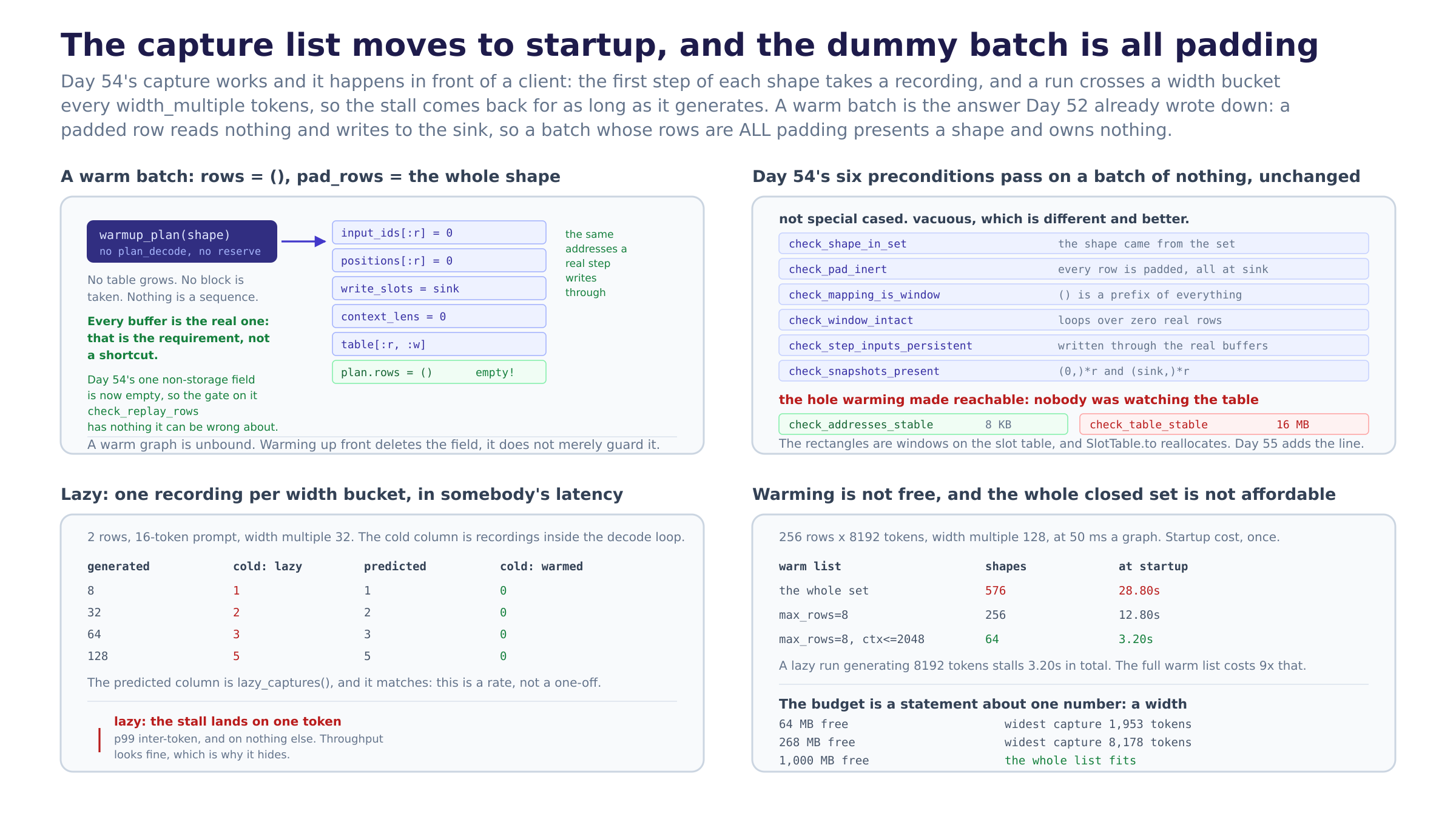
The dummy batch was already designed, three days ago, for something else. I spent the start of the day trying to build a fake batch that would not write into the pool, and the answer is that Day 52 built one. A padded row exists to hold a shape still while touching nothing: its context_lens entry is 0 so the whole row is masked, and its write_slots entry is sink_slot, one past the pool the allocator hands out, so its K/V lands at a legal address no BlockTable can name. A warm batch is a step whose rows are all padding. It is not a special case of a real plan, it is the limit of one, and that is why nothing had to be added to make it safe: the sink was already unconditional, the mask was already a length, and the write was already one index_put over the padded batch.
Every one of Day 54’s six preconditions passes on it, and passes vacuously. check_pad_inert’s third clause is “no real row writes to the sink” and there are no real rows. check_mapping_is_window wants the row set to be a prefix of the table’s and the empty tuple is a prefix of everything. check_window_intact and check_plan_addressing both loop over the real rows and find none. Vacuous is a better outcome than special-cased, because a gate that had to learn about warm-ups would be a gate whose meaning now depends on who is calling it.
Warming deletes Day 54’s one non-storage field rather than guarding it. Yesterday ended on check_replay_rows, the only gate on this arc whose subject is a Python value instead of a pointer: a mid-run capture freezes step 1’s plan.rows tuple and holds it for the life of the process, so a replay over a different set of sequences would write this step’s tokens into the other batch’s slots. A graph recorded on a warm batch freezes the empty tuple. There is nothing it can be wrong about. check_warm_graphs_unbound is that stated positively, and it is how you tell that every graph in the list came from the warm-up rather than from a step that slipped past it. I did not expect the two halves of the week to meet like that.
A graph recorded over nothing computes real steps, and it is not luck. The recorded call keeps its argument objects forever, and every one of them is a window on storage a real step writes through: slot_mapping is Day 51’s table, input_ids, positions, write_slots and context_lens are Day 53’s buffers. So the frozen plan reads this step’s numbers, and a warm engine’s tokens are the unwarmed engine’s tokens. Five days of moving things into fixed storage is what makes a sentence that sounds like a bug (“the graph holds a plan built over no sequences at all”) into a correctness argument.
The stall was never a one-off, and warming the whole set is not affordable. The lazy cost is one recording per width bucket a run crosses, so it recurs every width_multiple tokens for as long as a request generates: lazy_captures predicts it and the benchmark’s cold column matches at every length. But the closed set is a product, and the honest table is the one that hurts. At serving size the full list is 576 shapes, which at 50 ms a graph is 28.8 seconds of startup, against 3.2 seconds of total stall for a request that generates 8192 tokens. Warming everything is nine times worse than warming nothing. The warm list has to be trimmed on both axes, and the trim is a serving decision (how many rows will the scheduler admit, how long is the context this deployment sells) rather than a memory one. That is why warm_shapes takes two ceilings, and it is a design conclusion I would not have reached without printing the table.
What I learned
- The hardest part of the day was already solved and filed under another name. I went looking for a way to present a shape without owning a row, and the sink slot and the zero-length mask were both sitting in
nanoserve.bucketsfrom Day 52, written for padded rows in a real batch. A design where the degenerate case is the limit of the general one rather than a branch off it is the thing that made this a short module. - Vacuous is the outcome to want from a reused gate. Six preconditions passed on a batch with nothing in them, and my first instinct was to check whether they were really doing anything. They are: the same six fail on a real plan built the wrong way, and they fail on a warm plan built the wrong way (a warm plan whose rows are not empty trips
check_pad_inert’s sink clause). A gate that has nothing to say about a legal input is different from a gate that has been switched off. - Day 54 was guarding the small buffer and not the large one.
check_addresses_stablecompares four[max_batch]vectors, 8 KB at 256 rows. The rectangles those same graphs read are windows on[max_batch, max_model_len], 16 MB at 8192 tokens, andSlotTable.toreallocates. Nothing was watching it. Warming is what made the hole reachable rather than theoretical, because warming is now the first thing in the process to hand out a window and therefore the first thing that can hand one out on the wrong device.check_table_stableis one line and it should have been written on Day 51. - A capture list is a product and a stall is a rate, and comparing them needs both in seconds. I had “warming removes the stall” as the day’s claim, and the benchmark says warming the whole set costs nine times what the stall it removes costs. Both numbers are right and the conclusion is neither: warm a trimmed list. The lesson is that “move the cost to startup” is not free by virtue of being at startup, and the only way I found that out was pricing both sides in the same units.
- The budget is a statement about one number and that number is a width. Day 54 left
check_pool_budgetwanting “what is left after the weights and the pool” with nobody to ask. Connecting it to the probe was five lines; the useful part was realising what to do with a refusal. A shared pool is a max, so a budget does not trim the length of the list, it caps the widest shape in it.width_ceilingis the inversion, andwarm_shapes(max_width=width_ceiling(...))is the whole use. - An empty selection had to become legal in exactly three places, and refusing it everywhere else was the right call.
SlotTable.readtakes it only when something is padded;cache.view(())still refuses, because a scheduled view over no rows is a forward with nothing in it, and the warm-up builds itsBatchedCacheRowsdirectly to say that it means the empty tuple. Widening a guard for one caller is how a guard stops meaning anything, and the fix was to widen it by the condition that made the caller legitimate. - The pool gets allocated at warm time, which is a second thing warming buys.
_ensure_poolruns on the first write of a layer, and the first write in a warmed process is a synthetic row’s throwaway K/V. So the K/V pool is resident before the door opens rather than on the first prefill, which is what makeswarm_budget_bytesmeaningful: by the time anyone probes the device, everything large is already on it. - Recording the biggest shape first is a real ordering and not tidiness. Every capture after the first is handed the first one’s pool, and an arena is sized by what is allocated out of it. Descending order allocates it once at its final size; ascending grows it once per shape on the way up. It costs one
sortedand I only thought about it because Day 54’spool_sharing_ratiohad already made the arena the thing I was watching.
Diagram
warm-capture-list.png. Left top is what a warm batch is: warmup_plan with no plan_decode behind it, the five tensors that are windows on the real buffers, and the row tuple that is empty rather than frozen. Right top is Day 54’s six preconditions passing unchanged, and underneath them the two address gates side by side with what each one is worth in bytes. Left bottom is the benchmark’s cold column against lazy_captures’s prediction. Right bottom is the startup cost of the full list against two trimmed ones, and the budget read as a width ceiling.
Tomorrow
The warm-up exists and nothing in the boot path calls it. Engine.warm_decode is a method a caller has to know about, and build_engine does not even pass capture_decode through, so a real server started from serve.py runs the Day-47 loop with none of the last six days switched on. Day 56 is the wiring: thread bucket_decode, persist_inputs, capture_decode and the warm list through build_engine and create_app, warm after the pool is planned and before the app accepts, and print the boot line with the number of graphs and what they cost. Two things I expect to be wrong about. One is the trim: the warm list needs max_rows from the scheduler and max_width from the smaller of what the deployment sells and what width_ceiling allows, and those two numbers arrive from different places at different times in build_engine. The other is /health, which reports the KVPoolPlan today and now has a second sizing decision to report next to it, made after it rather than with it.
Post angle
Day 55 of building an LLM inference engine from scratch. Day 54’s CUDA graph capture worked and it happened in the wrong place: the first step of each shape takes a recording, mid-run, in front of a client waiting for a token. And it is not a one-off. A run crosses a width bucket every width_multiple tokens it generates, so the stall comes back for the whole life of a request. vLLM records its list at startup off dummy batches, so today was building one. The hard part is what a dummy batch is: a graph is bound to the addresses it was launched with, so a fake batch cannot be built somewhere quiet and thrown away, it has to go through the real slot table, the real input buffers and the real K/V pool. Which means the fake batch is about to write K/V into a pool full of real sequences before anything has been served. The answer turned out to be three days old. Day 52’s padded rows exist to hold a shape still while touching nothing: context_lens 0 so the row is masked, write_slots at the sink slot so its K/V lands where no block maps. A warm batch is a step whose rows are all padding. Not a special case of a real plan, the limit of one, which is why all six of yesterday’s preconditions pass on it unchanged and vacuously. The nice part is that warming deletes yesterday’s one weak spot instead of guarding it. A mid-run capture freezes step 1’s row tuple forever, and that tuple was the only thing a replay carried that was not live storage. A warm graph freezes the empty tuple, so there is no set of sequences it can be wrong about. The uncomfortable part is the number. The closed shape set is a product: 576 shapes at serving size, which at 50 ms a graph is 28.8s of startup, against 3.2s of total stall for a request generating 8192 tokens. Warming everything is nine times worse than warming nothing. So the warm list gets trimmed on both axes, and the trim is a serving decision, not a memory one. Moving a cost to startup is not free by virtue of being at startup. 1609 green.