Day 85: the table’s exit code says whether it is all results
Date: 2026-10-15 · Week 14 · Phase 5 Benchmark and optimize
What I added today
Day 84 marked every row clean, lost, rerun or ?. The marks were only in the text, so graphbench.py --table s.csv exited 0 for a sweep full of reruns. A script that guards a notebook had to parse stdout to find that out.
--strict on --table:
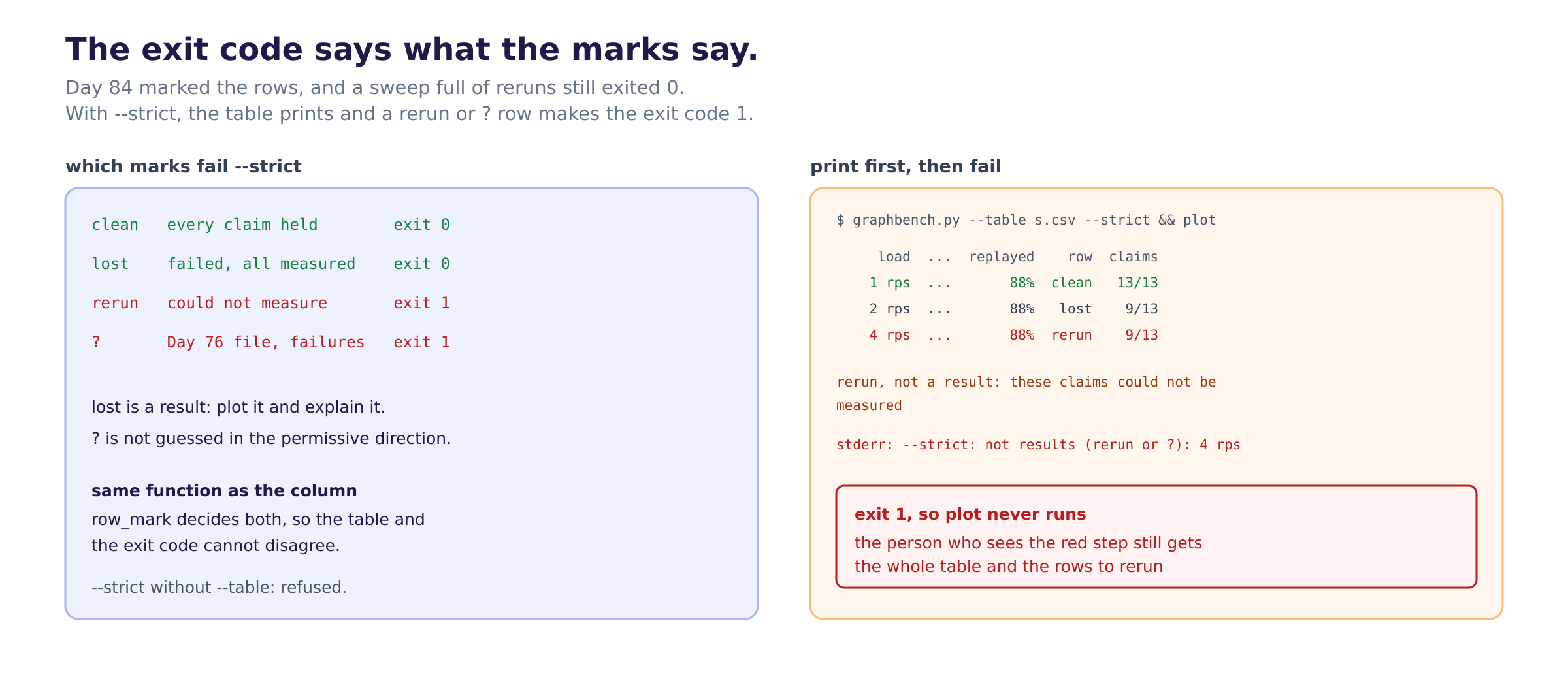
- The table prints first, in full. Then, if any row is
rerunor?, the process exits 1 with one sentence on stderr naming those rows’ loads. A sweep ofcleanandlostrows exits 0 with nothing on stderr. lostdoes not trip it. A capture that lost, with every failure measured, is a result to plot and explain. Only rows that are not comparisons fail the check.?trips it. A Day 76 file with failures cannot say which kind they were, and a guard should not guess in the permissive direction.reprintreturns the marks in table order, so a caller in Python does not re-derive them.-
--strictwithout--tableis refused by the parser, with a sentence naming--table. A live run has no file to check.graphbench.py –table docs/daily/data/day-74-graphbench.csv –strict && plot
tests/test_table_strict.py has 6 pure tests: a sweep of results exits 0 with a quiet stderr, a rerun exits 1 after the table printed and names only its own load, a ? row exits 1, no --strict still exits 0 on a rerun, --strict alone is refused, and reprint returns the marks.
Suite 2502 green (34 GPU-gated skips), ruff clean.
Why it matters
A check that needs parsing is a check nobody writes. The mark exists so a reader knows what to do with a row. A shell && is a reader too, and it only reads the exit code.
Print first, then fail. The person who sees the red step still wants to know which rows to rerun, so the failure carries the full table and a one-line reason.
The guard follows the table. It calls row_mark, the same function the column uses, so the table and the exit code cannot disagree about what a result is.
What I learned
- A test fixture has to write the real file. My first Day 76 test row had
claims_unsoundset to empty in the CSV, which reads back as “no unsound notes”, alostrow. A real Day 76 file has no such column. The test failed for the right reason and the fixture was the bug. - Strictness is a policy on the mark, not a new mark.
loststays a result under--strict; the flag chooses which marks fail, and adds no fifth. - Refuse a flag that cannot do anything.
--strictwith a live run would be silently ignored, and a silent no-op in a guard is the worst kind.
Diagram
table-strict.png. Left: the four marks and which of them --strict fails. Right: the table, the stderr sentence and the exit codes.
Tomorrow
The guard reads one file. A card booking produces several sweeps (one per day or per card), and checking them one command at a time loses the rows they have in common. Next: let --table take more than one CSV, print each sweep’s table under its path, and make --strict fail if any of them has a rerun.
The card run still comes first when hardware is booked.
Post angle
Day 85 of building an LLM inference engine from scratch. My benchmark table marked which rows were real results and which were reruns, and still exited 0 on a sweep full of reruns. Now --table --strict prints the table and exits 1 if any row is a rerun, so && plot refuses a sweep that is not all results. 2502 green.