Day 74: the benchmark script gets its third arm, and pads its own prompt past the chunk
Date: 2026-10-04 · Week 14 · Phase 5 Benchmark and optimize
What I added today
Yesterday’s “Tomorrow” was the script. Everything Days 68 to 73 built for the split arm (the arena, the crossing gate, the boot grades and the gate that holds them to what served) ran inside tests/test_reads.py. graphbench.py, the script a card run would actually use, still booted two servers, graphs and eager, and neither split. Now --split-read adds the third.
nanoserve/graphbench.py. Three additions:
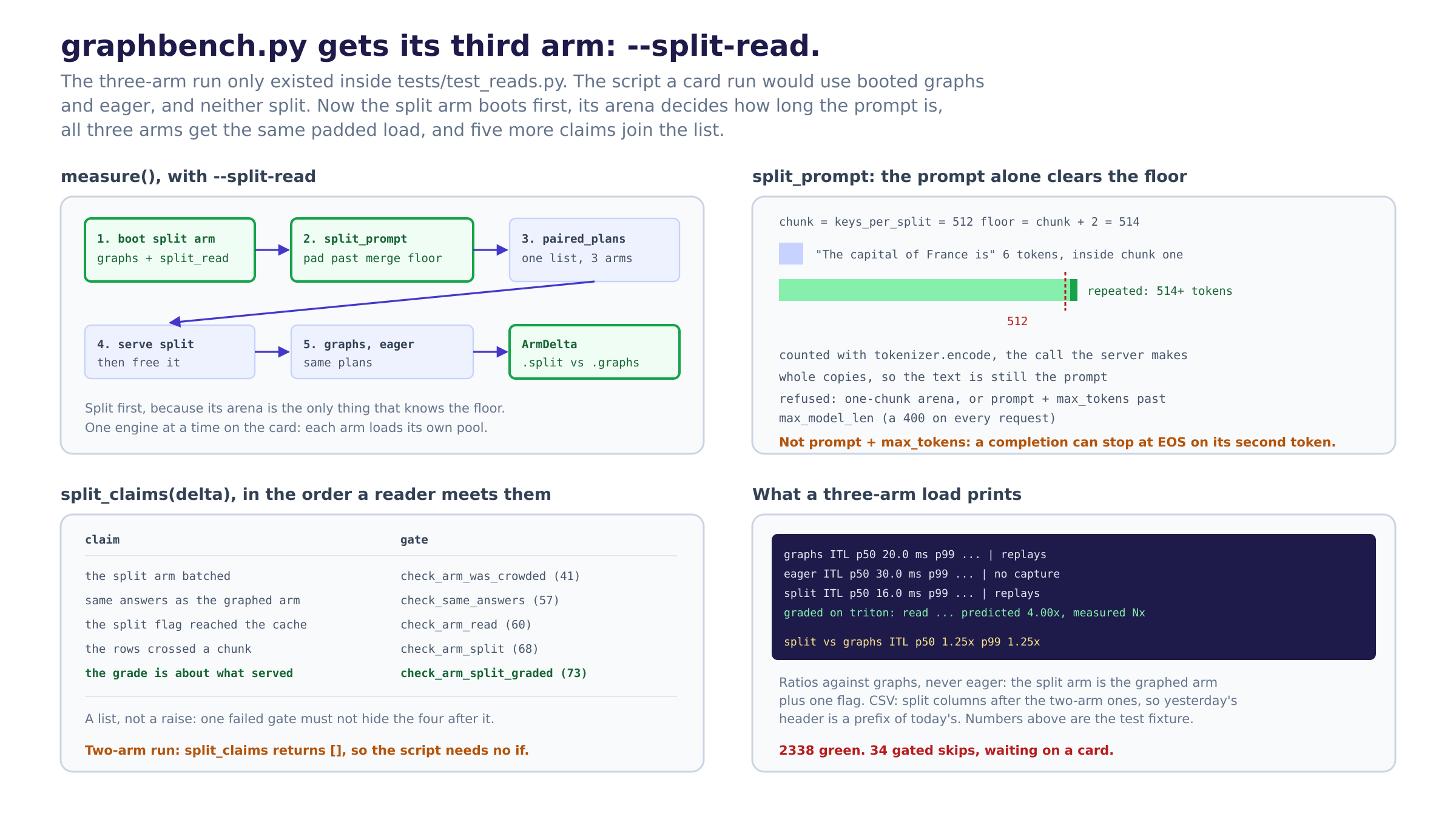
split_prompt(prompt, workspace, count=, max_tokens=, max_model_len=). It repeats the prompt, in whole copies, until the prompt alone is at leastsplit_merge_floortokens by the caller’s counter. It refuses a one-chunk (or missing) arena, a padded prompt plusmax_tokenspastmax_model_len, an empty prompt, and a counter that never grows.ArmDelta.split, an optional thirdArmReport. It bringssplit_itl_p50_speedupandsplit_itl_p99_speedup, both taken against the graphed arm.row()appends the split latency columns andSplitBoot.row()after the two-arm columns, andrender()prints the split arm, its boot line, and a “split vs graphs” ratio line.split_claims(delta), the split arm’s five gates as(check, note)pairs: it batched, it gave the graphed arm’s answers, the flag reached the cache, the rows crossed a chunk, the boot grade is about the read that served. An empty list for a two-arm run.
graphbench.py the script. --split-read boots the split arm first (the graphed arm’s flags plus split_read), takes its arena off app.state.workspace, loads the checkpoint’s tokenizer and pads --prompt with split_prompt. Only then does it build the plans, and the same plans go to all three arms. build_one gained split= and refuses a split without buckets before any weights load. The parser moved into make_parser() so a test can reach it. *split_claims(delta) joins the claims list, and the sweep table grows two split columns.
tests/test_split_script.py. 28 new tests: the padding arithmetic and its four refusals, the three-arm delta (ratios, columns, the two-arm prefix, the render), the claims (all pass, then each one failing alone), and the script’s wiring through a monkeypatched build_app. Suite 2338 green (34 GPU-gated skips), ruff clean.
Why it matters
The first card run can now be one command. graphbench.py --weights ./weights --device cuda --rates 1,2,4,8 --split-read boots three servers, sends them the same bytes, and prints the split arm’s ITL, its boot grade and its ratio against the graphed arm in one table. Before today, getting that number meant writing a script.
The load is decided by the server under test. The floor is keys_per_split + 2, and keys_per_split comes from the plan the split arm made on this card at this max_model_len. A prompt length hard-coded in the script would be right for one geometry and quietly short for the next, and check_arm_split would fail the run after twenty minutes of serving.
The comparison changes one thing. The split arm is the graphed arm plus split_read: the same capture, buckets, persistent inputs and compaction. So its ratio is against graphs, and a ratio against eager would credit the read with what the capture saved.
What I learned
- Count the half of the row you control. The first version padded until prompt plus
max_tokenscleared the floor. That works on paper and fails at runtime: a completion that hits EOS on its second token leaves a 500-token prompt inside a 512-key chunk. The prompt alone has to clear it. - Count with the server’s call. The completions handler does
tokenizer.encode(prompt). The script counts with the same call on the same checkpoint’s tokenizer. A word count would be off by the tokenizer’s ratio, and off in the direction that fails the gate. - The arm that decides the load boots first. All three arms have to get the same plans or
check_same_answerscompares two workloads, and only the split arm knows the floor. So the split arm loads, publishes its arena, sets the prompt, serves, and is dropped before the other two load. One engine on the card at a time. - A claims list beats a function that raises. The script reports every claim and only stops on
--sanity. Returning(check, note)pairs lets one failure sit next to the four that passed, and returning[]for two arms means the script splices it in with noif.
Diagram
graphbench-split-arm.png. Top left: the order measure() runs in with --split-read. Top right: the padding, a six-token prompt against a 512-key chunk. Bottom left: the five claims and the gate behind each. Bottom right: what a three-arm load prints (fixture numbers).
Tomorrow
The script runs three arms, but the only test of measure() end to end is still the in-process one in tests/test_reads.py. Next is a toy-weights smoke for the script itself: a tiny checkpoint and tokenizer written to a temp directory, then graphbench.py --split-read --allow-cpu --arrivals burst run over it at a width that splits. That checks the boot order, the padding and the CSV header on a real process.
The hardware caveat hasn’t changed: the card run with --split-read --rates 1,2,4,8 is still the first one to book, and it’s now a single command.
Post angle
Day 74 of building an LLM inference engine from scratch. My benchmark script now boots a third server with flash-decoding style split attention and compares it with the CUDA-graphed one. The gotcha: to test the split, rows have to cross a chunk, so the script pads the prompt past the chunk using the server’s own tokenizer, and it counts only the prompt because a completion can stop at EOS early. vLLM and SGLang ship split decode; I’m learning what it takes to measure one honestly. 2338 green.